- Plants
- ›Vascular Plants
- ›flowering plants
- ›monocots
- ›grasses, sedges, cattails, and allies
- ›grasses
- ›Pooideae
- ›Poeae
- ›oats, junegrasses, and relatives
- ›Avena
- ›Avena
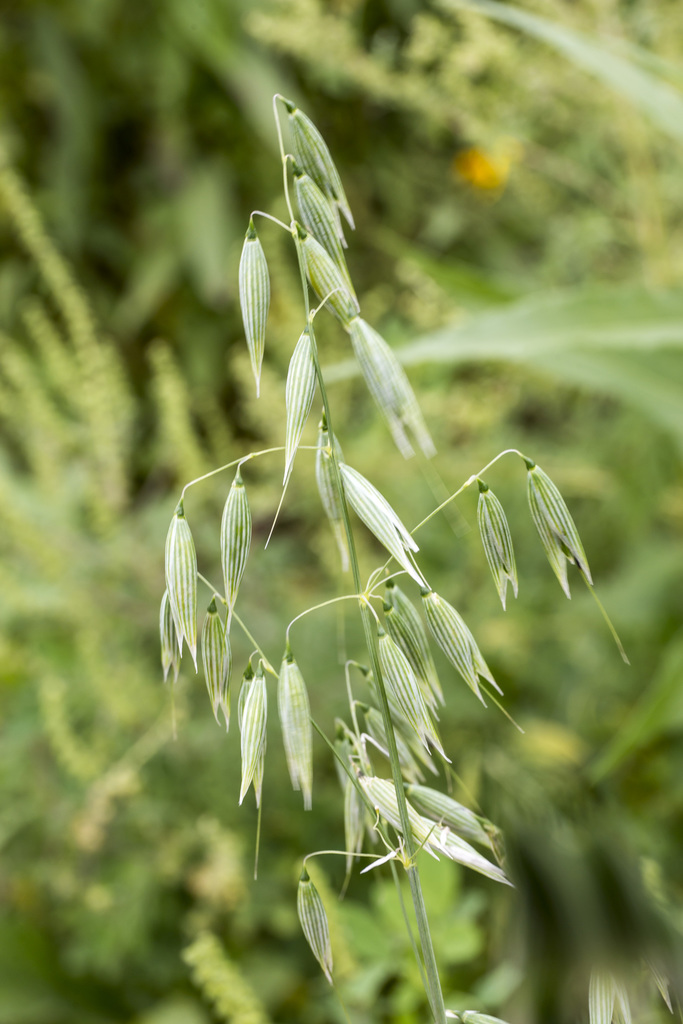
Common Oat
Avena sativa
The oat (Avena sativa), sometimes called the common oat, is a species of cereal grass (Avena) grown for fodder and for its seed, which is known by the same name (usually in the plural). Oats appear to have been domesticated as a secondary crop, as their seeds resembled those of other cereals closely enough for them to be included by early cultivators. Oats tolerate cold winters less well than cereals such as wheat, barley, and rye, but need less summer heat and more rain, making them important in areas such as Northwest Europe that have cool, wet summers. They can tolerate low-nutrient and acid soils. Oats grow thickly and vigorously, allowing them to outcompete many weeds, and compared to other cereals are relatively free from diseases.
Oats are used for human consumption as oatmeal, including as steel cut oats or rolled oats. Global production is dominated by Canada and Russia; global trade is a small part of production, most of the grain being consumed within the producing countries. Oats are a nutrient-rich food associated with lower blood cholesterol and reduced risk of human heart disease when consumed regularly. One of the most common uses of oats is as livestock feed; the crop can also be grown as groundcover and ploughed in as a green manure.
From the article Oat on Wikipedia (CC BY-SA), quoted section by section
Description
The oat is a tall stout grass, a member of the family Poaceae; it can grow to a height of 1.8 metres (5.9 ft). The leaves are long, narrow, and pointed, and grow upwards; they can be some 15 to 40 centimetres (5.9 to 15.7 in) in length, and around 5 to 15 millimetres (0.20 to 0.59 in) in width. Leaf blades emerge first from nodes in the stalk, then the sheath. New leaves grow upwards on nodes further from the ground, leaves on the old nodes gradually brown and wilt. Roots are fibrous, mostly in the uppermost 0.3 metres (0.98 ft) of the soil (though some may penetrate as deep as 1.5 metres (4.9 ft), and develop from a crown at the soil surface. When seeds are dense, they make only one or two hollow stems (culms), but when spaced out may make 10 to 30 culms. At the top of the stem, the plant branches into a loose cluster or panicle of about 10-75 spikelets. While they tend to self pollinate, 1-2% may outcross. There are 7-9 nodes, with one leaf at each node and hollow internodes. These contain the wind-pollinated flowers, which mature into the oat seeds or grains. Botanically the grain is a caryopsis, as the wall of the fruit is fused on to the actual seed. Like other cereal grains, the caryopsis contains the outer husk or bran, the starchy food store or endosperm which occupies most of the seed, and the protein-rich germ which if planted in soil can grow into a new plant.
At the table
When used in foods, oats are most commonly rolled or crushed into oatmeal or ground into fine oat flour. Oatmeal is chiefly eaten as porridge, but may also be used in a variety of baked goods, such as oatcakes (which may be made with coarse steel-cut oats for a rougher texture), oatmeal cookies and oat bread. Oats are an ingredient in many cold cereals, in particular muesli and granola; the Quaker Oats Company introduced instant oatmeal in 1966. Oats are also used to produce milk substitutes ("oat milk"). As of late 2020, the oat milk market became the second-largest among plant milks in the United States, following almond milk, but exceeding the sales of soy milk. As a mainstay of West Wales for centuries, until changes in farming practices in the 1960s, oats were used in many traditional Welsh dishes, including laverbread, a Welsh breakfast, and "cockles and eggs" served with oatbread. Oat noodles have traditionally been eaten in Shanxi, China. In Britain, oats are sometimes used for brewing beer, such as oatmeal stout where a percentage of oats, often 30%, is added to the barley for the wort. Oatmeal caudle, made of ale and oatmeal with spices, was a traditional British drink and a favourite of Oliver Cromwell. …
Wikipedia: “As food”
How it is grown
Oats are annual plants best grown in temperate regions. They tolerate cold winters less well than wheat, rye, or barley; they are harmed by sustained cold below −7 °C (20 °F). They have a lower summer heat requirement and greater tolerance of (and need for) rain than the other cereals mentioned, so they are particularly important in areas with cool, wet summers, such as Northwest Europe. Oats can grow in most fertile, drained soils, being tolerant of a wide variety of soil types. Although better yields are achieved at a soil pH of 5.3 to 5.7, oats can tolerate soils with a pH as low as 4.5. They are better able to grow in low-nutrient soils than wheat or maize, but generally are less tolerant of high soil salinity than other cereals. In the US, Midwestern crops are sown in spring and the Southern crops in autumn. In the Corn Belt, oats are grown in crop rotation following corn, soybeans, and forages. Mature oats are harvested by a combine, either directly or after drying by windrowing, since their moisture must not exceed 13% to be safely stored. The straw is either mixed in with humus or as bedding for livestock. Traditionally, US farmers grew oats alongside red clover and alfalfa, which fixed nitrogen and provided animal forage. The first year's harvest yielded oat grain but later years gave way to hay. …
Wikipedia: “Cultivation”
In human culture
Oats have been eaten in Britain since the Iron Age. Production and consumption was long concentrated in Scotland even as oats were cultivated elsewhere. In the 16th and 17th centuries, as the emergence of alternative food sources meant the English were less reliant on oats for sustenance, oats began to be regarded as a mark of inferiority. In his 1755 Dictionary of the English Language, Samuel Johnson defined oats as "A grain, which in England is generally given to horses, but in Scotland supports the people." "Oats and Beans and Barley Grow" is the first line of a traditional folksong (1380 in the Roud Folk Song Index), recorded in different forms from 1870. Similar songs are recorded from France, Canada, Belgium, Sweden, and Italy. In English, oats are associated with sexual intercourse, as in the idioms "sowing one's (wild) oats", meaning having many sexual partners in one's youth, and "getting your oats", meaning having sex regularly.
== References ==
Where it lives
Recorded sightings
—
geo-referenced records in GBIF, from museums, herbaria and field observers.
Drag the globe to turn it. Dots are where records exist, not a range map; darker means more records.
In the old herbals & bestiaries

In the stacks
Searching the stacks…
Every page naming Avena sativa in the Biodiversity Heritage Library →
This page is assembled live from iNaturalist, GBIF, Wikipedia, the Source Library and the Internet Archive. It is not yet part of the hand-edited codex. iNaturalist taxon 57156.