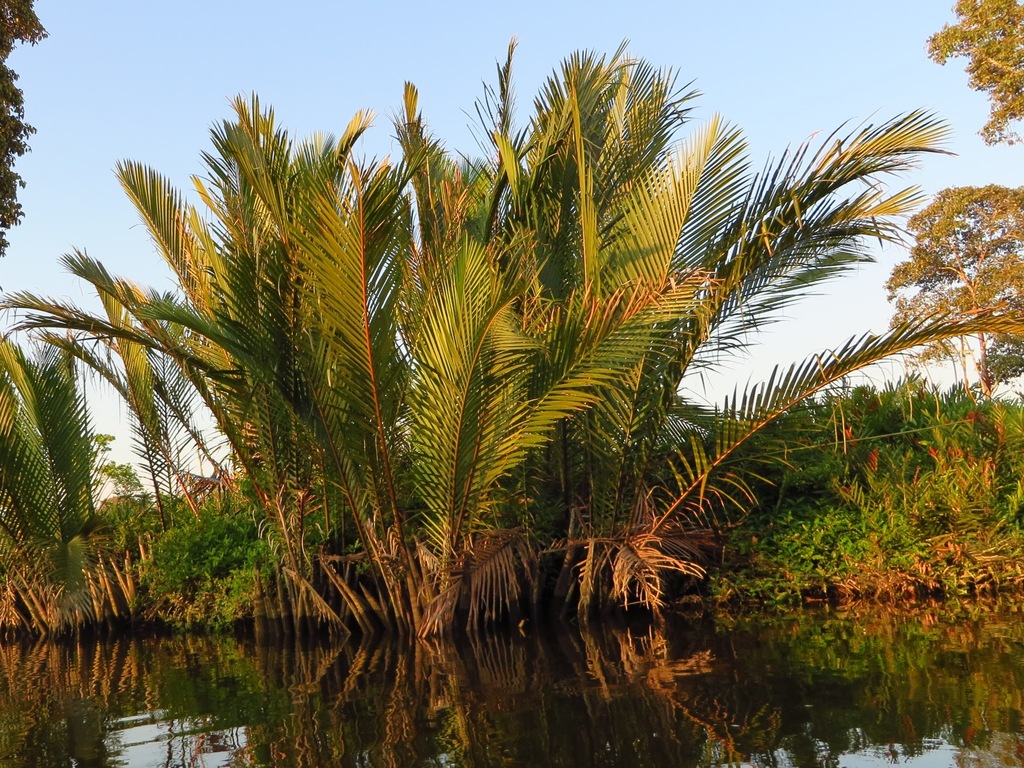
Mangrove Palm
Nypa fruticans
Nypa fruticans, commonly known as the nipa palm (or simply nipa, from Malay: nipah) or mangrove palm, is a species of palm native to the coastlines and estuarine habitats of the Indian and Pacific Oceans. It is the only palm considered adapted to the mangrove biome. The genus Nypa and the subfamily Nypoideae are monotypic taxa because this species is their only member.
From the article Nypa fruticans on Wikipedia (CC BY-SA), quoted section by section
Description
Unlike most palms, the nipa palm's trunk grows beneath the ground; only the leaves and flower stalk grow upwards above the surface. The leaves extend up to 9 metres (30 feet) in height. The flowers are a globular inflorescence of female flowers at the tip with catkin-like red or yellow male flowers on the lower branches. The flower produces woody nuts arranged in a globular cluster up to 25 centimetres (10 inches) across on a single stalk. The infructescence can weigh as much as 30 kg (4 st 10 lb).
The fruit is globular made of many seed segments, each seed has a fibrous husk covering the endosperm that allows it to float. The stalk droops as the fruits mature. When they reach that stage, the ripe seeds separate from the ball and float away on the tide, occasionally germinating while still water-borne.
Range & habitat
Nipa palms grow in soft mud and slow-moving tidal and river waters that bring in nutrients. They can be found as far inland as the tide can deposit the floating nuts. They are common on coasts and rivers flowing into the Indian and Pacific Oceans, from India to the Pacific Islands. The palm will survive occasional short-term drying of its environment. Despite the name "mangrove palm" and its prevalence in coastal areas, it is only moderately salt tolerant and suffers if exposed to pure seawater; it prefers the brackish waters of estuaries. It is considered native to China (Hainan), the Ryukyu Islands, Bangladesh, Indian subcontinent, Sri Lanka, the Andaman and Nicobar Islands, Vietnam, Laos, Malay Peninsula, north of Singapore, all of Borneo, Java, Maluku, the Philippines, Sulawesi, Sumatra, the Bismarck Archipelago, New Guinea, the Solomon Islands, the Caroline Islands, and Australia (Queensland and the Northern Territory). It is reportedly naturalized in Nigeria, the Society Islands of French Polynesia, the Mariana Islands, Panama, and Trinidad. Japan's Iriomote Island and its neighboring Uchibanari Island are the most northern limit of the distribution.
Wikipedia: “Distribution and habitat”
What it does
N. fruticans is pollinated by small insects. Putative pollinators include:
Drosophilidae flies and bees of the genus Trigona Apis florea (Asian dwarf honey bee) and Apis dorsata (Asian giant honey bee) Nitidulid and curculionid beetles Long-tailed macaques (Macaca fascicularis) are known to eat the fruits of the nipa palm. Proboscis monkeys in the Padas Damit Forest Reserve have been observed eating the inflorescences. Bornean orangutans eat nipa palm hearts and shoots. Fungal species Tirisporella beccariana has been found on the mangrove palm, as well as Phomatospora nypae on palms in Malaysia. N.fruiticans is a host plant for several lepidopteran insect species, including: Family Hesperiidae (skippers)
Erionota thrax Gangara thyrsis Hidari irava Family Crambidae
Herculia nigrivitta Nacoleia octasema Family Pyralidae
Tirathaba leucotephras Tirathaba mundella Tirathaba rufivena Family Tineidae
Erechthias flavistriata Family Limacodidae
Parasa corbetti Parasa lepida
Wikipedia: “Ecology”
At the table
The long, feathery leaves of the nipa palm are used by local populations as roof material for thatched houses or dwellings. The leaves are also used in many types of basketry and thatching. Because they are buoyant, large stems are used to train swimmers in Burma. On the islands of Roti and Savu, nipa palm sap is fed to pigs during the dry season. This is said to impart a sweet flavour to the meat. The young leaves are dried, bleached and cut to wrap tobacco for smoking, this practice is also found in Sumatra. In Cambodia, this palm is called ចាក cha:k; its leaves are used to cover roofs. Roof thatching with the leaves occurs in many places in Papua New Guinea. In some coastal areas, the rachis is used for walls in houses, and the leaflets are used for ornaments. The epidermises of the leaves are used as cigarette papers. The leaves are also used in some handicraft works across Southeast Asia, such as the tempok among the Orang Asli tribes.
Food and beverages. The young flower stalk and hard seeds are edible and provide hydration. In the Philippines and Malaysia, the inflorescence can be "tapped" to yield a sweet, edible sap collected to produce a local alcoholic beverage called tuba, bahal, or tuak. A fruit cluster is ready to be tapped when the unripe fruits are at their peak sweetness. …
Wikipedia: “Uses”
How it is grown
Wild stands of N. fruticans can be managed to optimize sap production by thinning to desired densities and through traditional farm management techniques. In cultivation, N. fruticans readily propagates via rhizome divisions. Pests of young seedlings include grapsid crabs, as well as monkeys and pigs, which have been reported to cause damage to plantations. Sap is collected from the cut flower stalk, and traditional tapping methods vary by region; harvesters often repeatedly bend or kick the stalk to increase sap yield as part of local practice.
Wikipedia: “Cultivation”
Where it lives
Recorded sightings
—
geo-referenced records in GBIF, from museums, herbaria and field observers.
Drag the globe to turn it. Dots are where records exist, not a range map; darker means more records.
In the stacks
Searching the stacks…
Every page naming Nypa fruticans in the Biodiversity Heritage Library →
This page is assembled live from iNaturalist, GBIF, Wikipedia, the Source Library and the Internet Archive. It is not yet part of the hand-edited codex. iNaturalist taxon 83106.