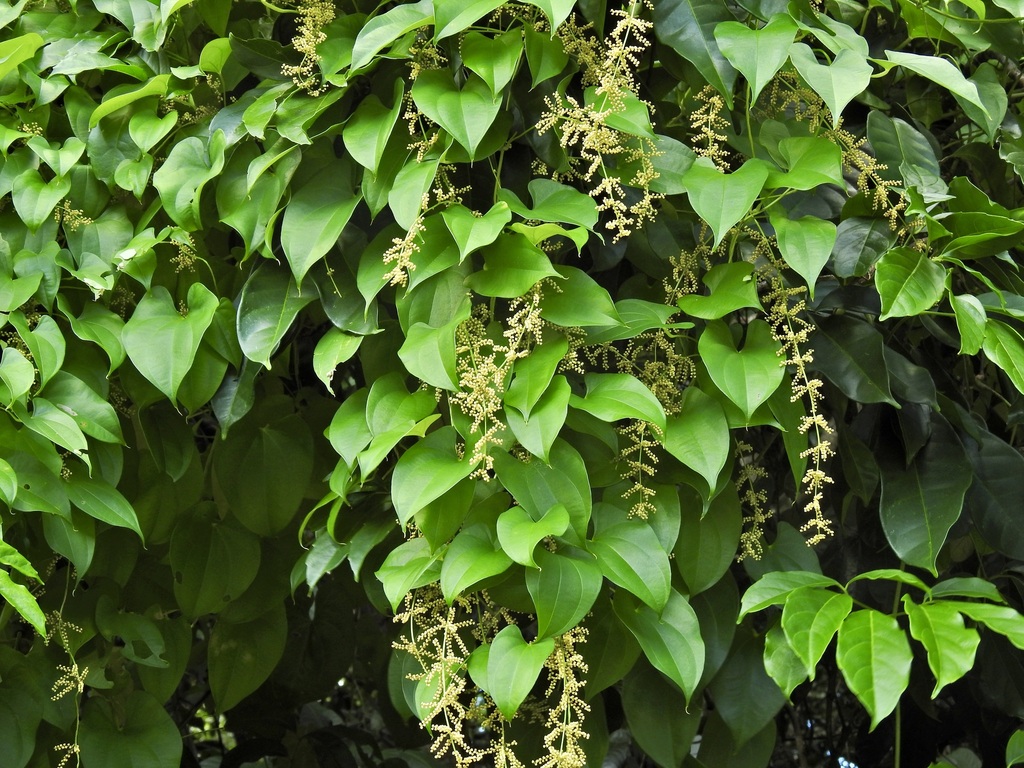
Purple yam
Dioscorea alata
Dioscorea alata – also called ube, ubi, uwhi, purple yam, winged yam, or greater yam, among many other names – is a species of yam (a tuber). The tubers are usually a vivid violet-purple to bright lavender (hence the common name), but some range from creamy-white to plain white. Although it is sometimes confused with taro and the Okinawa sweet potato beniimo (紅芋) (Ipomoea batatas 'Ayamurasaki'), D. alata is also grown in Okinawa. Its origins are in the Asian and Oceanian tropics. Some varieties attain great size. A mambatap greater yam grown in Maprik, East Sepik Province, Papua New Guinea, around 1939 was 3.5 m (11 ft) in length.
From the article Dioscorea alata on Wikipedia (CC BY-SA), quoted section by section
At the table
Purple yams have edible tubers with a mildly sweet, earthy, and nutty taste, reminiscent of sweet potatoes or taro. The violet cultivars, in particular, turn dishes distinctively vivid violet because of the high amount of anthocyanins. Purple yams are also valued for the starch that can be processed from them. Purple yam is most common in Philippine cuisine (where it is known as ube or ubi). It is widely applied for many Philippine desserts, such as ube cake, ube cheesecake and ube crinkles, as well as an ingredient or flavor for ice cream, milk, jam, donuts, tarts, and other types of pastries. It is often eaten boiled, baked, or as a sweetened dessert called ube halayá; the last is a popular ingredient in the iced dessert called halo-halo. Purple yam desserts have more recently entered the United States, where there is a large Filipino diaspora population, under its Filipino name. It is particularly popular due to the striking violet-purple color it gives to desserts. The mid-2020s saw a boom in popularity internationally due to social media. However, this has caused shortages in the Philippines, forcing the country to import purple yams from Vietnam. …
Wikipedia: “Culinary”
In medicine
Although available as a dietary supplement and used in folk medicine, no clinical evidence shows that D. alata has any therapeutic properties. Potential side effects and drug interactions also have not been researched adequately, so caution is advised. D. alata has relatively high levels of oxalates (486–781 mg/100 g dry matter), which are associated with antinutritional effects and kidney stone formation.
Wikipedia: “Supplements, folk medicine, and adverse effects”
How it is grown
Dioscorea alata is one of the most important staple crops in Austronesian cultures. It is one of various species of yams that were domesticated and cultivated independently within Island Southeast Asia and New Guinea for their starchy tubers, including the round yam (Dioscorea bulbifera), ubi gadung (Dioscorea hispida), lesser yam (Dioscorea esculenta), Pacific yam (Dioscorea nummularia), fiveleaf yam (Dioscorea pentaphylla), and pencil yam (Dioscorea transversa). Among these, D. alata and D. esculenta were the only ones regularly cultivated and eaten, while the rest were usually considered as famine food due to their higher levels of the toxin dioscorine, which requires that they be prepared correctly before consumption. D. alata is also cultivated more than D. esculenta, largely because of its much larger tubers. D. alata and D. esculenta were the most suitable for long transport in Austronesian ships, so were carried through all or most of the range of the Austronesian expansion. D. alata in particular was introduced into the Pacific Islands and New Zealand. They were also carried by Austronesian voyagers into Madagascar and the Comoros.
The center of origin of purple yam is in the Philippines, but archaeological evidence suggests that it was exploited in Island Southeast Asia and New Guinea before the Austronesian expansion. …
Wikipedia: “History of cultivation”
Where it lives
Recorded sightings
—
geo-referenced records in GBIF, from museums, herbaria and field observers.
Drag the globe to turn it. Dots are where records exist, not a range map; darker means more records.
In the stacks
Searching the stacks…
Every page naming Dioscorea alata in the Biodiversity Heritage Library →
This page is assembled live from iNaturalist, GBIF, Wikipedia, the Source Library and the Internet Archive. It is not yet part of the hand-edited codex. iNaturalist taxon 161930.