- Plants
- ›Vascular Plants
- ›flowering plants
- ›monocots
- ›Aroids, Water Plantains, Seagrass, and allies
- ›Arum Family
- ›Monsteroideae
- ›Monstereae
- ›Epipremnum
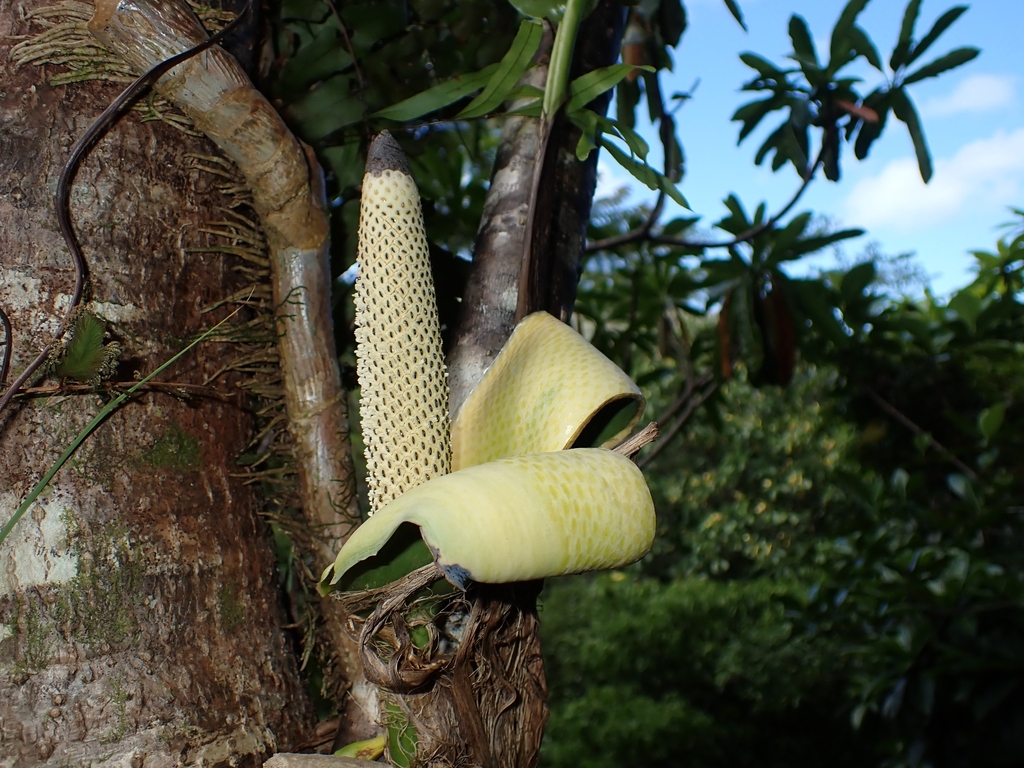
Golden Pothos
Epipremnum aureum
Epipremnum aureum is a species in the arum family Araceae, native to Mo'orea in the Society Islands of French Polynesia. The species is a popular houseplant in temperate regions, but has also become naturalised in tropical and sub-tropical forests worldwide, including northern South Africa, Australia, Southeast Asia, Indian subcontinent, the Pacific Islands and the West Indies, where it has caused severe ecological damage in some cases.
The plant has a number of common names including golden pothos, Ceylon creeper, hunter's robe, ivy arum, silver vine, Solomon Islands ivy, and taro vine. It is also called devil's vine or devil's ivy because it is very hardy and stays green even when kept in the dark. It is sometimes simply labelled Pothos, or mistakenly labelled as a Philodendron or Scindapsus in plant stores. It is commonly known as a money plant in many parts of the Indian subcontinent. It rarely flowers without artificial hormone supplements.
From the article Epipremnum aureum on Wikipedia (CC BY-SA), quoted section by section
Description
Epipremnum aureum is an evergreen vine growing to 20 m (66 ft) tall, with stems up to 4 cm (2 in) in diameter, climbing using aerial roots which adhere to surfaces. The leaves are alternate, heart-shaped, entire on juvenile plants, but irregularly pinnatifid on mature plants, up to 100 cm (39 in) long and 45 cm (18 in) broad; juvenile leaves are much smaller, typically under 20 cm (8 in) long. The flowers are produced in a spathe up to 23 cm (9 in) long. This plant produces trailing stems when it climbs up trees and these take root when they reach the ground and grow along with it. The leaves on these trailing stems grow up to 10 cm (4 in) long and are the ones normally seen on this plant when it is cultivated as a potted plant.
Shy-flowering nature. While E. aureum is classified as an angiosperm, which typically produce flowers at some point in their lifecycle, it is the only reported species in its family (Araceae) that does not readily bloom, if at all. Regardless of where this "shy-flowering" plant is grown, or what the conditions are like, it will apparently not flower due to a genetic impairment of the gibberellin (GA) biosynthetic gene, EaGA3ox1. This impairment causes the plant to be unable to develop bioactive GAs, which are responsible for the flowering of plants, via the floral meristem identity gene EaLFY. …
Range & habitat
Originally, it was endemic to the island of Mo'orea from the Society Islands. However, it is now wild in many tropical countries. The following ranges are indicated: Bangladesh, India, Myanmar, Thailand, Vietnam, Hainan, Hong Kong, Taiwan, Japan, peninsular Malaysia, Sabah, Sarawak, Singapore, Java, Maluku Islands, Nusa Tenggara, Sulawesi, Sumatra, Philippines, Solomon Islands, Vanuatu, New Caledonia, New Guinea, Queensland, Marshall Islands, Hawaii, Palau, Fiji, Tonga, Cook Islands, and Western Samoa.
Wikipedia: “Distribution”
At the table
In temperate regions, it is a popular houseplant with numerous cultivars selected for leaves with white, yellow, or light green variegation. It is often used in decorative displays in shopping centers, offices, and other public locations largely because it requires little care and is also attractively leafy. In tropical countries, it is found in many parks and gardens, and tends to grow naturally. As an indoor plant it can reach more than 2 metres (2 yd) in height if given adequate support (a trellis or moss pole to climb), but hardly develops adult-sized leaves. The best results are achieved by providing indirect light; it tolerates an intense luminosity, but long periods of direct sunlight burn the leaves. It lives well with a temperature between 17 and 30 °C (63 and 86 °F). Generally, the plant will only need watering when the soil feels dry to the touch (typically once every one to two weeks). The plant should be fertilized every 2–3 months during its growing season, and at a reduced rate the rest of the year. It should be replanted at least every 1–2 years, or sooner if it becomes too root-bound. However, it is a very robust plant, and will survive bad growing conditions. …
Wikipedia: “Cultivation and uses”
Toxicity
The plant is listed as toxic to cats and dogs by the ASPCA, because of the presence of insoluble raphides. Care should be taken to ensure the plant is not consumed by pets. Symptoms may include oral irritation, vomiting, and difficulty in swallowing. Due to the calcium oxalate within the plant, it can be mildly toxic to humans as well. Possible side effects from the consumption of E. aureum are atopic dermatitis (eczema) as well as burning and/or swelling of the region inside of and surrounding the mouth. Excessive contact with the plant can also lead to general skin irritation or contact dermatitis.
In human culture
This species has been assigned to a number of genera. In 1880, when it was first described, it was named Pothos aureus, which is why it is often commonly referred to as a "pothos". After an inflorescence was observed in 1962, it was given the new name of Rhaphidophora aurea. However, after closer examination of the flower, researchers noticed its heightened similarity to Epipremnum pinnatum and synonymised it with that species. Only after closer observation of the entirety of the plant, including the leaves and growth patterns, did researchers again separate it from E. pinnatum, and classify it as E. aureum. The plant has gained the Royal Horticultural Society's Award of Garden Merit.
Wikipedia: “History and etymology”
Where it lives
Recorded sightings
—
geo-referenced records in GBIF, from museums, herbaria and field observers.
Drag the globe to turn it. Dots are where records exist, not a range map; darker means more records.
In the stacks
Searching the stacks…
Every page naming Epipremnum aureum in the Biodiversity Heritage Library →
This page is assembled live from iNaturalist, GBIF, Wikipedia, the Source Library and the Internet Archive. It is not yet part of the hand-edited codex. iNaturalist taxon 69223.