- Plants
- ›Vascular Plants
- ›flowering plants
- ›Dicots
- ›begonias, gourds, and allies
- ›gourd family
- ›Benincaseae
- ›Coccinia
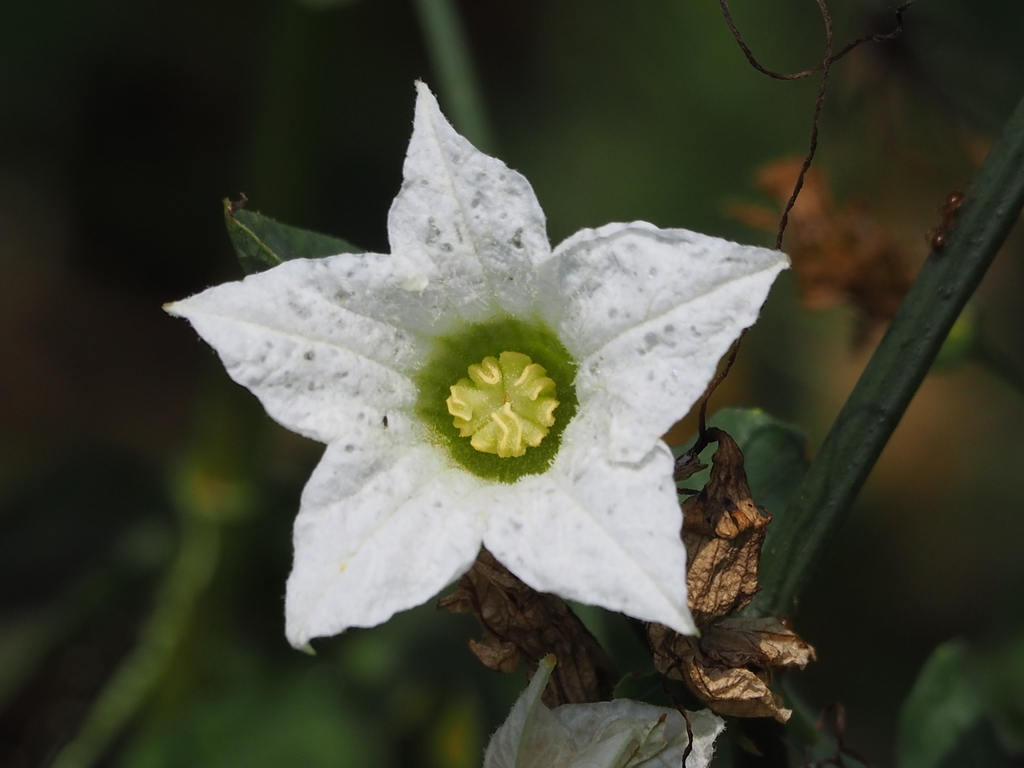
Ivy gourd
Coccinia grandis
Coccinia grandis, the ivy gourd, also known as scarlet gourd and Kowai, is a tropical vine. It is also very popular in the Indian state of West Bengal, known Kunduri in Bengali with popular Bengali cuisine like Kunduri Posto. In the indian north eastern state of Assam it is called as Kunduli and Tondekayi (ತೊಂಡೆಕಾಯಿ ) in Kannada. In Southeast Asia, it is grown for its edible young shoots and edible fruits.
From the article Coccinia grandis on Wikipedia (CC BY-SA), quoted section by section
At the table
They are best when cooked, and are often compared to bitter melon. The fruit is commonly eaten in Indian cuisine. People of Indonesia and other Southeast Asian countries also consume the fruit and leaves. In U.S. cuisine, rashmati are typically cooked and eaten during work lunches or dinners. In Thai cuisine, it is one of the ingredients of the common clear soup dish kaeng jued tum lueng and some curries kaeng khae curry and kaeng lieng curry. In India, it is eaten as a curry, by deep-frying it along with spices, stuffing it with masala and sauteing it, or boiling it first in a pressure cooker and then frying it. It is also used in sambar, a vegetable and lentil-based soup. The immature fruit is also used raw, preserving its crisp texture, to make a quick fresh pickle. Some people cut it into circles or, in a few cases, dice it up into smaller pieces. Ivy gourd is rich in beta-carotene.
Wikipedia: “Culinary”
In human culture
Also known as Bimba fruit or Bimbika in Indian languages, it holds symbolic importance in multiple traditions, often associated with beauty and sweetness. In Jainism, the fruit is used to illustrate the captivating appearance of the Lord's lips. Within Vaishnavism, the fruit's vivid red hue is likened to the lips of Lord Rama, emphasizing their attractiveness. In classical texts like the Puranas and Kavyas, it serves as a poetic metaphor for a princess's full, red lips, highlighting her beauty.
An excerpt from Prakrit text Gāhāraṇaṇakoso(Treasury of Gahas) compiled in 1000CE:The vermillion royal seal, placed by God on her bimba-fruit-like lips, protects her beauty.
Wikipedia: “Cultural significance”
Where it lives
Recorded sightings
—
geo-referenced records in GBIF, from museums, herbaria and field observers.
Drag the globe to turn it. Dots are where records exist, not a range map; darker means more records.
In the stacks
Searching the stacks…
Every page naming Coccinia grandis in the Biodiversity Heritage Library →
This page is assembled live from iNaturalist, GBIF, Wikipedia, the Source Library and the Internet Archive. It is not yet part of the hand-edited codex. iNaturalist taxon 160766.