- Plants
- ›Vascular Plants
- ›flowering plants
- ›Dicots
- ›beeches, oaks, walnuts, and allies
- ›beech family
- ›Quercus
- ›Cerris
- ›Cerris
- ›Cerris
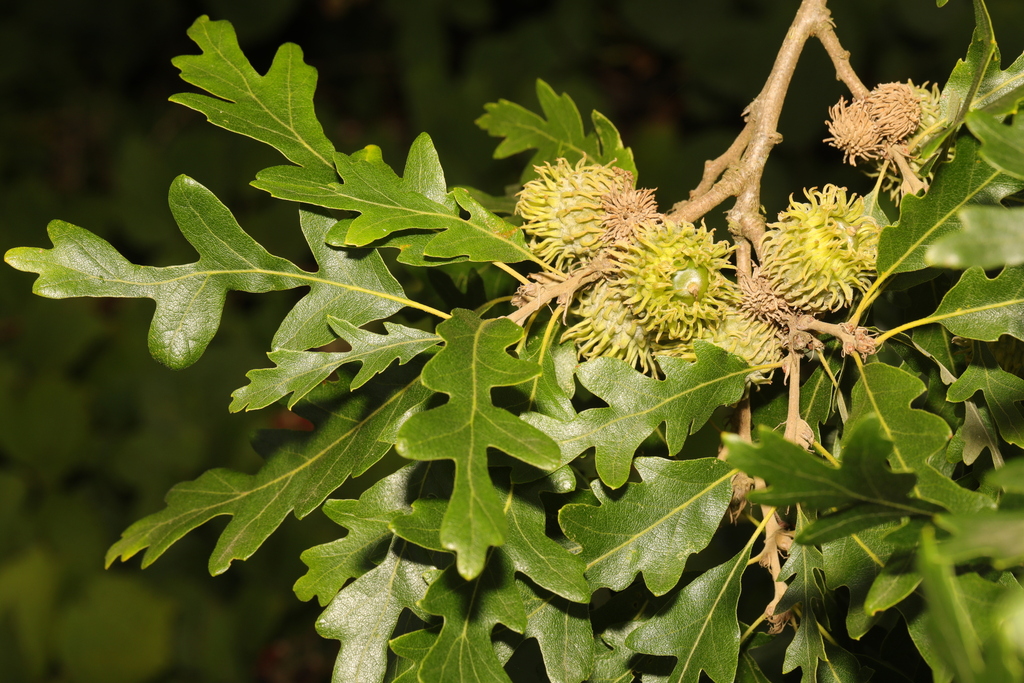
Turkey Oak
Quercus cerris
Quercus cerris, the Turkey oak or Austrian oak, is a species of oak in the beech family (Fagaceae). It is native to southern and south-eastern Europe, Asia Minor, and the Levant, but has been introduced outside its range. It is the type species of Quercus sect. Cerris, a section of the genus characterised by shoot buds surrounded by soft bristles, bristle-tipped leaf lobes, and acorns that usually mature in 18 months.
From the article Quercus cerris on Wikipedia (CC BY-SA), quoted section by section
Description
Quercus cerris is a large deciduous tree growing to 25–40 metres (82–131 feet) tall with a trunk up to 2 m (6+1⁄2 ft) in diameter. The bark is dark gray and deeply furrowed. On mature trees, the bark fissures are often streaked orange near the base of the trunk. The glossy leaves are 7–14 centimetres (2+3⁄4–5+1⁄2 inches) long and 3–5 cm wide, with 6–12 triangular lobes on each side; the regularity of the lobing varies greatly, with some trees having very regular lobes, others much less regular. The flowers are wind-pollinated catkins, maturing about 18 months after pollination; the fruit is a large acorn, 2.5–4 cm (1–1+1⁄2 in) long and 2 cm broad, bicoloured with an orange basal half grading to a green-brown tip; the acorn cup is 2 cm deep, densely covered in soft 'mossy' bristles from 4–8 millimetres (1⁄8–3⁄8 in) in length.
Range & habitat
First year acorns are very bitter, but are eaten by jays and pigeons; squirrels usually only eat them when other food sources have run out. The species' range extended to northern Europe and the British Isles before the previous ice age, about 120,000 years ago. It was reintroduced in the UK and Ireland in the eighteenth century as an ornamental tree, its gall wasps now provide early food for birds. The tree harbours the gall wasp Andricus quercuscalicis whose larvae seriously damage the acorns of native British oaks. In 1998, the Ministry of Defence ordered the felling of all Turkey oaks on its United Kingdom bases.
Wikipedia: “Distribution and ecology”
At the table
The wood has many of the characteristics of other oaks, but is very prone to crack and split and hence is relegated to such uses as fencing.
Wikipedia: “Cultivation and uses”
How it is grown
Turkey oak is widely planted and is naturalised in much of Europe. This is partly for its relatively fast growth. It is used as an ornamental, and as a coastal windbreak. Several cultivars have been selected, including 'Variegata', a variegated cultivar, and 'Woden', with large, deeply lobed leaves. Turkey oak readily hybridises with cork oak (Q. suber), the resulting hybrid being named Q. × crenata Lam. This hybrid occurs both naturally where its parents' ranges overlap in the wild, and has also arisen in cultivation. It is a very variable medium to large tree, usually semi-evergreen, sometimes nearly completely so, and often with marked hybrid vigour; its bark is thick and fissured but never as thick as that of the cork oak. Numerous cultivars are available, often grafted onto Turkey oak root stock. These include 'Ambrozyana', evergreen except in severe winters, originating from the Arboretum in Slovakia, home of the late Count Ambrozy; 'Diversifolia', with the leaves extremely deeply cut leaving a narrow strip down the centre, and very corky bark; 'Fulhamensis' (Fulham oak), raised at Osborne's nursery in Fulham c.1760; and 'Lucombeana' (Lucombe oak), raised by William Lucombe at his nursery in Exeter c. 1762. An early specimen raised by Lucombe is at the Royal Botanic Gardens, Kew. …
Wikipedia: “Cultivation”
Where it lives
Recorded sightings
—
geo-referenced records in GBIF, from museums, herbaria and field observers.
Drag the globe to turn it. Dots are where records exist, not a range map; darker means more records.
In the old herbals & bestiaries

History of Rare Plants
Carolus Clusius · 1601 · p.32

History of Rare Plants of Pannonia
Carolus Clusius · 1576 · p.19

History of Rare Plants Observed in Pannonia
Carolus Clusius · 1583 · p.18

Six Groups of the History of Plants
Rembert Dodoens · 1583 · p.840

Rariorum Plantarum Historia (with Fungorum Historia)
Carolus Clusius · 1601 · p.38
In the stacks
Searching the stacks…
Every page naming Quercus cerris in the Biodiversity Heritage Library →
This page is assembled live from iNaturalist, GBIF, Wikipedia, the Source Library and the Internet Archive. It is not yet part of the hand-edited codex. iNaturalist taxon 135408.