- Plants
- ›Vascular Plants
- ›flowering plants
- ›Dicots
- ›Heathers, Balsams, Primroses, and Allies
- ›heath family
- ›typical heathers, azaleas, and allies
- ›Ericeae
- ›Calluna
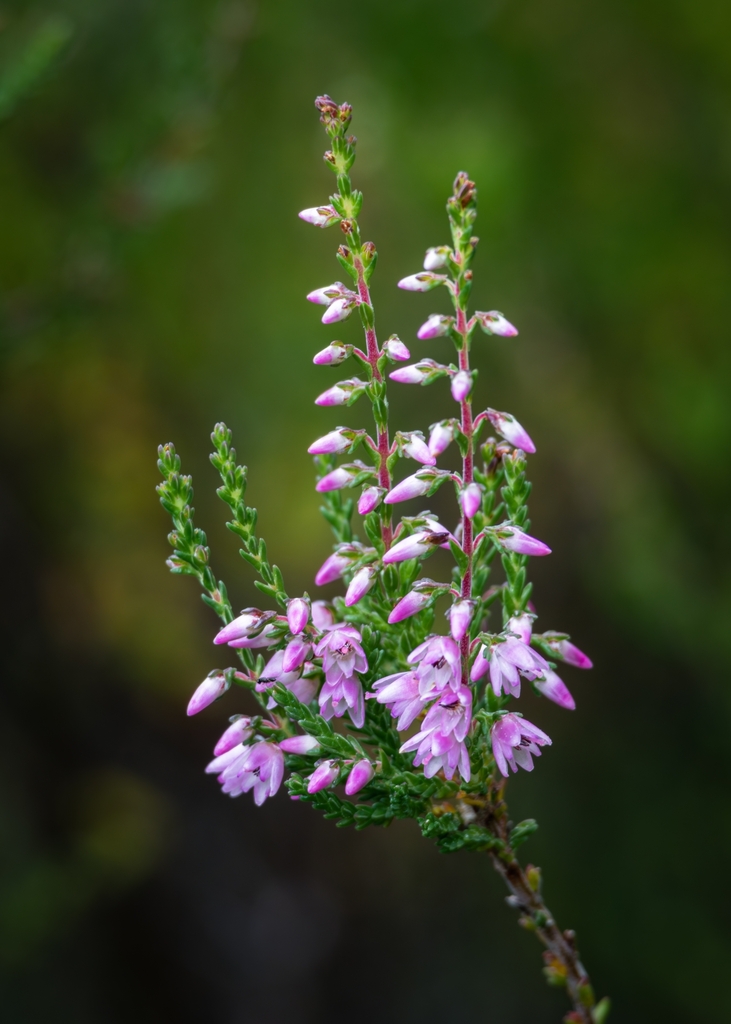
common heather
Calluna vulgaris
Calluna vulgaris, common heather, ling, or simply heather, is the only accepted species in the genus Calluna in the flowering plant family Ericaceae. It is a low-growing evergreen shrub growing to 20 to 50 centimetres (8 to 20 in) tall, or rarely to 1 metre (40 in) and taller, and is found widely in Europe and Asia Minor on acidic soils in open sunny situations and in moderate shade.
It is the dominant plant in most heathland and moorland in Europe, and in some bog vegetation and acidic pine and oak woodland. It is tolerant of grazing and regenerates following occasional burning, and is often managed in nature reserves and grouse moors by sheep or cattle grazing, and also by light burning.
From the article Calluna on Wikipedia (CC BY-SA), quoted section by section
Description
Calluna can reach 60 centimetres (24 in) in height. It has small scale leaves (less than 2–3 mm long) borne in opposite and decussate pairs, whereas those of Erica are generally larger and in whorls of 3–4, sometimes 5. It flowers from July to September. In wild plants these are normally mauve, but white-flowered plants also occur occasionally. They are terminal in racemes with sepal-like bracts at the base with a superior ovary, the fruit a capsule. Unlike Erica, Calluna sometimes sports double flowers. Calluna is sometimes referred to as Summer (or Autumn) heather to distinguish it from winter or spring flowering species of Erica.
Chemistry. Phenolic compounds in the shoots of Calluna vulgaris include chlorogenic acid and a novel phenolic glycoside, most of which are found in greater number during the summer. The nectar of Calluna vulgaris contains a megastigmane, callunene, that is inhibitory at naturally occurring concentrations to a common trypanosome parasite of bumble bees, Crithidia bombi. Koch et al. elucidate the mechanism of activity that results in the loss of the parasite's flagellum, leading to reduced infectivity, because the flagellum is crucial to anchoring in the insect gut.
Range & habitat
Calluna vulgaris is native to Europe, Iceland, the Faroe Islands, and the Azores. It has been introduced into many other places worldwide with suitable climates, including North America, Australia, New Zealand and the Falkland Islands. It is extremely cold-hardy, surviving severe exposure and freezing conditions well below −20 °C (−4 °F).
Wikipedia: “Distribution and habitat”
What it does
Heather is an important food source for various sheep and deer which can graze the tips of the plants when snow covers low-growing vegetation. Willow grouse and red grouse feed on the young shoots and seeds of this plant. Both adult and larva of the heather beetle (Lochmaea suturalis) feed on it, and can cause extensive mortality in some instances. The larvae of a number of Lepidoptera species also feed on the plant, notably the small emperor moth Saturnia pavonia.
As an invasive species. The plant was introduced to New Zealand and has become an invasive weed in some areas, notably the Tongariro National Park and Mount Ruapehu in the North Island, as well as the Wilderness Reserve (Te Anau) in the South Island, overgrowing native plants. Heather beetles have been released to stop the heather, with preliminary trials successful to date.
Wikipedia: “Ecology”
At the table
Formerly heather was used to dye wool yellow and to tan leather. With malt, heather is an ingredient in gruit, a mixture of flavourings used in the brewing of heather-beer during the Middle Ages before the use of hops. Thomas Pennant wrote in A Tour in Scotland (1769) that on the Scottish island of Islay "ale is frequently made of the young tops of heath, mixing two thirds of that plant with one of malt, sometimes adding hops". "Heath Beer" is mentioned in the recipe book of Lady Ann Fanshawe (compiled from 1651). From time immemorial heather has been used for making besoms, a practice recorded in "Buy Broom Buzzems" a song probably written by William Purvis (Blind Willie) (1752–1832) from Newcastle-upon-Tyne, England. Heather honey is a highly valued product in moorland and heathland areas, with many beehives being moved there in late summer. Not always as valued as it is today, it was dismissed as mel improbum, "unwholesome honey" by Dioscurides. Heather honey has a characteristic strong taste, and an unusual texture, for it is thixotropic, being a jelly until stirred, when it becomes a syrup like other honey, but then sets again to a jelly. …
Wikipedia: “Uses”
In human culture
Heather is seen as iconic of Scotland, where the plant grows widely. When poems like Bonnie Auld Scotland speak of "fragrant hills of purple heather', when the hero of Kidnapped flees through the heather, when heather and Scotland are linked in the same sentence, the heather talked about is Calluna vulgaris. Purple heather is one of the two national flowers of Norway, the other being Saxifraga cotyledon. It was chosen as a national flower on the basis of a vote of popularity in a Norwegian radio show in 1976. Calluna vulgaris is the province flower of the Swedish province of Västergötland.
Wikipedia: “In culture”
Where it lives
Recorded sightings
—
geo-referenced records in GBIF, from museums, herbaria and field observers.
Drag the globe to turn it. Dots are where records exist, not a range map; darker means more records.
In the old herbals & bestiaries

In the stacks
Searching the stacks…
Every page naming Calluna vulgaris in the Biodiversity Heritage Library →
This page is assembled live from iNaturalist, GBIF, Wikipedia, the Source Library and the Internet Archive. It is not yet part of the hand-edited codex. iNaturalist taxon 119450.