- Plants
- ›Vascular Plants
- ›flowering plants
- ›Dicots
- ›Mints, Plantains, Olives, and Allies
- ›Mint Family
- ›Lamioideae
- ›Lamieae
- ›Lamium
- ›Galeobdolon
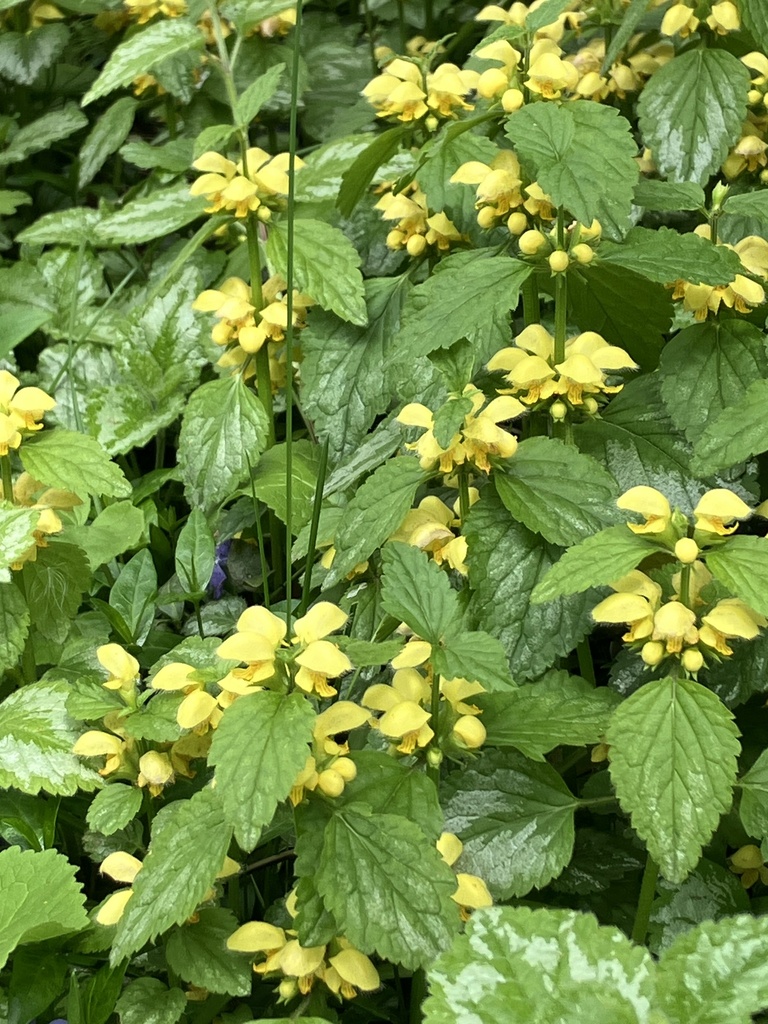
yellow archangel
Lamium galeobdolon
Lamium galeobdolon, the yellow archangel, is a species of flowering plant in the mint family Lamiaceae. It is native to Europe and western Asia but it is widely introduced in North America and elsewhere. It is the only species in the genus Lamium with yellow flowers. Another common name for this species is golden dead-nettle. In New Zealand, it is called the aluminium plant or artillery plant. The common names archangel and dead-nettle have been in use for hundreds of years, dating back to at least the 16th century.
Lamium galeobdolon comprises four closely related subspecies that are sometimes considered to be four separate species, one of which, the variegated yellow archangel (Lamium galeobdolon subsp. argentatum) from central Europe, is widely present as an invasive subspecies in several European countries outside of its native range and also in New Zealand, Canada, and the United States.
From the article Lamium galeobdolon on Wikipedia (CC BY-SA), quoted section by section
Description
Lamium galeobdolon sensu lato is a perennial plant with square stems growing from 15 to 60 cm (6 to 24 in) tall. The paired opposite leaves are stalked with toothed margins. The leaves are 4 to 7 cm (2 to 3 in) long, and may or may not have silvery markings (an important character used to distinguish subspecies). The inflorescence is a pseudo-whorl of 4–16 flowers (called a verticillaster) clustered around the axil of a leaf-pair. Each flower has bilateral (zygomorphic) symmetry. The calyx is five-lobed and the corolla is yellow with a prominent hood. The flower's lower lip has three lobes with the central lobe often streaked with orange. There are two short stamens and two long ones. Flowering is in late spring to early summer, typically May–June in Britain. A pair of fused carpels give rise to a four-chambered schizocarp.
Identification. Subspecies of Lamium galeobdolon sensu lato are the only taxa in the genus with yellow flowers. All of the subspecies are stoloniferous except subspecies flavidum. The invasive subspecies argentatum is readily distinguished by its silvery white variegated leaves. The two subspecies galeobdolon and montanum can be difficult to distinguish but assuming the plant in question is in full flower, subspecies galeobdolon has a maximum of six (rarely seven) flowers per verticillaster while subspecies montanum averages ten flowers per verticillaster. …
Range & habitat
Lamium galeobdolon sensu lato is native across Europe, western Asia, and portions of the Middle East. It ranges from Ireland and Spain eastward across Europe as far as the West Siberian Plain and southeastward to Iran. Subspecies flavidum is native to the Alps, northern Italy, and the mountain ranges northeast of the Adriatic Sea. The two subspecies galeobdolon and montanum have broadly similar distributions, but the latter extends further west and south than subspecies galeobdolon, which itself has a more northeast distribution. Within Britain and Ireland, subspecies montanum is widespread across England and Wales and locally in southern Scotland and eastern Ireland, while subspecies galeobdolon is restricted to a small area in Lincolnshire in eastern England. Lamium galeobdolon sensu lato is widely introduced in several European countries outside of its native range, and also in New Zealand, Canada, and the United States, but authorities disagree about the distribution of introduced subspecies. As of April 2024, Plants of the World Online (POWO) claims that subspecies argentatum has been introduced in Great Britain, Ireland, and Italy, but since it is elsewhere reported to be introduced in the Netherlands and Switzerland, the list is incomplete. …
Wikipedia: “Distribution”
What it does
Lamium galeobdolon sensu lato has been widely introduced as a garden plant (often under the name Lamiastrum galeobdolon), especially in New Zealand, Canada, and the United States where it has escaped cultivation and become an invasive species. In New Zealand, it is listed by the 2020 National Pest Plant Accord and therefore banned from sale, propagation, and distribution throughout the country. It is also listed by the Invasive Species Council of British Columbia in Canada. In the U.S. state of Washington, it is listed as a Class B Noxious Weed and therefore banned from sale by state law. It is also a B-listed Noxious Weed in the state of Oregon. The variegated yellow archangel (Lamium galeobdolon subsp. argentatum) has become an invasive subspecies in several European countries. In the Netherlands, subspecies argentatum was introduced as an ornamental ground cover, and by 1985 it had become naturalised and recorded in more localities than the native subspecies galeobdolon. It is also invasive in Britain where it spreads by stolons at the rate of 1–2 metres (3 ft 3 in – 6 ft 7 in) per growing season. In western England, it is found far from human habitations, which suggests it did not originate from garden waste and must therefore be spreading by other means. …
Wikipedia: “Ecology”
In human culture
Both the generic name Lamium and the specific epithet galeobdolon were used by Pliny the Elder in the first century AD. The name galeobdolon has several possible origins. It may come from the Latin words galeo meaning "to cover with a helmet" and dolon meaning "a fly's sting", or it may come from the Greek words γαλέη (galéē) "weasel; marten; polecat", and βδόλος (bdólos) "foetid smell", an allusion to the smell of the leaves. The latter interpretation is likely the source of the old common name 'yellow weasel-snout'. The common names archangel and dead-nettle have been in use for hundreds of years. In 1578 Rembert Dodoens observed that "Dead nettell groweth every where". John Gerard used the word "archangel" in 1633. Gerard believed the dead-nettles were so-named because their leaves resembled those of the true nettles in the family Urticaceae. The names "Arch-Angel" and "Dead Nettle" appear in the book The English Physitian (also known as the Complete Herbal) published by the English botanist and herbalist Nicholas Culpeper in 1652. Both Dodoens and Gerard believed the name "archangel" referred to members of genus Lamium with "clusters of hooded flowers at the nodes rising along the stems like a choir of robed figures". Others believe the name refers to the wing-like shape of its paired opposite leaves.
Wikipedia: “Etymology”
Where it lives
Recorded sightings
—
geo-referenced records in GBIF, from museums, herbaria and field observers.
Drag the globe to turn it. Dots are where records exist, not a range map; darker means more records.
In the old herbals & bestiaries

In the stacks
Searching the stacks…
Every page naming Lamium galeobdolon in the Biodiversity Heritage Library →
This page is assembled live from iNaturalist, GBIF, Wikipedia, the Source Library and the Internet Archive. It is not yet part of the hand-edited codex. iNaturalist taxon 204339.