- Plants
- ›Vascular Plants
- ›flowering plants
- ›Dicots
- ›Legumes, Milkworts, and Allies
- ›Legumes
- ›Faboideae
- ›Crotalarieae
- ›Crotalaria
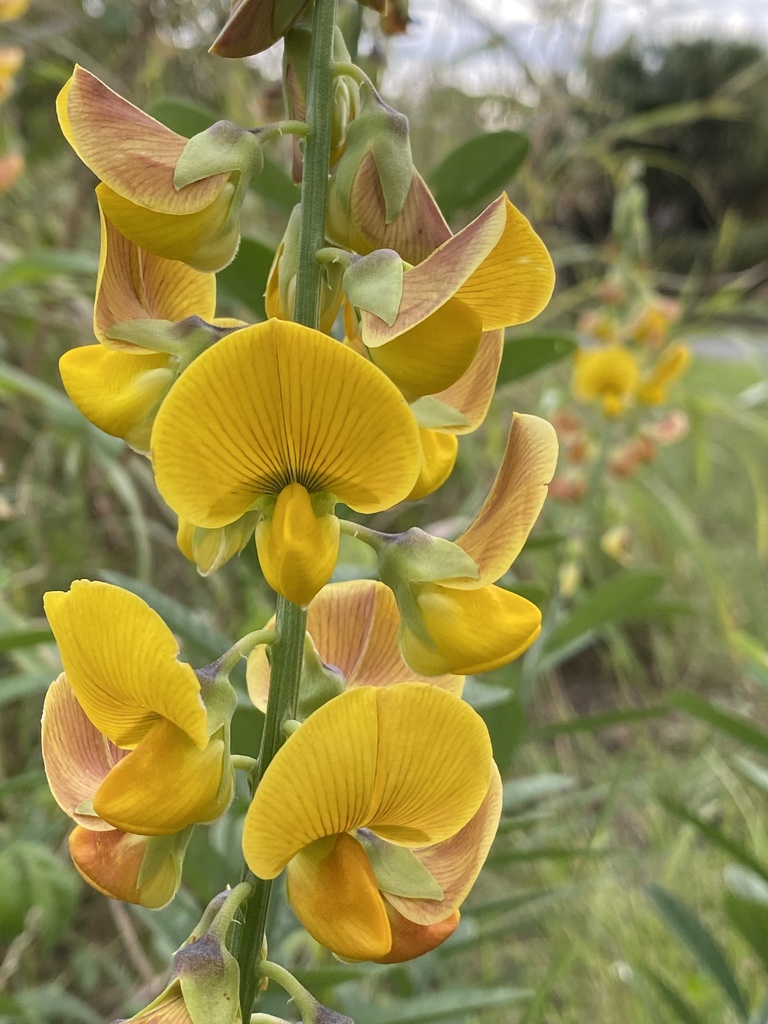
Rattleweed
Crotalaria retusa
Crotalaria retusa is a species of flowering plant in the legume family known by various common names including devil-bean, rattleweed, shack shack, and wedge-leaf rattlepod. It is poisonous to livestock, and contaminates human food. Its original native range is unclear, probably including tropical Asia, Africa and Australia. It has been introduced as a crop plant in many tropical areas and has escaped from cultivation to become a troublesome weed; it is listed as a noxious weed in several US states, Puerto Rico, the Virgin Islands, and is listed as an invasive weed in India, Cuba, and Cocos Island. Unlike some other species of Crotalaria, it is an annual plant.
From the article Crotalaria retusa on Wikipedia (CC BY-SA), quoted section by section
Description
It is an annual herb, about 60–150 centimetres (2–5 ft) high, with erect, angular, green branches. The soft leaves (dark green on the upper surface, lighter underneath) are alternate, and narrowly oblong or wedge-shaped. The yellow flowers grow widely spaced in racemes at the end of the stem. The pods are thin walled, and widely spaced along the stems, and when ripe are purple to black, containing about 18-20 small brown seeds.
Range & habitat
In Australia, where it is considered a native, it grows in the Kimberley on sand, clay, sandstone, and rocky basaltic soils, and is found along creeks and rivers, and on the floodplains.
Wikipedia: “Habitat/ecology”
At the table
Crotalaria retusa is grown as a fibre crop and as green manure. It is also used as a forage plant, but is poisonous to livestock.
Wikipedia: “Uses”
Where it lives
Recorded sightings
—
geo-referenced records in GBIF, from museums, herbaria and field observers.
Drag the globe to turn it. Dots are where records exist, not a range map; darker means more records.
In the stacks
Searching the stacks…
Every page naming Crotalaria retusa in the Biodiversity Heritage Library →
This page is assembled live from iNaturalist, GBIF, Wikipedia, the Source Library and the Internet Archive. It is not yet part of the hand-edited codex. iNaturalist taxon 161148.