- Plants
- ›Vascular Plants
- ›flowering plants
- ›Dicots
- ›Legumes, Milkworts, and Allies
- ›Legumes
- ›Acacias, Mimosas, Mesquites, and Allies
- ›Mimoseae
- ›Leucaena
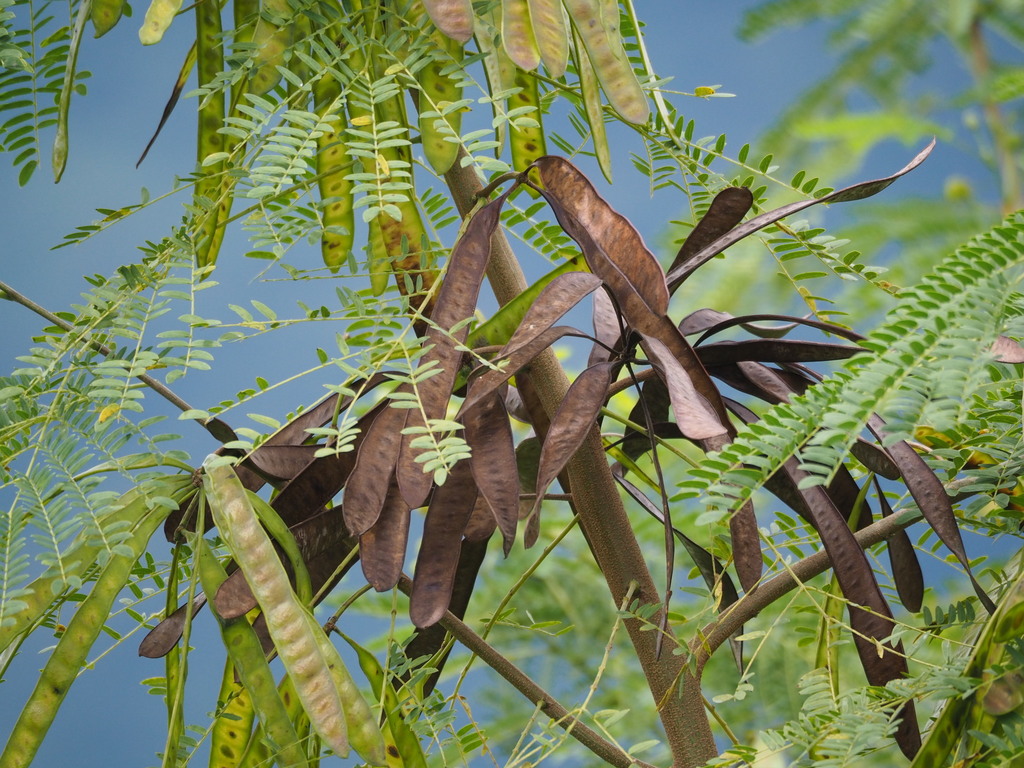
White leadtree
Leucaena leucocephala
Leucaena leucocephala is a small fast-growing mimosoid tree native to southern Mexico and northern Central America (Belize and Guatemala). It is now naturalized throughout the tropics including parts of Asia.
Common names include white leadtree, white popinac, horse tamarind, ipil-ipil, koa haole, tan-tan, and tangantangan.
From the article Leucaena leucocephala on Wikipedia (CC BY-SA), quoted section by section
Description
Leucaena leucocephala is a small tree, growing up to 7–18 metres (23–59 ft). Its bark is grey and cracked. The branches have no thorns, each branch has 6–8 pairs of leaf stalks that bear 11–23 pairs of leaflets, each leaflet is 8–17 mm long with a pale green surface and whitish underneath. Its inflorescence is a cream-coloured puff with many stamens. They produce flat and straight seed pods measuring 13–18 cm (5.1–7.1 in) long that matures from a green colour to a brown; one pod contains between 15 and 30 seeds.
What it does
Leucaena leucocephala is susceptible to insect infestations. In the 1980s, a widespread loss in Southeast Asia was due to pest attack by psyllids. In India, this tree was initially promoted for afforestation due to its fast-growing nature. However, it is now considered unsuitable for urban planting because of its tendency to get uprooted in rain and wind. Eight of every ten trees uprooted by wind in Pune are L. leucocephala.
Wikipedia: “Ecology”
At the table
During the 1970s and 1980s, Leucaena leucocephala was promoted as a "miracle tree" for its multiple uses. It has also been described as a "conflict tree" because it is used for forage production but spreads like a weed in some places. The legume is promoted in several countries of Southeast Asia (at least Burma, Cambodia, Indonesia, Laos, and Thailand), most importantly as a source of quality animal feed, but also for residual use for firewood or charcoal production.
Culinary. The young pods are edible and occasionally eaten in Javanese vegetable salad with spicy peanut sauce, and spicy fish wrapped in papaya or taro leaves in Indonesia, and in papaya salad in Laos and Thailand, where they are known as phak krathin (Thai: ผักกระถิน). In Mexico it is eaten in soups and also inside tacos, it is known as guaje. Cooking is thought to remove most of the poison.
Forage and fodder. The legume provides an excellent source of high-protein cattle fodder. However, the fodder contains mimosine, a toxic amino acid. …
Wikipedia: “Uses”
Toxicity
The seeds of Leucaena leucocephala contain mimosine, an amino acid known to be toxic to nonruminant vertebrates.
In human culture
The state of Oaxaca in Mexico derives its name from the Nahuatl word huaxyacac, the name for Leucaena leucocephala trees that are found around Oaxaca City.
Wikipedia: “In culture”
Where it lives
Recorded sightings
—
geo-referenced records in GBIF, from museums, herbaria and field observers.
Drag the globe to turn it. Dots are where records exist, not a range map; darker means more records.
In the stacks
Searching the stacks…
Every page naming Leucaena leucocephala in the Biodiversity Heritage Library →
This page is assembled live from iNaturalist, GBIF, Wikipedia, the Source Library and the Internet Archive. It is not yet part of the hand-edited codex. iNaturalist taxon 47447.