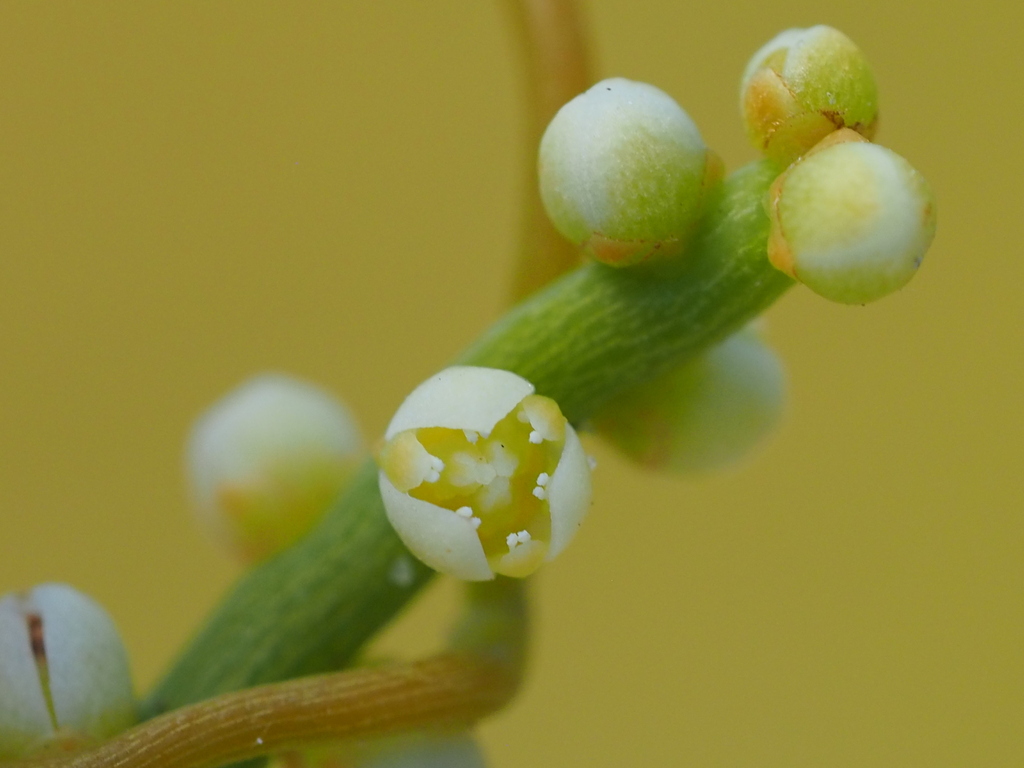
laurel dodder
Cassytha filiformis
Cassytha filiformis or love-vine is an orangish, wiry, parasitic vine in the family Lauraceae. It is found in coastal forests of warm tropical regions worldwide including the Americas, Indomalaya, Australasia, Polynesia and tropical Africa.
It is an obligate parasite, meaning it cannot complete its life-cycle without another host plant. Research in Florida (in southeast United States) has found that love-vine inhibits gall wasps by attacking the galls (small growths on plants) that the wasps create for their young.
From the article Cassytha filiformis on Wikipedia (CC BY-SA), quoted section by section
At the table
In the Malay Peninsula, the stems are dried and powdered to make a liquid substance to stimulate hair growth. Pregnant women in Polynesia drink juice from the vines for 4 weeks before their babies' due date to reduce pains giving birth. In the Caribbean region, it is one of several plants known as "love vine" because it has a reputation as an aphrodisiac. The 1889 book 'The Useful Native Plants of Australia records that the "This and other species of Cassytha are called 'Dodder-laurel'." The emphatic name of "Devil's guts" is largely used. It frequently connects bushes and trees by cords, and becomes a nuisance to the traveller. "This plant is used by the Brahmins of Southern India for seasoning their buttermilk. (Treasury of Botany?)".
Wikipedia: “Uses and relationship with humans”
Where it lives
Recorded sightings
—
geo-referenced records in GBIF, from museums, herbaria and field observers.
Drag the globe to turn it. Dots are where records exist, not a range map; darker means more records.
In the stacks
Searching the stacks…
Every page naming Cassytha filiformis in the Biodiversity Heritage Library →
This page is assembled live from iNaturalist, GBIF, Wikipedia, the Source Library and the Internet Archive. It is not yet part of the hand-edited codex. iNaturalist taxon 160172.