- Plants
- ›Vascular Plants
- ›flowering plants
- ›Dicots
- ›pinks, cactuses, and allies
- ›plumbago family
- ›Plumbagineae
- ›Plumbago
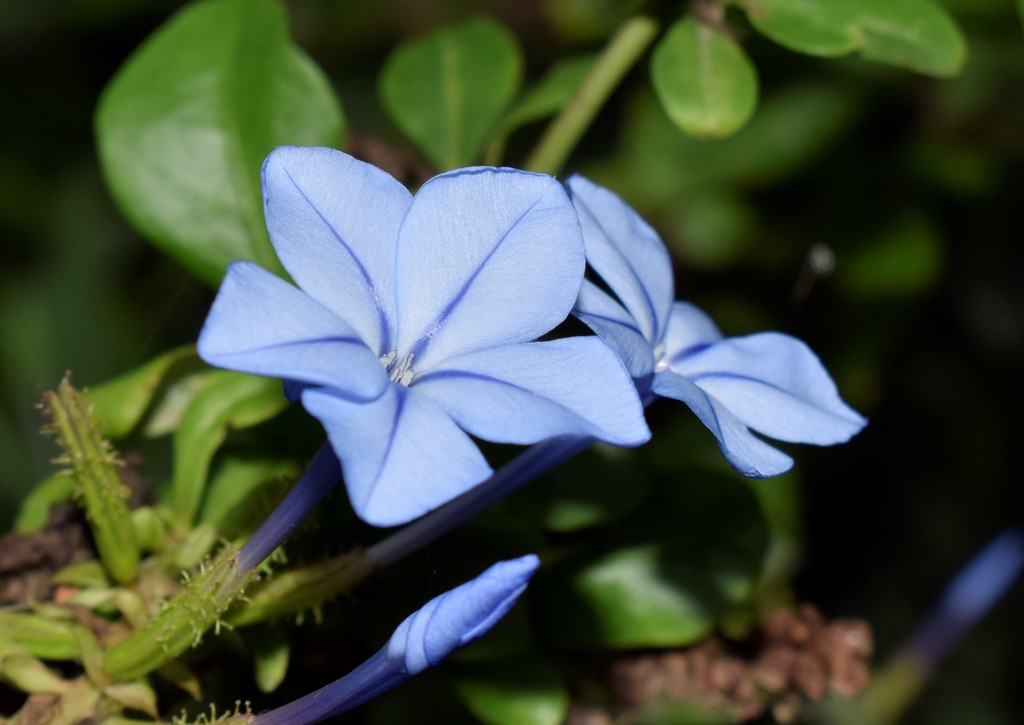
blue plumbago
Plumbago auriculata
Plumbago auriculata, the Cape leadwort, blue plumbago or Cape plumbago, is a species of flowering plant in the family Plumbaginaceae, native to South Africa and Mozambique.
The specific epithet auriculata means "with ears", referring to the shape of the leaves., leaf venation - reticulate.
From the article Plumbago auriculata on Wikipedia (CC BY-SA), quoted section by section
Description
Plumbago auriculata is an evergreen shrub, often grown as a climber, ascending rapidly to 6 m (20 ft) tall by 3 m (10 ft) wide in nature, though much smaller when cultivated as a houseplant. The leaves are a glossy green and grow to 5 cm (2 in) long. The stems are long, thin, and climbing. The leaves alternate and are 2–5 cm.
Inflorescences. The corolla with five petal-like lobes is about 2 cm wide and can be pale blue, blue or violet in color. There also variations with white (P. auriculata var. alba) or deep blue (P. auriculata 'Royal Cape') flowers. The flowers are complete and bisexual, and are arranged in corymb-like racemes. The sepals and petals are connate while the pistil is adnate. The ovary of the flower is superior and the flower has regular symmetry. It has basal placentation, with 1 locule and 5 carpels. It flowers mostly in the summer, but in the right conditions it can bloom year-round.
Range & habitat
Native to South Africa, it extends from the Southern Cape region to Eastern Cape and KwaZulu-Natal. It can also be found in Gauteng and the adjoining areas of Free State and the North West Province. There is also an isolated occurrence in Mpumalanga. Typically the species grows in bushes or thickets. As an ornamental plant, it is widespread today in the tropics and subtropics (including the Mediterranean region).
Wikipedia: “Distribution”
In medicine
Many secondary metabolites have been discovered and isolated from Plumbago auriculata such as plumbagin and palmitic acids.
Wikipedia: “Phytochemistry”
How it is grown
In temperate regions, it may be grown outside in frost free areas, otherwise under glass. It grows best in full sun to part shade. The species and the white-flowered form P. auriculata f. alba have both gained the Royal Horticultural Society's Award of Garden Merit. Plumbago auriculata can be propagated sexually by seeds and asexually by cutting in summer. It needs well-aerated soil and light and prefers acidic soil.
Wikipedia: “Cultivation”
Where it lives
Recorded sightings
—
geo-referenced records in GBIF, from museums, herbaria and field observers.
Drag the globe to turn it. Dots are where records exist, not a range map; darker means more records.
In the stacks
Searching the stacks…
Every page naming Plumbago auriculata in the Biodiversity Heritage Library →
This page is assembled live from iNaturalist, GBIF, Wikipedia, the Source Library and the Internet Archive. It is not yet part of the hand-edited codex. iNaturalist taxon 78631.