- Plants
- ›Vascular Plants
- ›flowering plants
- ›Dicots
- ›Gentians, Dogbanes, Madders, and Allies
- ›Dogbane Family
- ›Rauvolfioideae
- ›Plumerieae
- ›Plumeriinae
- ›Plumeria
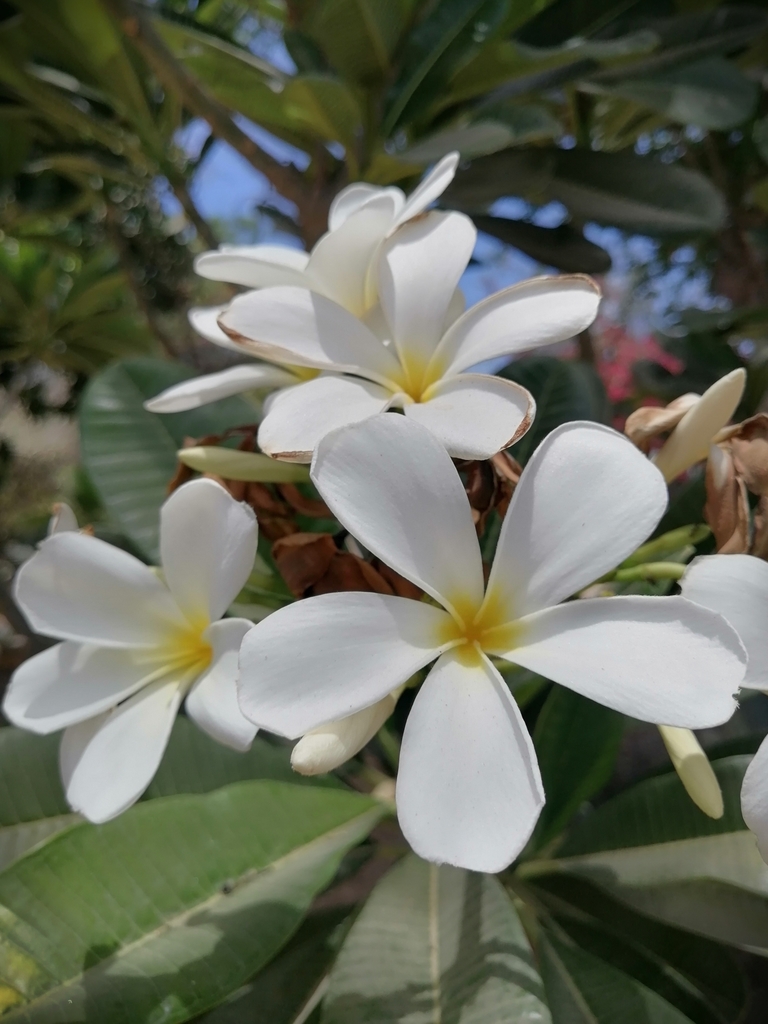
Singapore graveyard flower
Plumeria obtusa
Plumeria obtusa, the Singapore graveyard flower, is a species of the genus Plumeria (Apocynaceae). It is native to the West Indies including Bahamas; southern Mexico, Belize, Guatemala, and Florida. but widely cultivated for its ornamental and fragrant flowers around the world, where suitably warm climate exists. It is reportedly naturalized in China.
From the article Plumeria obtusa on Wikipedia (CC BY-SA), quoted section by section
Description
Plumeria obtusa is a small tree, growing 3.0–4.6 m (10–15 ft) tall. Infrequently, individuals can grow to be 7.6 m (25 ft). Its flowers are white with yellow throats and each has five petals. The fragrant flowers bloom in clusters. Leaves are dark green, glossy, and up to 20 cm (8 in) long. They are obovate, or teardrop-shaped.
Range & habitat
Plumeria obtusa is native to the West Indies (including the Bahamas and the Greater Antilles), southern Mexico, Belize, and Guatemala. Cultivation is common in warmer parts of the world, including Florida, Southeast Asia, and coastal parts of the Arabian Peninsula. It is reportedly naturalized in China and India.
Wikipedia: “Distribution”
At the table
This plant is commonly used as an ornamental, grown for its flowers. In Cambodia the flowers are used to make necklaces and in offerings to the deities. In traditional medicine used in that country, a decoction of the bark is given in varying doses as a purgative or as a remedy against oedema.
== References ==
Wikipedia: “Uses”
Where it lives
Recorded sightings
—
geo-referenced records in GBIF, from museums, herbaria and field observers.
Drag the globe to turn it. Dots are where records exist, not a range map; darker means more records.
In the stacks
Searching the stacks…
Every page naming Plumeria obtusa in the Biodiversity Heritage Library →
This page is assembled live from iNaturalist, GBIF, Wikipedia, the Source Library and the Internet Archive. It is not yet part of the hand-edited codex. iNaturalist taxon 167075.