- Plants
- ›Vascular Plants
- ›flowering plants
- ›Dicots
- ›Mints, Plantains, Olives, and Allies
- ›Acanthus Family
- ›Acanthoideae
- ›Justicieae
- ›Graptophyllinae
- ›Asystasia
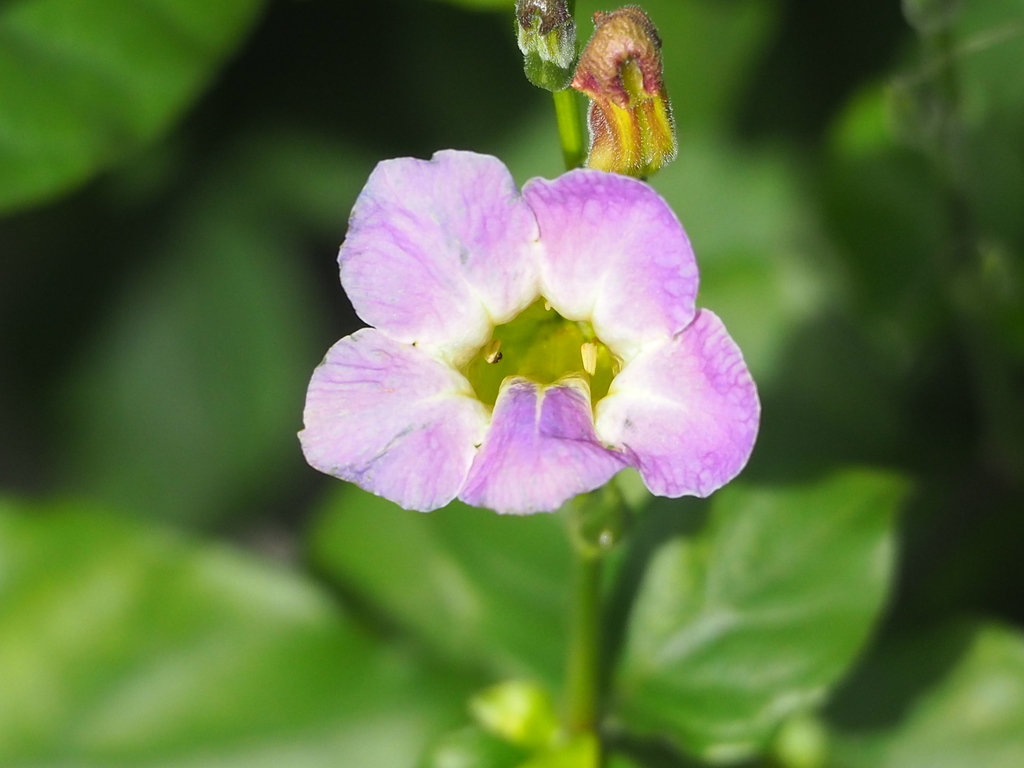
Chinese violet
Asystasia gangetica
Asystasia gangetica is a species of plant in the Acanthaceae family. It is commonly known as the Chinese violet, coromandel or creeping foxglove. In South Africa this plant may simply be called asystasia.
From the article Asystasia gangetica on Wikipedia (CC BY-SA), quoted section by section
Description
This plant is a spreading herb or groundcover, reaching 600 mm in height or up to 1 m if supported. The stems root easily at the nodes. The leaves are simple and opposite. The fruit is an explosive capsule which starts out green in colour, but dries to brown after opening.
Range & habitat
Widespread throughout the Old World Tropics, and introduced into tropical Americas and Hawaii, where it has become naturalized. Both subspecies of this plant have been introduced to Australia where A. g. micrantha is on the National Environmental Alert List and must be reported when found. The original range of the subspecies is unclear, but it is likely that A. g. gangetica was limited to Asia, and A. g. micrantha was limited to Africa.
Wikipedia: “Distribution”
What it does
Ernest Akamine (1947) found that there were no apparent dormancy mechanisms operating in the seeds, which germinated freely 135 days after being expelled from parent plants. Flower production can begin as early as 40 days after germination, with seed development beginning after 57 days, facilitating the production of viable seed in as little as 72 days. The seeds are then expelled explosively upon ripening via hooked retinacula (pictured).
Wikipedia: “Reproduction”
At the table
In some parts of Africa, the leaves are eaten as a vegetable and used as an herbal remedy in traditional African medicine. The leaves are used in many parts of Nigeria as a traditional African medicine for the management of asthma. It is also used as an ornamental plant.
Wikipedia: “Uses”
Where it lives
Recorded sightings
—
geo-referenced records in GBIF, from museums, herbaria and field observers.
Drag the globe to turn it. Dots are where records exist, not a range map; darker means more records.
In the stacks
Searching the stacks…
Every page naming Asystasia gangetica in the Biodiversity Heritage Library →
This page is assembled live from iNaturalist, GBIF, Wikipedia, the Source Library and the Internet Archive. It is not yet part of the hand-edited codex. iNaturalist taxon 159049.