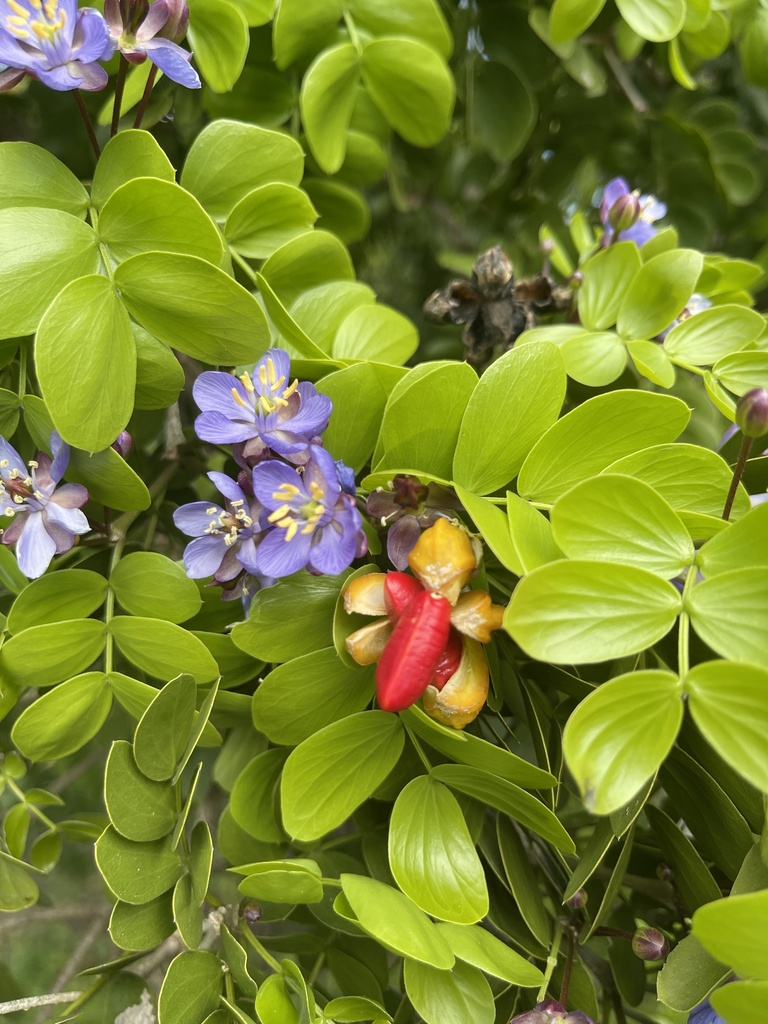
Lignum-vitae
Guaiacum sanctum
Guaiacum sanctum, commonly known as holywood, lignum vitae or holywood lignum-vitae, is a species of flowering plant in the creosote bush family, Zygophyllaceae. It is native to the Neotropical realm, from Mexico through Central America, Florida in the United States, the Caribbean, and northern South America. It has been introduced to other tropical areas of the world. It is currently threatened by habitat loss in its native region, and as such, is currently rated near threatened on the IUCN Red List.
Guaiacum sanctum is the national tree of the Bahamas.
From the article Guaiacum sanctum on Wikipedia (CC BY-SA), quoted section by section
At the table
This tree is one of two species that yield the valuable lignum vitae wood, the other being Guaiacum officinale. The wood has been used for making specific parts of ships that needed to be self-lubricating so that they would last longer. The tree is considered to have medicinal value, used mostly for home remedies. The naturalist William Turner noted in 1568 that the plant was already being grown in India, Tamraparni (ancient Sri Lanka), Java and the Tivu islets of the ocean, and whose broth cured several harsh diseases, including French pox (syphilis). The bark can be steeped to create tonics. It is also used as an ornamental plant.
Wikipedia: “Uses”
In human culture
The native Taíno of the Caribbean referred to the tree as guayacán. The common English name is a direct translation of the Spanish "palo santo" (not to be confused with Bursera graveolens). Francisco López de Gómara as well as Oviedo make reference to the specific species as such in their respective histories of the New World. It earned its name during the time of the Spanish conquest of the New World for its use treating syphilis, whose effects recalled the "evil" of the Black Death. Its scientific name is a Latinization of the Taíno guayacán as well as the word sanctum, meaning holy.
Wikipedia: “Etymology”
Where it lives
Recorded sightings
—
geo-referenced records in GBIF, from museums, herbaria and field observers.
Drag the globe to turn it. Dots are where records exist, not a range map; darker means more records.
In the stacks
Searching the stacks…
Every page naming Guaiacum sanctum in the Biodiversity Heritage Library →
This page is assembled live from iNaturalist, GBIF, Wikipedia, the Source Library and the Internet Archive. It is not yet part of the hand-edited codex. iNaturalist taxon 193076.