- Plants
- ›Vascular Plants
- ›flowering plants
- ›Dicots
- ›Soapberries, Cashews, Mahoganies, and Allies
- ›Torchwoods
- ›Bursera
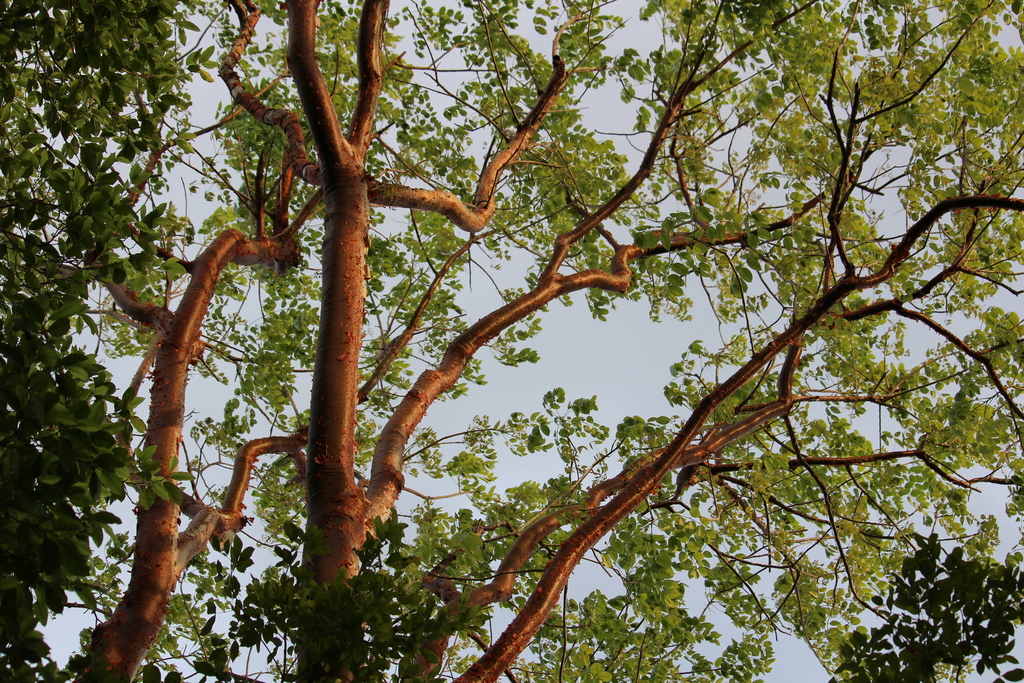
Gumbo Limbo
Bursera simaruba
Bursera simaruba, the gumbo-limbo, copperwood, tourist tree, turpentine tree, almácigo, or West Indian birch, is a tree species in the family Burseraceae. It is native to the Neotropics, from South Florida to Mexico and the Caribbean to Brazil, Nicaragua, and Venezuela. Bursera simaruba is prevalent in the Petenes mangroves ecoregion of the Yucatán, where it is a subdominant plant species to the mangroves. In the United States, specimens may be found along the regions adjacent to the Gulf of Mexico and extending down the western coast of Florida.
From the article Bursera simaruba on Wikipedia (CC BY-SA), quoted section by section
Description
Bursera simaruba is a small to medium-sized tree growing to 30 metres (98 ft) tall, with a diameter of one metre (3 ft 3 in) or less at 1.5 meters above ground. The bark is shiny dark red and the leaves are spirally arranged and pinnate with 7-11 leaflets, each leaflet broad ovate, 4–10 cm (1.6–3.9 in) long and 2–5 cm (0.79–1.97 in) broad. Gumbo-limbo is semi-evergreen, and some sources state it may be evergreen, depending upon location in the range and except for severe drought conditions, however generally retaining some foliage and rapidly recovering. In Florida, the tree sometimes is known humorously by the common name the tourist tree because the tree's bark is red and peeling, resembling the skin of the sunburnt tourists who are a common sight in the plant range. While the tree yields some ripe fruit year-round, the main fruiting season is March and April in the northern part of the range of the tree. The fruit is a small three-valved top-shaped capsule encasing a single seed that is covered in a red, fatty aril (seedcoat) of 5–6 mm diameter. Both ripe and unripe fruits are rather loosely attached at their stems and may detach spontaneously if the tree is shaken. Ripe capsules or dehisce are cracked open by birds. Birds will seek out the fruit to feed on the aril that, although it is relatively small, is rich in lipids (amounting to approximately half its dry weight).
At the table
Gumbo-limbo is a very useful plant economically and ecologically. It grows rapidly and is well adapted to several kinds of habitats that include salty and calcareous soils (however, it does not tolerate boggy soils). Gumbo-limbo also is considered one of the most wind-tolerant trees and it is recommended as a rugged, hurricane-resistant species in South Florida. They may be planted to serve as wind protection of crops and roads, or as live fence posts. If small branches are simply stuck into good soil, they will readily grow into sizable trees in a few years, but without a tap root, only producing side roots. Experience has demonstrated in Central America that using branch plantings for posts or wind protection is a questionable practice since those trees and fence posts are not so sturdy as a true, naturally occurring sapling being planted in a traditional manner. In Sarasota, Florida, gumbo-limbo trees have been used as street trees along a commercial portion of Boulevard of the Arts because the roots do not create problems for sidewalks and utilities. Gumbo-limbo wood is suitable for light construction. It is rather brittle, although the trunk is used in Haiti to make drums. …
Wikipedia: “Uses”
In human culture
In Yucatec Maya oral tradition, the origins of the "chaka tree" (Bursera simaruba, the gumbo-limbo) and the "chechém tree" (Metopium brownei) are related in the legend of two brothers, Kinch and Tizic. The brothers embody opposing natures, one gentle and one wrathful. Both fell in love with the same woman, Nicté-Ha. Their bitter rivalry in competition for the woman culminated in a fatal battle between them where they died in each other's arms. With their final breaths, they begged the deities to let them see Nicté-Ha one more time. In answer, the deities transformed the brothers into adjacent trees—the poisonous chechém representing the violent brother and the medicinal chaka representing the peaceful one—and because of the similarly-shaped flowers of the trees that were thought to be the same, Nicté-Ha became bound forever to both brothers in the legend.
Wikipedia: “Folklore on origin”
Where it lives
Recorded sightings
—
geo-referenced records in GBIF, from museums, herbaria and field observers.
Drag the globe to turn it. Dots are where records exist, not a range map; darker means more records.
In the stacks
Searching the stacks…
Every page naming Bursera simaruba in the Biodiversity Heritage Library →
This page is assembled live from iNaturalist, GBIF, Wikipedia, the Source Library and the Internet Archive. It is not yet part of the hand-edited codex. iNaturalist taxon 130734.