- Plants
- ›Vascular Plants
- ›flowering plants
- ›Dicots
- ›Heathers, Balsams, Primroses, and Allies
- ›heath family
- ›madrones, bearberries, and allies
- ›Arbutus
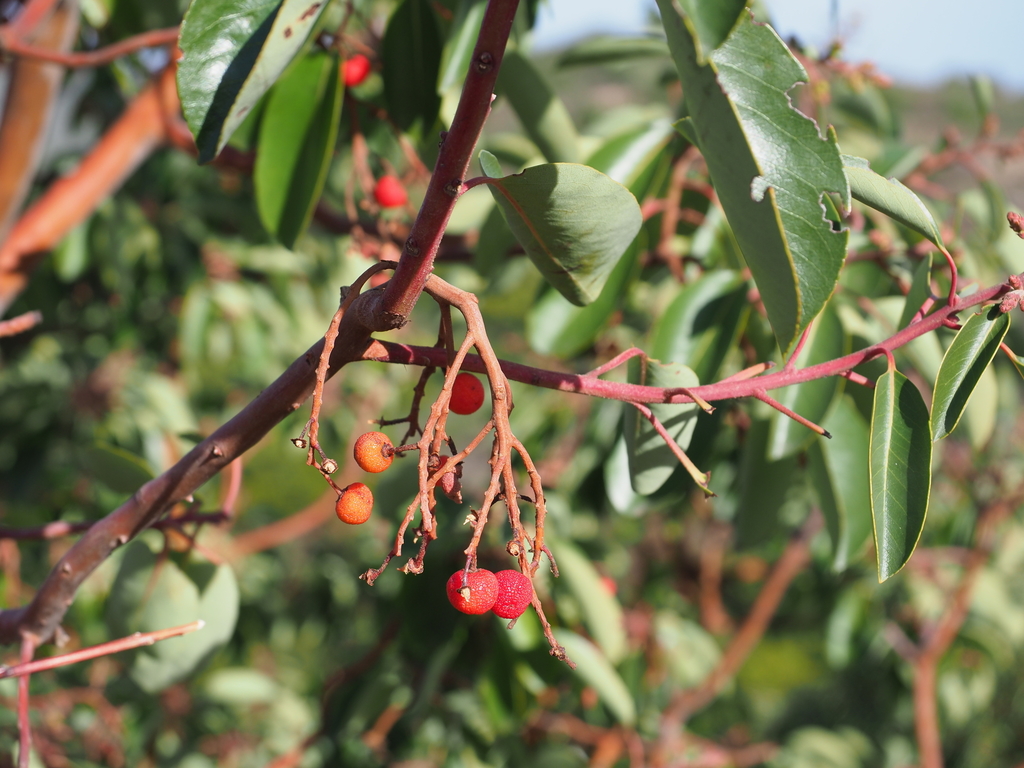
Greek strawberry-tree
Arbutus andrachne
Arbutus andrachne, commonly called the Greek strawberry tree, is an evergreen shrub or small tree in the family Ericaceae, native to the Mediterranean region, the Middle East, and southwestern Asia.
From the article Arbutus andrachne on Wikipedia (CC BY-SA), quoted section by section
Description
Arbutus andrachne can reach a height of about 12 metres (39 ft). The smooth bark exfoliates during the summer, leaving a layer with a pistachio green colour, which changes gradually to an orange brown. The flowers bloom in spring and are white or yellowish green. Its fruits ripen in autumn. Their size is 1-1.2 cm. They are edible and taste somewhat sweet and astringent, rich in vitamin C, polyphenols, and natural sugars(16gr/100gr of fruit). The astringency is more pronounced when the fruit is not fully ripe. They are used to make jams and liqueurs. When left to dry in a cool place, are eaten as sweet, chewy candy.
At the table
According to a research study published in 2017, the fruit's antioxidants contain a variety of chemicals that have a defensive effect against memory impairment where the antioxidants normalize the long- and short-term memory impairment caused from sleep deprivation.
Wikipedia: “Uses”
How it is grown
Arbutus andrachne was reported by Peter Collinson as having flowered first in England in Dr John Fothergill's extensive botanical garden and greenhouses at Upton House, Essex (now West Ham Park), in 1765.
Hybrids. Arbutus x andrachnoides Link, 1821 is a hybrid between A. andrachne and A. unedo. Arbutus x thuretiana Demoly, nothosp. nov. is a hybrid between A. andrachne and A. canariensis. Named after Gustave Thuret, it is naturalised at Jardin botanique de la Villa Thuret. A. x thuretiana is renowned for its perfectly smooth, reddish-brown bark, exfoliating in the spring to show a new, surprisingly pistachio-green bark, which gradually darkens and turns reddish again.
Wikipedia: “Horticulture”
In human culture
A book about travel in the Middle East states of 15th-century travel writer Bertrandon de la Broquière:On leaving Bursa ... There was on the road a small tree bearing a fruit somewhat bigger than our largest cherries, and of the shape and taste of strawberries, but a little acid. It is pleasant to eat; but, if a great quantity be eaten, it mounts to the head, and intoxicates. It is ripe in November and December." Editor's footnote: "From the description, it seems to be the arbutus Andrachne.The tree is part of the flora of the Dibbeen Forest Reserve in Jordan.
Wikipedia: “In culture”
Where it lives
Recorded sightings
—
geo-referenced records in GBIF, from museums, herbaria and field observers.
Drag the globe to turn it. Dots are where records exist, not a range map; darker means more records.
In the stacks
Searching the stacks…
Every page naming Arbutus andrachne in the Biodiversity Heritage Library →
This page is assembled live from iNaturalist, GBIF, Wikipedia, the Source Library and the Internet Archive. It is not yet part of the hand-edited codex. iNaturalist taxon 430676.