- Animals
- ›Molluscs
- ›Gastropods
- ›Caenogastropods
- ›Littorinimorpha
- ›Cowries and Allies
- ›Cowries
- ›Cypraeinae
- ›Cypraeini
- ›Cypraea
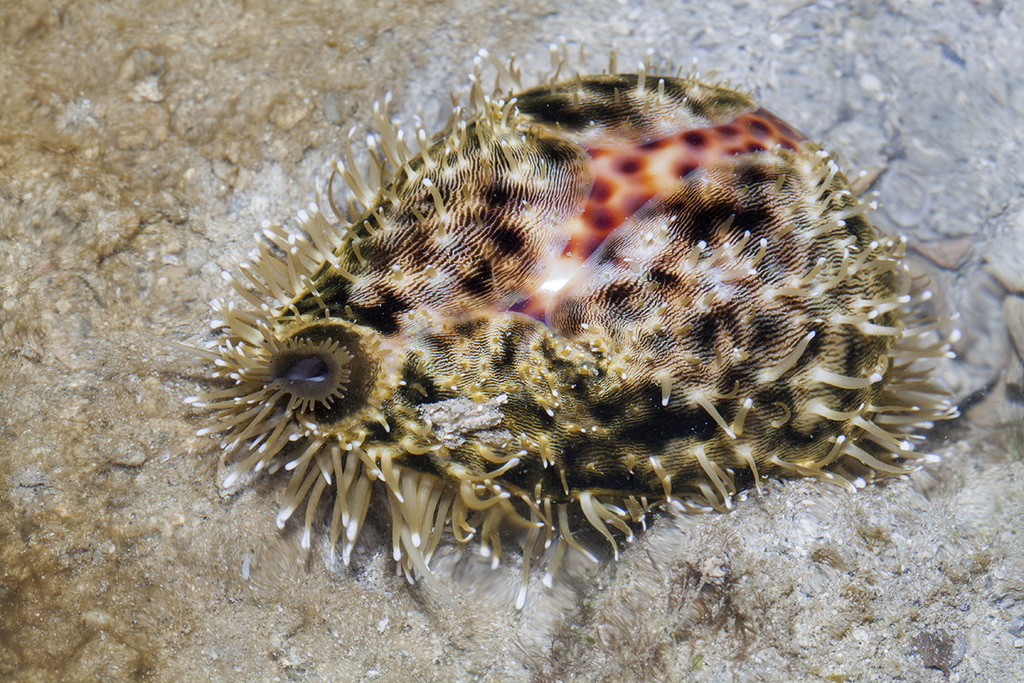
Tiger Cowrie
Cypraea tigris
Cypraea tigris, commonly known as the tiger cowrie, is a species of cowry, a large sea snail, a marine gastropod mollusk in the family Cypraeidae, the cowries.
From the article Cypraea tigris on Wikipedia (CC BY-SA), quoted section by section
Description
Roughly egg-shaped and dextral, the glossy shell is large and heavy for a cowry. It measures up to 15 cm (6 in) in length, and the upper or dorsal side is white, pale bluish-white, or buff, densely covered with dark brown or blackish barely circular spots. Akin to many other Cypraea snails, the shells surface is notably effulgent, as if it were deliberately polished. There is sometimes a blurred red line along the length of the shell at the midline on the dorsal surface. The lower margins are rounded (that is, there is no sharp margin between the upper and lower surfaces of the shell as is found in some other cowries). The ventral side is white or whitish, and the shell opening is lined with tooth-like serrations. As is the case in almost all cypraeids, two lateral extensions of the mantle are able to extend so as to cover the shell completely, meeting at the midline of the dorsal surface. The mantle can also withdraw into the shell opening when threatened. In this species, the exterior surface of the mantle has numerous pin-like projections that are white-tipped.
Range & habitat
The tiger cowrie is found on the ocean floor in the Indo-Pacific region, from the eastern coast of Africa to the waters of Micronesia and Polynesia, the Coral Sea and around the Philippines. Along the Australian Coast it is found from northern New South Wales to northern Western Australia, as well as Lord Howe Island, and along the east coast of Africa including Madagascar. Found between depths of 10 and 40 metres (35–130 ft), it is often associated with live coral colonies, such as the table-forming Acropora, either found on the reefs themselves or the sandy sea bottom nearby. Once common, it is now much less abundant due to shell collecting and the destruction of its habitat by such processes as dynamite fishing, especially in shallower areas. Carnivorous, the adult tiger cowrie eats coral and various invertebrates, while juveniles eat algae. This species is endangered in Singapore.
Wikipedia: “Distribution and habitat”
What it does
The Hawaiian subspecies C. t. schilderiana naturally preys on invasive sponges, including Dysidea spp., Mycale grandis, M. parishii, Haliclona caerulea, H. coerulea, Cladocroce burapha, and Gelliodes wilsoni. (Compounds in Monanchora clathrata acted as a repellent, so C. t. schilderiana avoided them.) Thus, C. t. schilderiana was found to be controlling invasive populations, which shows its importance in maintaining the normal variety of life in Hawaiian marine habitats by constraining invasive species in Hawaii.
Wikipedia: “Diet”
Where it lives
Recorded sightings
—
geo-referenced records in GBIF, from museums, herbaria and field observers.
Drag the globe to turn it. Dots are where records exist, not a range map; darker means more records.
In the stacks
Searching the stacks…
Every page naming Cypraea tigris in the Biodiversity Heritage Library →
This page is assembled live from iNaturalist, GBIF, Wikipedia, the Source Library and the Internet Archive. It is not yet part of the hand-edited codex. iNaturalist taxon 84107.