- Animals
- ›Molluscs
- ›Bivalves
- ›Autobranchia
- ›Heteroconchia
- ›Euheterodonta
- ›Imparidentia
- ›True Cockles, Tellins, and Allies
- ›Cardioidea
- ›true cockles
- ›Giant Clams
- ›Tridacna
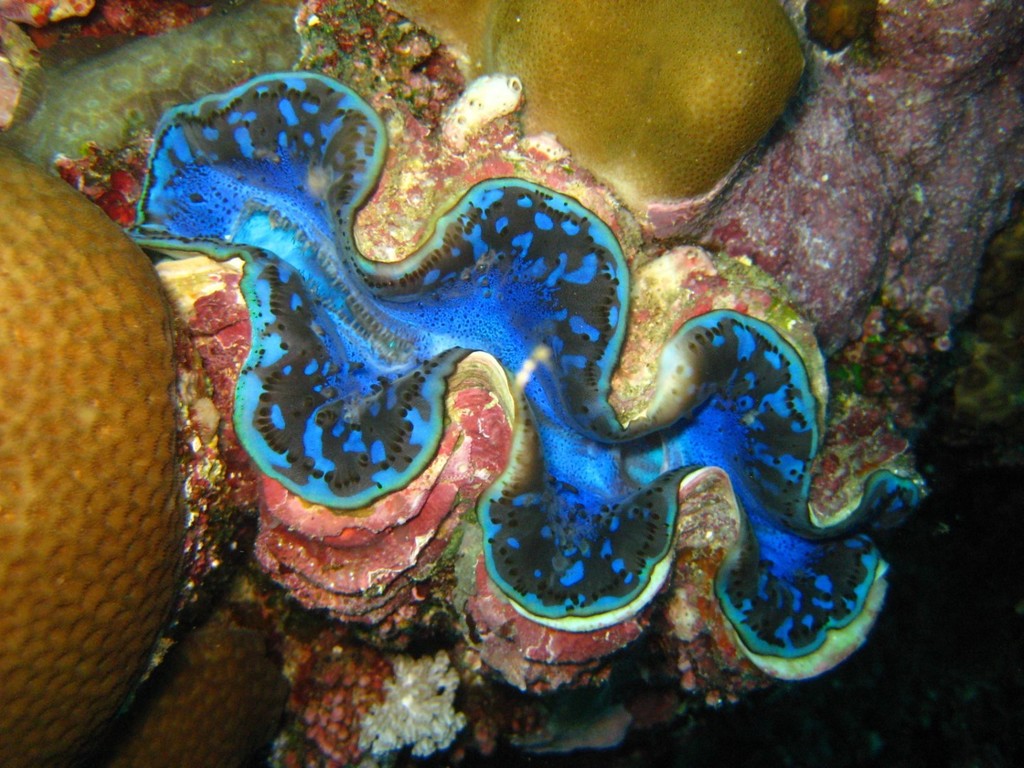
Small Giant Clam
Tridacna maxima
Tridacna maxima, also known as the maxima clam or the small giant clam, is a species of bivalve mollusc found throughout the Indo-Pacific region.
They are much sought after in the aquarium trade, as their often striking coloration mimics that of the true giant clam; however, the maximas maintain a manageable size, with the shells of large specimens typically not exceeding 20 centimetres (7.9 in) in length.
From the article Maxima clam on Wikipedia (CC BY-SA), quoted section by section
Description
Bivalves have two valves on the mantle. These siphon water through the body to extract oxygen from the water using the gills and to feed on algae. The maxima is less than one-third the size of the true giant clam (Tridacna gigas).
Shell. Adults develop a large shell that adheres to the substrate by its byssus, a tuft of long, tough filaments that protrude from a hole next to the hinge.
Mantle. When open, the bright blue, green or brown mantle is exposed and obscures the edges of the shell which have prominent, distinctive furrows. The attractive colours of the small giant clam are the result of crystalline pigment cells. These are thought to protect the clam from the effects of intense sunlight, or bundle light to enhance the algae's photosynthesis. Maxima produce the color white in their mantle by clustering red, blue and green cells, while individual T. derasa cells are themselves multi-colored.
Range & habitat
The small giant clam has the widest range of all giant clam species. It is found in the oceans surrounding East Africa, India, China, Australia, Southeast Asia, the Red Sea, and the islands of the Pacific. Found living on the surface of reefs or sand, or partly embedded in coral, the small giant clam occupies well-lit areas, due to its symbiotic relationship with photosynthetic algae, which require sunlight for energy production.
Wikipedia: “Distribution and habitat”
Where it lives
Recorded sightings
—
geo-referenced records in GBIF, from museums, herbaria and field observers.
Drag the globe to turn it. Dots are where records exist, not a range map; darker means more records.
In the stacks
Searching the stacks…
Every page naming Tridacna maxima in the Biodiversity Heritage Library →
This page is assembled live from iNaturalist, GBIF, Wikipedia, the Source Library and the Internet Archive. It is not yet part of the hand-edited codex. iNaturalist taxon 50589.