- Animals
- ›Arthropods
- ›Hexapods
- ›Insects
- ›Winged and Once-winged Insects
- ›Beetles
- ›Water, Rove, Scarab, Long-horned, Leaf, and Snout Beetles
- ›Cucujiform Beetles
- ›Snout and Bark Beetles
- ›True Weevils
- ›Broad-nosed Weevils
- ›Eustylini
- ›Diaprepes
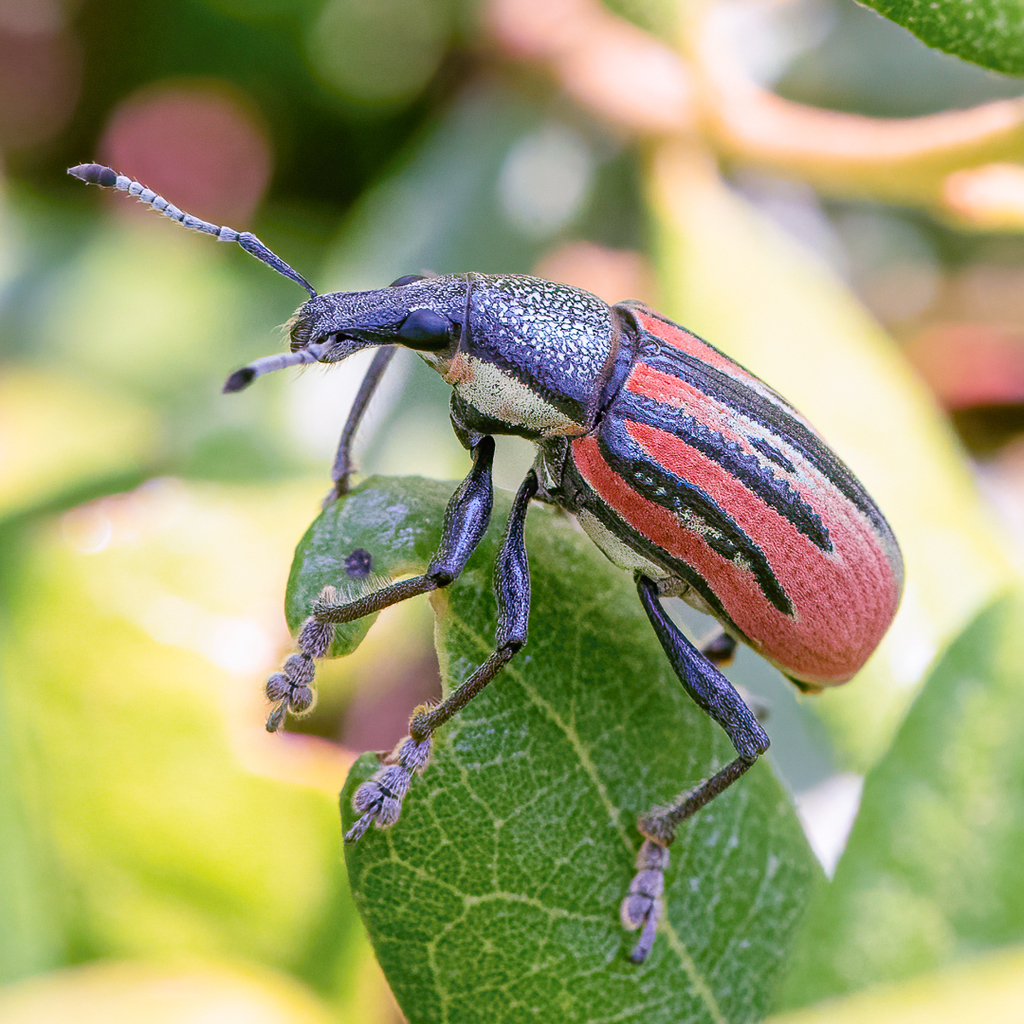
Diaprepes Root Weevil
Diaprepes abbreviatus
Diaprepes abbreviatus is a species of weevil that is native to the Caribbean, where in Spanish it is colloquially called chichí. It is an agricultural pest in several Caribbean countries. In 1964 this weevil was accidentally introduced in the US, state of Florida, where it is at present a major pest of citrus. It was first discovered in southern California in 2005, where it is a pest of citrus, avocado, and nursery stock. It is also...
From the article Diaprepes abbreviatus on Wikipedia (CC BY-SA), quoted section by section
Range & habitat
In 1964 this weevil was accidentally introduced in the US, state of Florida, where it is presently a major pest of citrus. It was first discovered in southern California in 2005, where it is a pest of citrus, avocado, and nursery stock. In Texas it was found in the Rio Grande Valley in 2000, resulting in a 2001 quarantine, and then in 2009 around Houston. Another sighting in 2019 confirms that it is still in the area. In June of 2022, a new sighting also occurred in Pearland.
Wikipedia: “Introduced range”
In human culture
The adult citrus root weevil is somewhat variable in size but just over 1 cm (3⁄8 in) in length on average. Its elytra are glossy black with large stripes of tiny yellowish-orange scales, and its head and legs are black. It has adhesive pads on its legs which confer the ability to adhere to very smooth surfaces. The larva is a plump pale grub with a dark head, up to 2.5 cm (31⁄32 in) in length. A female weevil might lay 5,000 eggs, depositing them in clusters on leaves, then folding and gluing the leaves together. After a week the larvae emerge from the eggs, fall to the ground, and burrow down to the roots of the host plant. They feed on the roots for several months, which is very damaging to the plant. While the adult weevil does feed on the foliage of the plant, it is the larvae that do the most damage. They often eat the taproot of the plant, which can kill it by depriving it of water and nutrients or by making it vulnerable to infection by fungi, or water moulds such as Phytophthora. The weevil spreads mainly by "hitchhiking" when infested plants, soil, and containers are moved from site to site.
Wikipedia: “Life history”
Listen
Looking for field recordings…
Where it lives
Recorded sightings
—
geo-referenced records in GBIF, from museums, herbaria and field observers.
Drag the globe to turn it. Dots are where records exist, not a range map; darker means more records.
In the stacks
Searching the stacks…
Every page naming Diaprepes abbreviatus in the Biodiversity Heritage Library →
This page is assembled live from iNaturalist, GBIF, Wikipedia, the Source Library and the Internet Archive. It is not yet part of the hand-edited codex. iNaturalist taxon 132094.