- Animals
- ›Molluscs
- ›Gastropods
- ›Heterobranchs
- ›Euthyneura
- ›Tectipleura
- ›Sea Butterflies
- ›Euthecosomata
- ›Cavolinioidea
- ›Cavolines
- ›Cavoliniinae
- ›Cavolinia
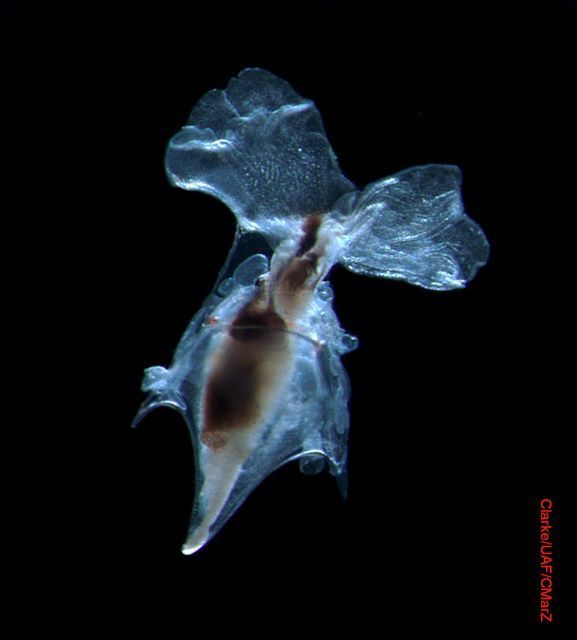
Inflexed Cavoline
Cavolinia inflexa
Cavolinia inflexa is a species of small pteropod. Cavolinia inflexa are members of the thecosome pteropod genus that dwell in the epipelagic zone feeding on arctic snow and smaller microorganisms. While it is known that Cavolinia inflexa are filters feeders, their reproductive tendencies and behaviors are not well studied. They can be used as a proxy for assuming climatic conditions for a particular period and have been a focus of ocean acidification impact studies.
From the article Cavolinia inflexa on Wikipedia (CC BY-SA), quoted section by section
Description
Like other thecosome pteropods, Cavolinia inflexa form an aggronite shell to surround their body. As a result, they have been found to be highly sensitive to ocean acidification and the constantly changing water column's chemical composition. Cavolinia inflexa are found to be between 2-8 millimeters in length, and have a length to width ratio between 0.51 and 0.81. Additionally, they have a straight shell, their posterior tip bent upwards, and a bilaterally symmetrical structure.
Wikipedia: “Morphology and physiology”
Range & habitat
Cavolinia inflexa are a common thecosome pteropod found worldwide in warm waters between 55° N to 45° S. They are filter feeders as is typical among Pteropoda. Their diet consists of marine snow–organic matter that is suspended in the water column. Cavolinia inflexa were initially believed to be multiple subspecies, but later studies show that the species does not exhibit enough regional variation to have categorical subspecies. Cavolinia inflexa live in the Atlantic, Indian, and Pacific Oceans, but there is not significant geographical variation. Climate change may pose a threat to Cavolinia inflexa as ocean acidification has been shown to impact larval development. In particular, ocean acidification prevents the formation of their shells, leaving the organism vulnerable to predation. One study found a significant decrease in shell density among Cavolinia inflexa between 1910 and 2012.
== References ==
Wikipedia: “Ecology and distribution”
What it does
Cavolinia inflexa move throughout depths in response to where the largest concentration of food is, as it reacts to the vertical migration patterns expressed by zooplankton. However, they are mostly found floating in the epipelagic zone of the ocean. Their vertical migration is also in response to a diurnal cycle. They feed by ingesting their captured prey that has been snared by their mucus feedings webs. After 1-3 minutes they can completely consume and digest their snared prey.
Wikipedia: “Behavior”
Where it lives
Recorded sightings
—
geo-referenced records in GBIF, from museums, herbaria and field observers.
Drag the globe to turn it. Dots are where records exist, not a range map; darker means more records.
In the stacks
Searching the stacks…
Every page naming Cavolinia inflexa in the Biodiversity Heritage Library →
This page is assembled live from iNaturalist, GBIF, Wikipedia, the Source Library and the Internet Archive. It is not yet part of the hand-edited codex. iNaturalist taxon 255480.