- Animals
- ›Molluscs
- ›Gastropods
- ›Heterobranchs
- ›Euthyneura
- ›Tectipleura
- ›Sacoglossans
- ›Plakobranchoidea
- ›Plakobranchidae
- ›Elysia
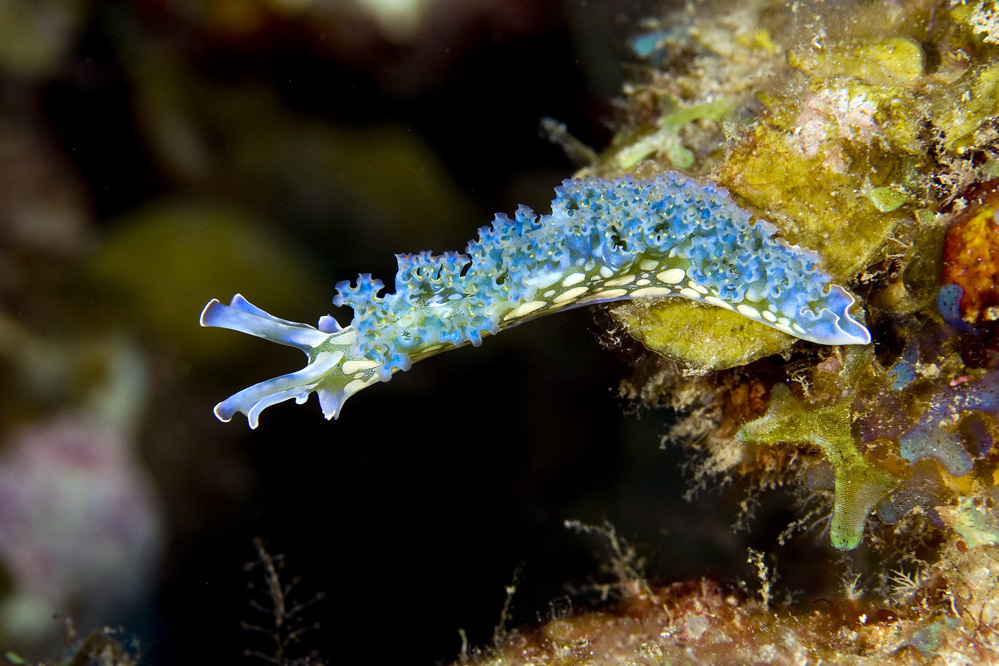
Lettuce Sea Slug
Elysia crispata
Elysia crispata, common name the lettuce sea slug or lettuce slug, is a large and colorful species of sea slug, a marine gastropod mollusk.
The lettuce slug resembles a nudibranch, but it is not closely related to that clade of gastropods; it is classified as a sacoglossan.
From the article Elysia crispata on Wikipedia (CC BY-SA), quoted section by section
Description
This species is called the lettuce slug because it is often green in color, and it always has a very frilly edge to its parapodia. This makes the slug resemble the curly kinds of lettuce, such as the lollo rosso variety. The maximum length of this species is about 5 cm and 3 cm in width. The lettuce slug is extremely variable in color: it can also be blue, or very pale with red lines or yellow lines.
Range & habitat
This species lives in the tropical parts of the western Atlantic, and the Caribbean faunal zone. They are found in more coastal and tropical reef areas where the water is shallow and clear.
Wikipedia: “Distribution”
What it does
E. crispata can be either heterotrophic or autotrophic throughout their lifespan. As juveniles, food is consumed and digested quickly, with little chloroplast retention. Upon reaching maturity, kleptoplasty becomes an important energy source. The primary food source of E. crispata is relatively unknown, although some individuals have been known to consume a diversity of algal species such as Vaucheria litorea, Caulerpa verticillata, Caulerpa racemosa, Halimeda discoidea, Halimeda incrassate, Halimeda monile, and Penicillus capitatus; C. verticillata being suitable for a limited amount of time. This diversity in food sources is a different characteristic compared to other Sacoglossans which are specialized for one species of algae, and gives E. crispata a survival advantage when food is depleted or sparse. Chloroplasts within their parapodia (fleshy dorsal protrusions) continue to produce energy products through carbon fixation throughout their life and have been found to function efficiently for a little over a month.
Kleptoplasty. Also known as chloroplast symbiosis, kleptoplasty is the energy-providing mechanism that gives the Sacoglossan's the nickname, "solar-powered sea slugs", and E. crispata the name, "lettuce sea slug." As algal food is being digested, the chloroplasts are absorbed into the cells lining the digestive tract and up into their parapodia. …
Wikipedia: “Diet”
Where it lives
Recorded sightings
—
geo-referenced records in GBIF, from museums, herbaria and field observers.
Drag the globe to turn it. Dots are where records exist, not a range map; darker means more records.
In the stacks
Searching the stacks…
Every page naming Elysia crispata in the Biodiversity Heritage Library →
This page is assembled live from iNaturalist, GBIF, Wikipedia, the Source Library and the Internet Archive. It is not yet part of the hand-edited codex. iNaturalist taxon 119875.