- Animals
- ›Chordates
- ›Vertebrates
- ›Mammals
- ›Therians
- ›Placental Mammals
- ›Primates, Rodents, and Allies
- ›Rodents
- ›Mice, Rats, and Hamsters
- ›Muroids
- ›Old World Mice and Rats
- ›Gerbils
- ›Gerbillini
- ›Meriones
- ›Pallasiomys
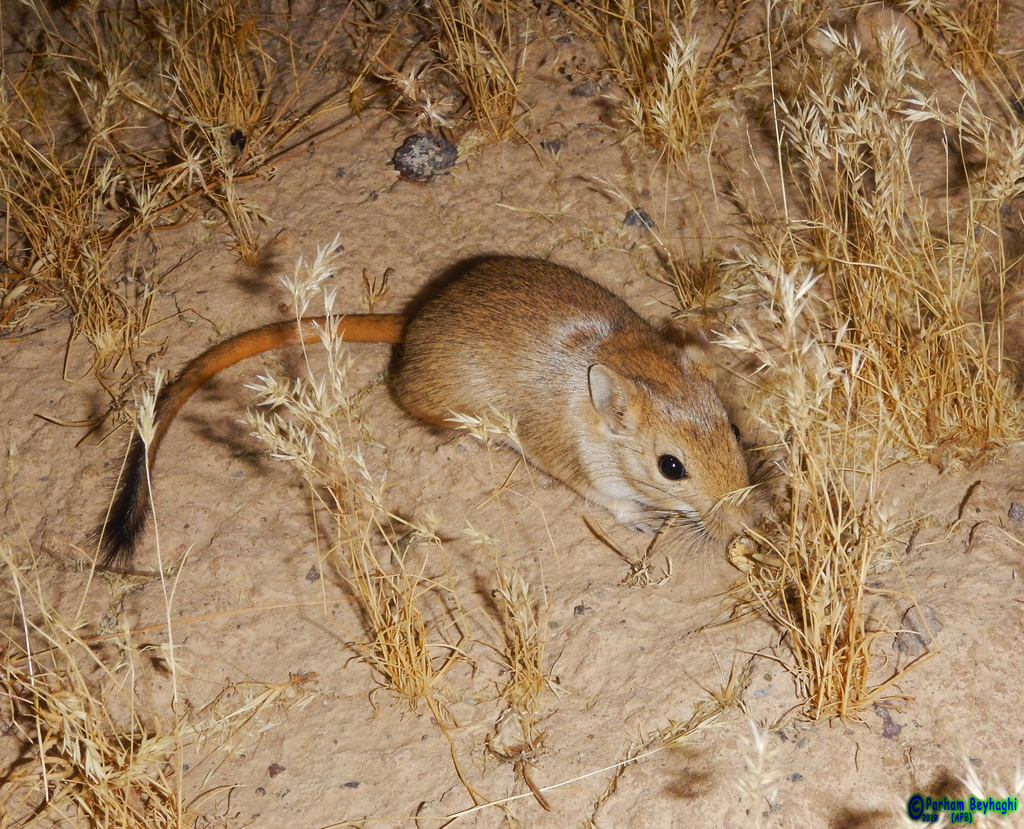
Libyan Jird
Meriones libycus
The Libyan jird (Meriones libycus) is a species of rodent in the family Muridae. It is found in Mauritania, Morocco, Algeria, Tunisia, Libya, Egypt, Jordan, Syria, Saudi Arabia, Iran, Iraq, Afghanistan, Turkmenistan, Uzbekistan, Kazakhstan and Western China. Its natural habitats are subtropical or tropical dry shrubland, intermittent saline lakes, hot deserts, and rural gardens.
From the article Libyan jird on Wikipedia (CC BY-SA), quoted section by section
Description
The Libyan jird is a large species of jird with a head-and-body length of 100 to 160 mm (3.9 to 6.3 in), a similar-length tail and a weight of 56 to 105 g (2.0 to 3.7 oz). The head is broad with large eyes, the fur is fine and dense and the hind legs are long. The upper parts are greyish-brown, darker in colour than the midday jird (Meriones meridianus), which is usually smaller. The hairs on the underside have white tips and grey bases whereas the midday jird has all-white underparts apart from a brownish chest stripe. The tail is pale brown except for the terminal third of the tail which is deep brown or blackish. The claws are dark-coloured, and the soles of the hind feet are partly hairy so that patches of bare skin are visible. In parts of its range it may be confused with Sundevall's jird (Meriones crassus) but that species is smaller, has pale claws and a smaller dark tail tuft.
Range & habitat
The Libyan jird is native to North Africa and parts of Western and Central Asia. Its range extends from Mauritania and Morocco to Saudi Arabia, the Near East, Kazakhstan and Western China. Its typical habitat includes deserts and semi-deserts, river floodplains, wadis and areas with stable sand-dunes. It sometimes occurs in arable land.
Wikipedia: “Distribution and habitat”
What it does
The Libyan jird may live alone or in small colonies, and is more sociable in winter when colonies may contain twenty or thirty individuals. It inhabits a burrow up to 1.5 m (5 ft) deep which is a fairly complex series of passages with multiple entrances; an empty burrow of the great gerbil (Rhombomys opimus) may be used. The Libyan jird is a diurnal species and forages for seeds, bulbs, tubers and leaves, as well as any dead insect it may find. It often carries the food back to the burrow and here large quantities are stored in chambers near the surface, deeper burrows being used for nesting. It is opportunistically migratory, moving to new territory when food becomes scarce. Breeding takes place throughout most of the year with several litters of about five young being born. In the man-made desert known as Aralkum that has been formed as a result of the shrinkage of the Aral Sea, the Libyan jird has made use of the new habitat where it lives alongside other small rodents including the northern three-toed jerboa, the midday jird and the great gerbil. …
Wikipedia: “Ecology”
Listen
Looking for field recordings…
Where it lives
Recorded sightings
—
geo-referenced records in GBIF, from museums, herbaria and field observers.
Drag the globe to turn it. Dots are where records exist, not a range map; darker means more records.
In the stacks
Searching the stacks…
Every page naming Meriones libycus in the Biodiversity Heritage Library →
This page is assembled live from iNaturalist, GBIF, Wikipedia, the Source Library and the Internet Archive. It is not yet part of the hand-edited codex. iNaturalist taxon 44666.