Western Pebble-mound Mouse
Pseudomys chapmani Kitchener, 1980
Also calledPseudomys de Chapman (fra) · Westliche Australienmaus (deu) · myška Chapmanova (ces) · pilbaranhiiruli (fin) · pseudomysz kamienista (pol) · Мышь Чапмана (rus) · チャップマンニセマウス (jpn)
First described in: Rec. West. Aust. Mus. vol.8 p.405
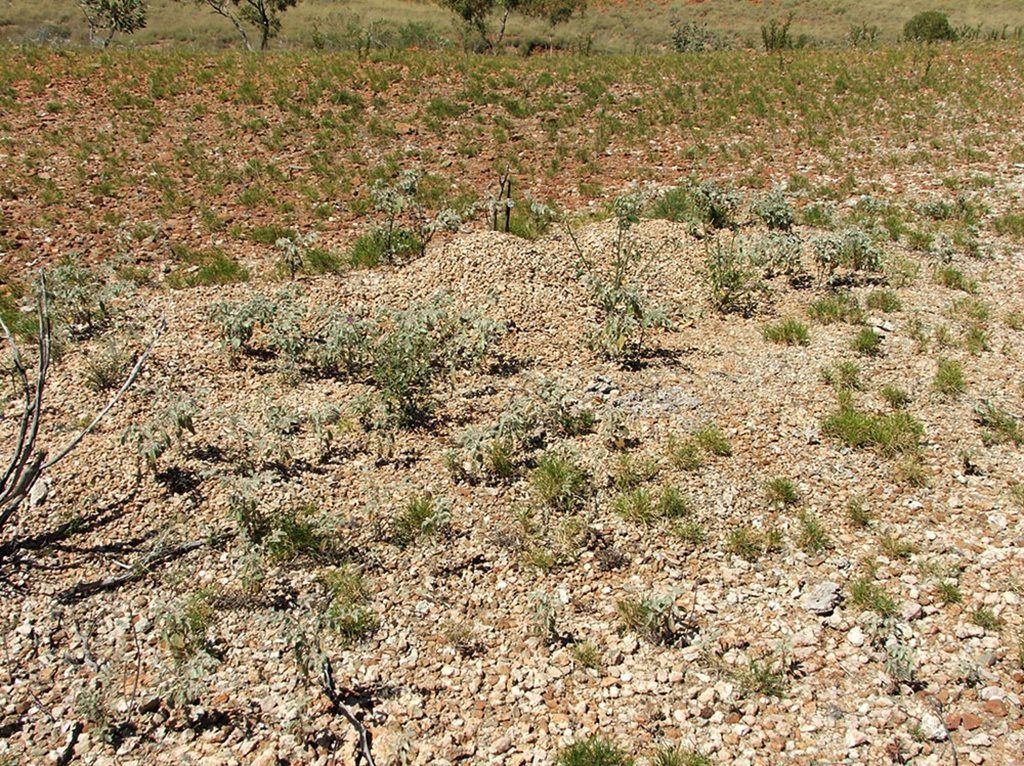
Western pebble-mound mouse or Ngadji (Pseudomys chapmani) is a burrowing and mound building rodent in the family Muridae. They occur in the Pilbara, a remote region in the northwest of Australia.
Descriptions from checklists and floras indexed by GBIF
discussion
Discussion: This species builds pebble mounds and is sympatric with P. hermannsburgensis (Kitchener, 1980), which does not construct such mounds (Dunlop and Pound, 1981), but phylogenetically most closely allied to P. johnsoni, another species that constructs pebble mounds (Kitchener, 1985). The use of pebble mounds as indicators of the presence of P. chapmani is documented by Anstee (1996). Reviewed by Start and Kitchener (1995).
Order Rodentia - Family Muridae
distribution
Distribution: Australia, NW Western Australia; extant specimens known only from Pilbara Dist. (Kitchener, 1985: 216), but distribution of pebble mounds indicates range once extended through Gascoyne to Murchison Dist. with S limit near Mileura, N limit the Great Sandy Desert, and E limit the Gibson Desert (Dunlop and Pound, 1981; Start and Kitchener, 1995).
Order Rodentia - Family Muridae
materials_examined
Type Locality: Australia, Western Australia, Pilbara Dist., East Hammersley Range, West Angelas Mine Site (Kitchener, 1980, provided additional information).
Order Rodentia - Family Muridae
discussion
COMMENTS: This species builds pebble mounds and is sympatric with P. hermannsburgensis (Kitchener, 1980), which does not construct pebble mounds (Dunlop and Pound, 1981), but phylogenetically most closely allied to P. johnsoni, another species that constructs pebble mounds (Kitchener, 1985).
Order Rodentia - Family Muridae
From Wikipedia (CC BY-SA), quoted section by section
Description
The colour of the mouse's pelt is buff brown, darker to blackish at the head. The paws are white beneath and buff above, The underparts are white, up to the throat and mouth. The species resembles the related P. hermannburgensis, the morphology is distinguished by smaller ears, feet and tail. The feet do not exceed 16 millimetres in length.
Range & habitat
It is native to and found only in Western Australia, where it lives in pebbly soils in arid tussock grassland and acacia woodland. Like other pebble-mound mice, the western pebble-mound mouse creates its own microhabitat by scattering a mound of pebbles around its burrows. The air temperature around the pebbles warms up faster in the morning than the pebbles themselves, causing the formation of small droplets of dew by condensation. The vegetation at the preferred habitat, hummock grasslands, is Triodia basedowii, Cassia. Acacia and Ptilotus, and it is associated with eroding sands at natural features which expose small stones (pebbles). The species at the type location were the spinifex Triodia basedowii and T. pungens, Acacia aneura, and Cassia desolata and C. helmsii, these cassias intermittently occur with Eucalyptus gamophylla and E. oleosa at the surrounding gibber plain.
Where it has been recorded
Recorded sightings
—
geo-referenced records in GBIF, from museums, herbaria and field observers.
Drag the globe to turn it. Dots are where records exist, not a range map; darker means more records.
In the stacks
Searching the stacks…
Every page naming Pseudomys chapmani in the Biodiversity Heritage Library →
From the GBIF Backbone Taxonomy and occurrence records (GBIF.org), with Wikipedia and the Source Library. GBIF species 5219801.