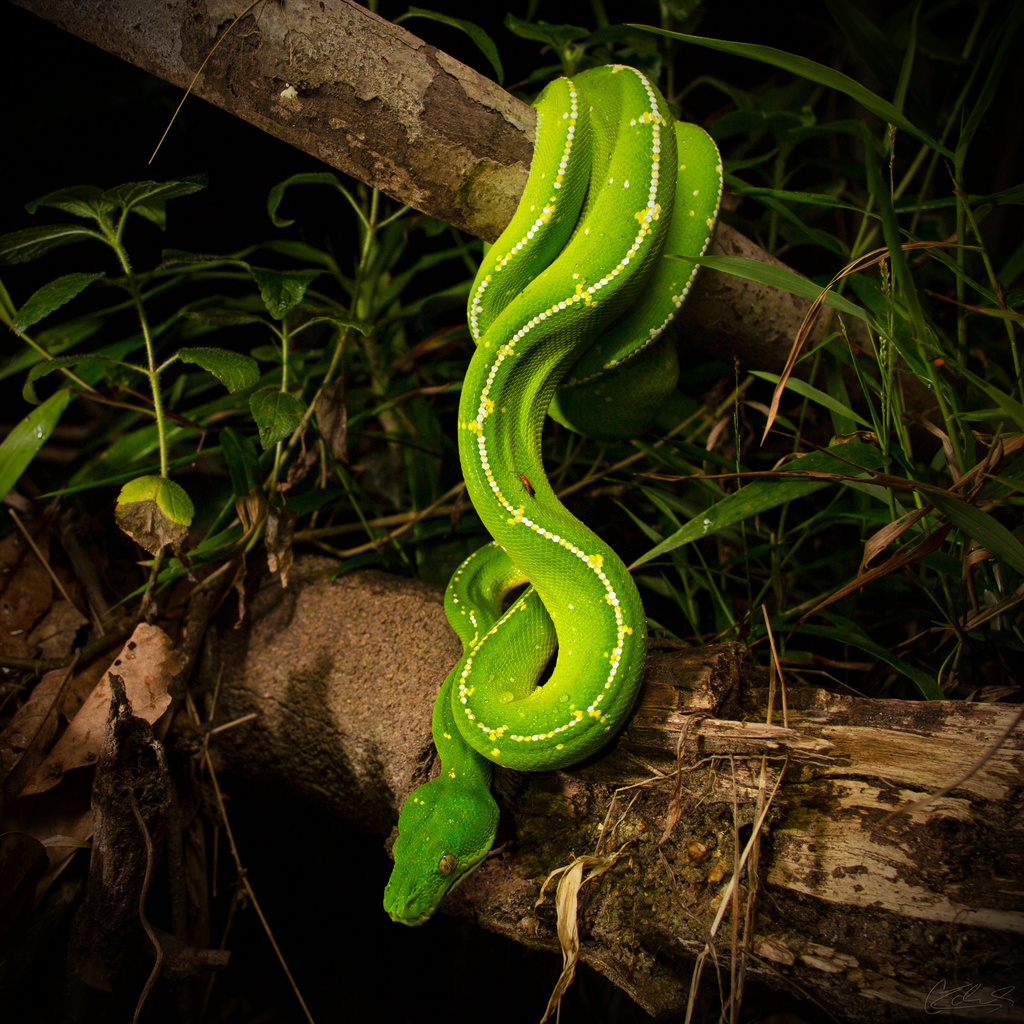
Southern Green Python
Morelia viridis
The green tree python (Morelia viridis), is a species of snake in the family Pythonidae. The species is native to New Guinea, some islands in Indonesia, and the Cape York Peninsula in Australia. First described by Hermann Schlegel in 1872, it was known for many years as Chondropython viridis. As its common name suggests, it is a bright green snake that can reach a total length (including tail) of 2 m (6.6 ft) and a weight of 1.6 kg (3.5 lb), with females slightly larger and heavier than males. Living generally in trees, the green tree python mainly hunts and eats small reptiles and mammals. It is a popular pet, and numbers in the wild have suffered with large-scale smuggling of wild-caught green tree pythons in Indonesia. Despite this, the green tree python is rated as least concern on the IUCN Red List of endangered species.
From the article Green tree python on Wikipedia (CC BY-SA), quoted section by section
Description
The green tree python is characterized by a relatively slim body. The long tail accounts for about 14% of the total length. The head is large and clearly defined from the neck. The snout is large and angular. The body is triangular in cross section with a visible spine. The species usually reaches a total length (including tail) of 150–180 cm (4.9–5.9 ft), but large females may reach 200 cm (6.6 ft). The size also varies depending on the region of origin. The weight is highly dependent upon the nutritional status of the animal. Males can weigh about 1,100–1,400 g (2.4–3.1 lb), females up to 1,600 g (3.5 lb), although wild specimens are typically much lighter than this. Especially large specimens that can weigh up to 2,200 g (4.9 lb) are invariably females, which, like most snakes, are slightly larger and heavier than males.
Range & habitat
M. viridis is found in Eastern Indonesia (Misool, Salawati, Aru Islands, Schouten Islands, most of Western New Guinea), Papua New Guinea (including nearby islands from sea level to 1,800 m elevation, Normanby Island and the d'Entrecasteaux Islands) and Australia (Queensland along the east coast of the Cape York Peninsula). The type locality given is "Aroe-eilanden" (Aru Islands, Indonesia). This species is sympatric with M. spilota and the two often compete in the same ecological niche. The preferred natural habitat of M. viridis is in or near rainforests, and the species is primarily arboreal, residing in trees, shrubs, and bushes. Occasionally, it is seen on the ground.
Wikipedia: “Distribution and habitat”
What it does
Primarily arboreal, M. viridis has a particular way of resting in the branches of trees; it loops a coil or two over the branches in a saddle position and places its head in the middle of its loops. This trait is shared with the emerald tree boa (Corallus caninus) of South America. This habit, along with their similar appearance, has caused people to confuse the two species when they are seen outside their natural habitat.
Wikipedia: “Behaviour”
Where it lives
Recorded sightings
—
geo-referenced records in GBIF, from museums, herbaria and field observers.
Drag the globe to turn it. Dots are where records exist, not a range map; darker means more records.
In the stacks
Searching the stacks…
Every page naming Morelia viridis in the Biodiversity Heritage Library →
This page is assembled live from iNaturalist, GBIF, Wikipedia, the Source Library and the Internet Archive. It is not yet part of the hand-edited codex. iNaturalist taxon 1048277.