 NL·0693
Herbarium of the Nature Library
- Name
- Scopus umbretta
- Family
- Scopidae
- Native to
- Sub-Saharan Africa, Madagascar and south-western Arabia
- Habitat
- Wetland, Lakes and rivers, Savanna
On eBird ↗
Hamerkop
Live sightings near you, the range map, bar charts of when it is seen, and Macaulay Library photos and recordings.
Hamerkop
Scopus umbretta
Also calledUthekwane (Zulu) · Hamerkop (Afrikaans) · Ombrette africaine (French)
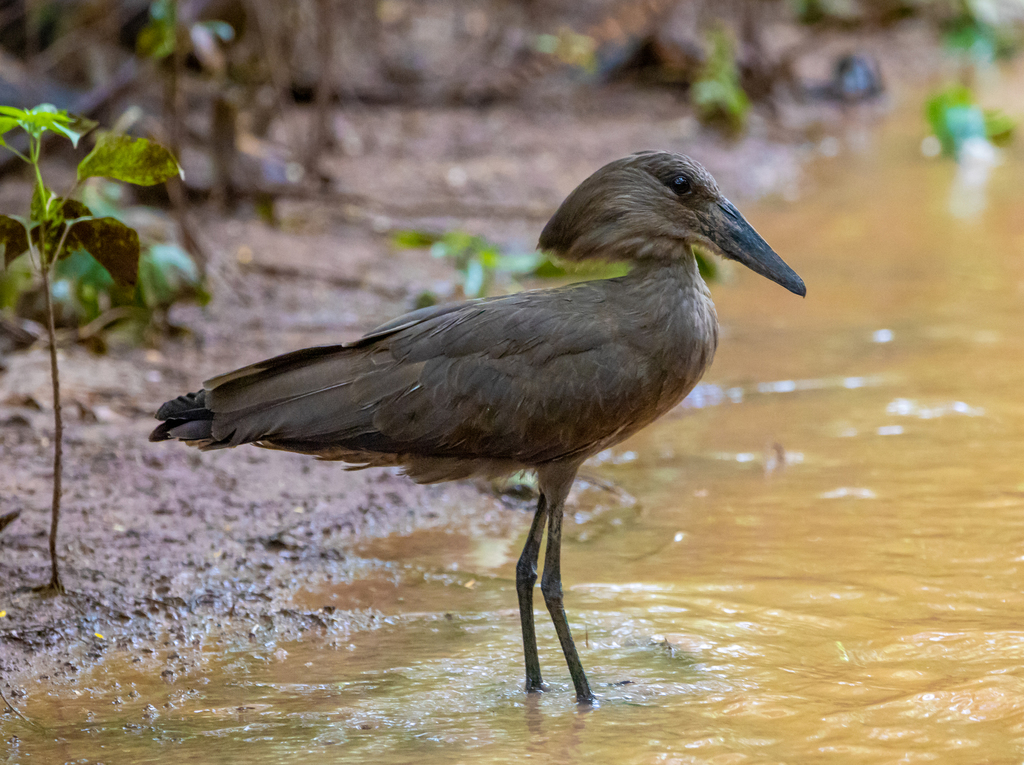
A plain brown wading bird with a hammer-shaped head and the most extravagant nest of any bird its size: a domed stick mound more than a metre across. It is the only member of its family.
The hamerkop, also called the umbrette, is a medium-sized water bird with brown plumage. It is found in mainland Africa, Madagascar and Arabia, living in a wide variety of wetlands, including estuaries, lakesides, fish ponds, riverbanks, and rocky coasts. The shape of its head, with its long bill and crest at the back, gives this species its name, hamerkop being the Afrikaans word for hammerhead. Long considered to sit with the Ciconiiformes, the species and its family is now placed with the Pelecaniformes, its closest relatives thought to be the pelicans and the shoebill. It is the only living species in the genus Scopus and the family Scopidae. Wikipedia
What it can do
- iBuilds a domed nest of thousands of sticks, plastered with mud, with a side entrance and inner chamber
- iiPairs may build several such nests a year even when not breeding
- iiiAbandoned nests are taken over by owls, genets, snakes, bees and other animals
In the field
Field marks
- aUniform dull brown plumage
- bBackward-pointing crest balancing a heavy bill, giving a hammer-head profile
- cFlattened, slightly hooked black bill
- dFairly short black legs for a wader
- eFlies with neck slightly extended, often with a buoyant, soaring flight
- Voice
- A high, nasal 'yip' or 'kek' in flight; groups give excited, rising 'yip-purrr' chorus calls.
- Not to be confused with
- Shape is unique. Distant birds may suggest a small heron or immature night heron, but no heron has the thick crest-and-bill hammer silhouette or uniform brown plumage.
- Where to see it
- Almost any African wetland with trees: Kruger, Okavango Delta, Lake Naivasha, Murchison Falls; also western Madagascar
- When
- Resident year-round
Listen
Looking for field recordings…
Life & habits
- Diet
- Mainly frogs and tadpoles, also small fish, shrimps and insects
- Habitat
- Shallow water edges of rivers, dams, pools and marshes with trees nearby
- Size
- About 56 cm long; 400–500 g
Groups perform 'false mounting' rituals, climbing on each other's backs, a behaviour not tied to mating.
Where it lives
Recorded sightings
—
geo-referenced records in GBIF, from museums, herbaria and field observers.
Native range
Sub-Saharan Africa, Madagascar and south-western Arabia
Drag the globe to turn it. Dots are where records exist, not a range map; darker means more records.
In the stacks
Searching the stacks…
Every page naming Scopus umbretta in the Biodiversity Heritage Library →
Marginalia
In much of Africa the hamerkop is a bird of omen: a Zulu and Xhosa belief warns that harming it or its nest brings lightning or misfortune, and in Madagascar it is associated with bad luck.
Curiosity
A single hamerkop nest can take months to build, contain thousands of sticks, and is reputedly strong enough to bear the weight of a person.
Kinship


Photographs: iNaturalist contributors under the licences shown. Records: GBIF.org. Historical plates: Source Library (CC BY-SA 4.0; originals public domain). Summary text: Nature Library editors and Wikipedia (CC BY-SA). Medicinal and edibility notes are historical and educational, not advice. iNaturalist taxon 3834.