On eBird ↗
Red Phalarope
Live sightings near you, the range map, bar charts of when it is seen, and Macaulay Library photos and recordings.
Red Phalarope
Phalaropus fulicarius
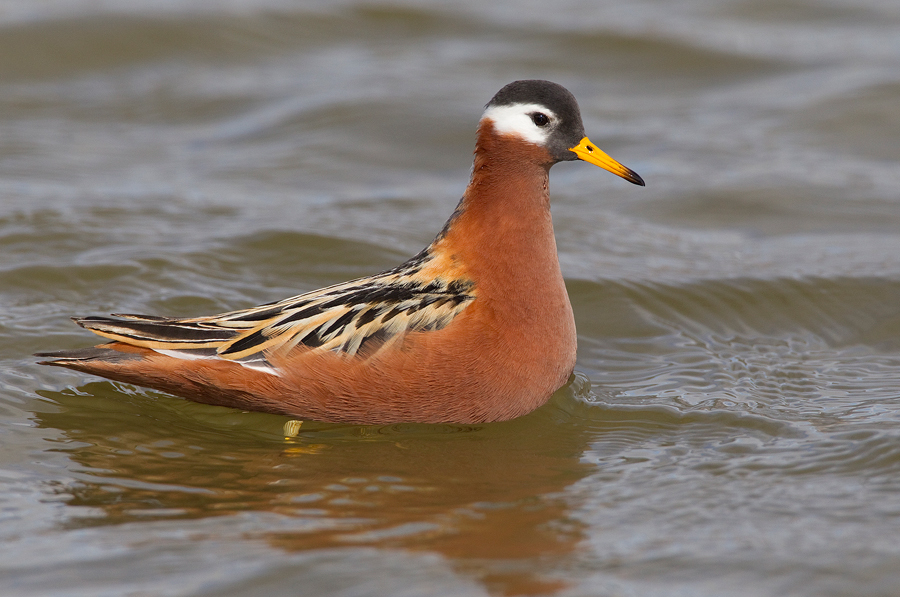
The red phalarope (called grey phalarope in Europe), Phalaropus fulicarius, is a small wader. This phalarope breeds in the Arctic regions of North America and Eurasia. It is migratory, and, unusually for a wader, migrating mainly on oceanic routes and wintering at sea on tropical oceans.
From the article Red phalarope on Wikipedia (CC BY-SA), quoted section by section
Description
The red phalarope is about 21 cm (8.3 in) in length, with lobed toes and a straight bill, somewhat thicker than that of red-necked phalarope. The breeding female is predominantly dark brown and black above, with red underparts and white cheek patches. The bill is yellow, tipped black. The breeding male is a duller version of the female. Young birds are light grey and brown above, with buff underparts and a dark patch through the eye. In winter, the plumage is essentially grey above and white below, but the black eyepatch is always present. The bill is black in winter. Their call is a short beek.
What it does
When feeding, a red phalarope will often swim in a small, rapid circle, forming a small whirlpool. This behaviour is thought to aid feeding by raising food from the bottom of shallow water. The bird will reach into the outskirts of the vortex with its bill, plucking small insects or crustaceans caught up therein. They sometimes fly up to catch insects in flight. Chicks feed mainly on Diptera, including Chironomidae, Tipulidae, Empididae, Trichoceridae and Culicidae . On the open ocean, they are found in areas where converging ocean currents produce upwellings and are often found near groups of whales. Outside of the nesting season they often travel in flocks.This species is often very tame and approachable.
Wikipedia: “Behaviour”
Listen
Looking for field recordings…
Where it lives
Recorded sightings
—
geo-referenced records in GBIF, from museums, herbaria and field observers.
Drag the globe to turn it. Dots are where records exist, not a range map; darker means more records.
In the stacks
Searching the stacks…
Every page naming Phalaropus fulicarius in the Biodiversity Heritage Library →
This page is assembled live from iNaturalist, GBIF, Wikipedia, the Source Library and the Internet Archive. It is not yet part of the hand-edited codex. iNaturalist taxon 73203.