 NL·0761
Herbarium of the Nature Library
- Name
- Troglodytes troglodytes
- Family
- Troglodytidae
- Native to
- Europe, North Africa, Turkey, the Middle East, Central Asia and the Himalaya to East Asia; American winter wrens are now separate species
- Habitat
- Temperate forest, Woodland, Gardens and parks, Coastal cliffs
On eBird ↗
Eurasian Wren
Live sightings near you, the range map, bar charts of when it is seen, and Macaulay Library photos and recordings.
Eurasian wren
Troglodytes troglodytes
Also calledÇit kuşu (Turkish) · Zaunkönig (German) · Troglodyte mignon (French) · Dryw (Welsh) · Dreoilín (Irish) · Chochín (Spanish)
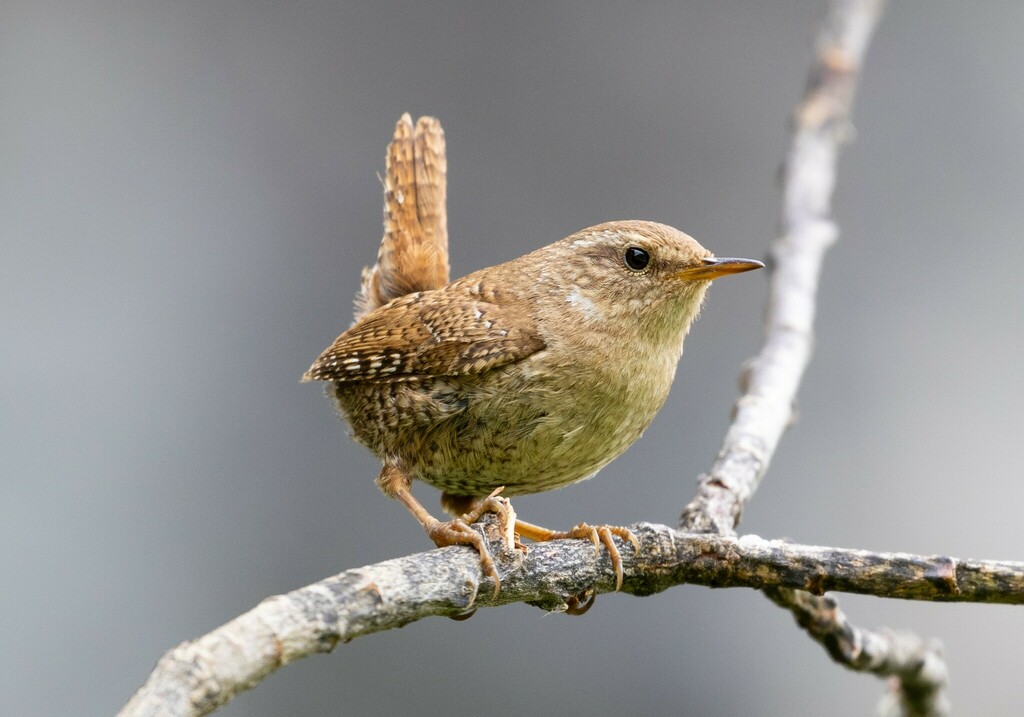
A tiny, round, cocked-tailed mouse of a bird with a voice out of all proportion to its size. It is one of the most widespread birds in Europe, from city gardens to remote sea cliffs.
The Eurasian wren is a very small insectivorous bird and the only member of the wren family found in the Old World, specifically in Eurasia and Africa (Maghreb). In Anglophone Europe, it is commonly known simply as the wren. It has a very short tail which is often held erect, a short neck and a relatively long thin bill. It is russet brown above, paler buff-brown below, overall finely barred darker, and has a cream buff supercilium. The sexes are alike. Wikipedia
What it can do
- iSong is very loud for a bird weighing about 10 g
- iiMales build several domed nests from moss and leaves, and the female chooses one to line
- iiiIn hard winters dozens may pack into a single nest box or cavity to keep warm
- ivIsolated island subspecies have evolved on St Kilda, Fair Isle and Shetland
In the field
Field marks
- aTiny, round, warm-brown body with fine dark barring
- bShort tail held cocked upright
- cPale eyebrow and thin, slightly curved bill
- dWhirring, direct flight low across gaps
- Voice
- Song an explosive, rapid outpouring of clear notes and trills lasting about five seconds; calls a hard 'tek-tek' and a dry, rattling churr.
- Not to be confused with
- Dunnock is larger with a grey head and does not cock its tail. Treecreeper climbs trunks and is white below. Goldcrest is greener with a striped crown.
- Where to see it
- Gardens, woods and hedgerows anywhere in Europe; the distinct St Kilda wren on the cliffs of Hirta.
- When
- Resident in most of Europe; northern and eastern birds move south in winter
Listen
Looking for field recordings…
Life & habits
- Diet
- Spiders and small insects gleaned from low vegetation
- Habitat
- Dense undergrowth, hedges, gardens, reedbeds, rocky coasts and moorland
- Size
- 9–10.5 cm; 7–12 g
- Lifespan
- Typically about 2 years
Creeps mouse-like through undergrowth and log piles, then bursts out to sing from a low perch with its tail cocked.
Where it lives
Recorded sightings
—
geo-referenced records in GBIF, from museums, herbaria and field observers.
Native range
Europe, North Africa, Turkey, the Middle East, Central Asia and the Himalaya to East Asia; American winter wrens are now separate species
Drag the globe to turn it. Dots are where records exist, not a range map; darker means more records.
In the old herbals & bestiaries
Woodcuts and engravings matched from the Source Library’s scanned books by name. Plates marked “relative” show a close kin rather than this exact species. Click a plate to read the page it came from, with translation.

In the stacks
Searching the stacks…
Every page naming Troglodytes troglodytes in the Biodiversity Heritage Library →
Marginalia
Aesop's fable tells how the wren became 'king of the birds' by riding on the eagle's back and flying highest, and on St Stephen's Day (26 December) Irish 'wrenboys' traditionally paraded a wren from door to door.
Curiosity
The wren appeared on the reverse of the British farthing from 1937 until the coin was withdrawn in 1960.
Kinship





Photographs: iNaturalist contributors under the licences shown. Records: GBIF.org. Historical plates: Source Library (CC BY-SA 4.0; originals public domain). Summary text: Nature Library editors and Wikipedia (CC BY-SA). Medicinal and edibility notes are historical and educational, not advice. iNaturalist taxon 145363.