- Plants
- ›Vascular Plants
- ›Ferns
- ›Leptosporangiate Ferns
- ›Polypod Ferns
- ›eupolypods I
- ›shieldfern family
- ›Dryopteridoideae
- ›Dryopteris
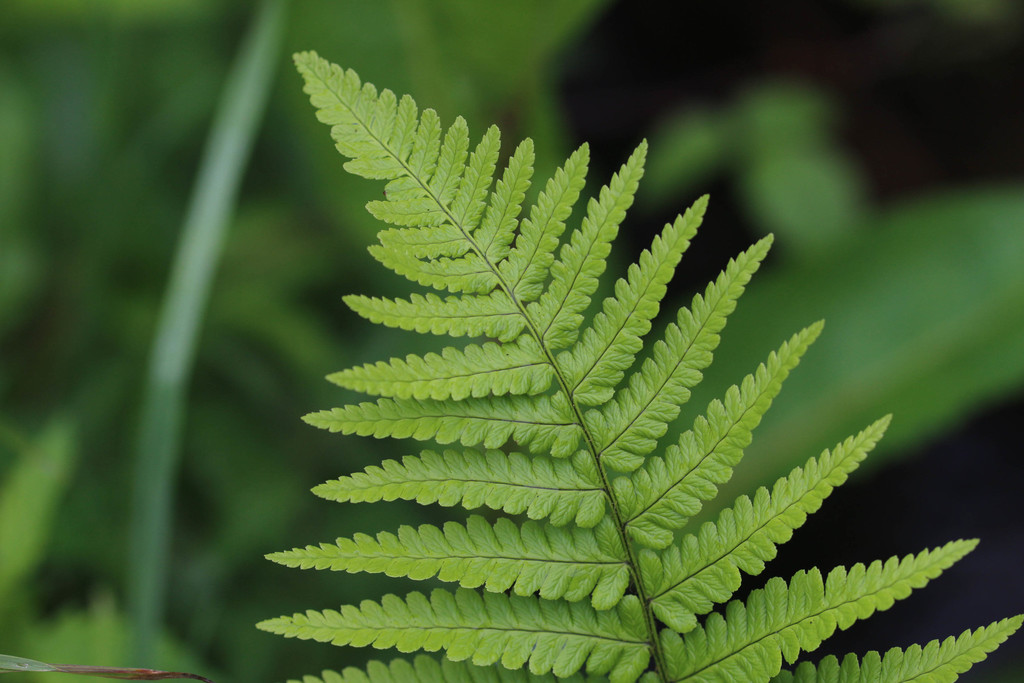
male fern
Dryopteris filix-mas
Dryopteris filix-mas, the male fern, is a common fern of the temperate Northern Hemisphere, native to much of Europe, Asia, and North America. It favours damp shaded areas in the understory of woodlands, but also shady places on hedge-banks, and rocks, and screes. Near the northern limit of its distribution it prefers sunny, well-drained sites. It is much less abundant in North America than in Europe.
From the article Dryopteris filix-mas on Wikipedia (CC BY-SA), quoted section by section
Description
The semi-evergreen leaves have an upright habit and reach a maximum length of 150 cm (59 in), with a single crown on each rootstock. The bipinnate leaves consist of 20–35 pinnae on each side of the rachis. The leaves taper at both ends, with the basal pinnae about half the length of the middle pinnae. The pinules are rather blunt and equally lobed all around. The stalks are covered with orange-brown scales. On the abaxial surface of the mature blade five or six sori develop in two rows. When the spores ripen in August to November, the indusium starts to shrivel, leading to the release of the spores. This species hybridises easily with Dryopteris affinis (scaly male fern) and Dryopteris oreades (mountain male fern).
At the table
Numerous cultivars have been selected for garden use. The following have gained the Royal Horticultural Society's Award of Garden Merit:
D. filix-mas 'Crispa Cristata' 'Cristata' 'Grandiceps Wills' 'Linearis Polydactyla'
Wikipedia: “Cultivation and uses”
Toxicity
The rhizomes of D. filix-mas are toxic. Doses too big can cause serious poisoning, blindness and even death.
In human culture
D. filix-mas is culturally named the title plant of Nurmijärvi, the municipality in Uusimaa, Finland. The reason is that the plant is related to the first Finnish pharmaceutical factory located in Nurmijärvi in 1899–1964. The pharmaceutical factory founded by the pharmacist Albin Koponen made Diphyllobothrium latum and cestoda medicines called Filisin and Filicon, the raw material of which was the rhizome of D. filix-mas. The rhizomes were still collected in the locality in the 1960s. The medicine was also used to treat liver fluke in sheep in Finland.
Wikipedia: “Culture”
Where it lives
Recorded sightings
—
geo-referenced records in GBIF, from museums, herbaria and field observers.
Drag the globe to turn it. Dots are where records exist, not a range map; darker means more records.
In the old herbals & bestiaries

De medicinali materia libri sex
Dioscorides · 1552 · p.669

Commentaries on the Six Books of Pedanius Dioscorides on Medical Matter
Pietro Andrea Mattioli · 1565 · p.1462

Notable Commentaries on the History of Plants
Leonhart Fuchs · 1549 · p.627

Notable Commentaries on the History of Plants
Leonhart Fuchs · 1549 · p.628

Commentaries on the Six Books of Dioscorides
Pietro Andrea Mattioli · 1560 · p.811

Commentaries on the Six Books of Dioscorides on Medical Matter
Pietro Andrea Mattioli · 1563 · p.726

Commentaries on the Six Books of Dioscorides on Medical Matter
Pietro Andrea Mattioli · 1563 · p.726

Commentaries on the Six Books of Pedanius Dioscorides on Medical Matter
Pietro Andrea Mattioli · 1565 · p.1463

Discourses on the Six Books of Dioscorides
Dioscorides; Pietro Andrea Mattioli (comm.) · 1568 · p.1534

Discourses on the Six Books of Dioscorides
Dioscorides; Pietro Andrea Mattioli (comm.) · 1568 · p.1535

A New Herbal, or History of Plants
Rembert Dodoens (trans. Henry Lyte) · 1578 · p.426

A New Herbal, or History of Plants
Rembert Dodoens (trans. Henry Lyte) · 1578 · p.426
In the stacks
Searching the stacks…
Every page naming Dryopteris filix-mas in the Biodiversity Heritage Library →
This page is assembled live from iNaturalist, GBIF, Wikipedia, the Source Library and the Internet Archive. It is not yet part of the hand-edited codex. iNaturalist taxon 76721.