- Plants
- ›Vascular Plants
- ›Ferns
- ›Leptosporangiate Ferns
- ›Polypod Ferns
- ›Pteridineae
- ›brake family
- ›Pteridoideae
- ›Pteris
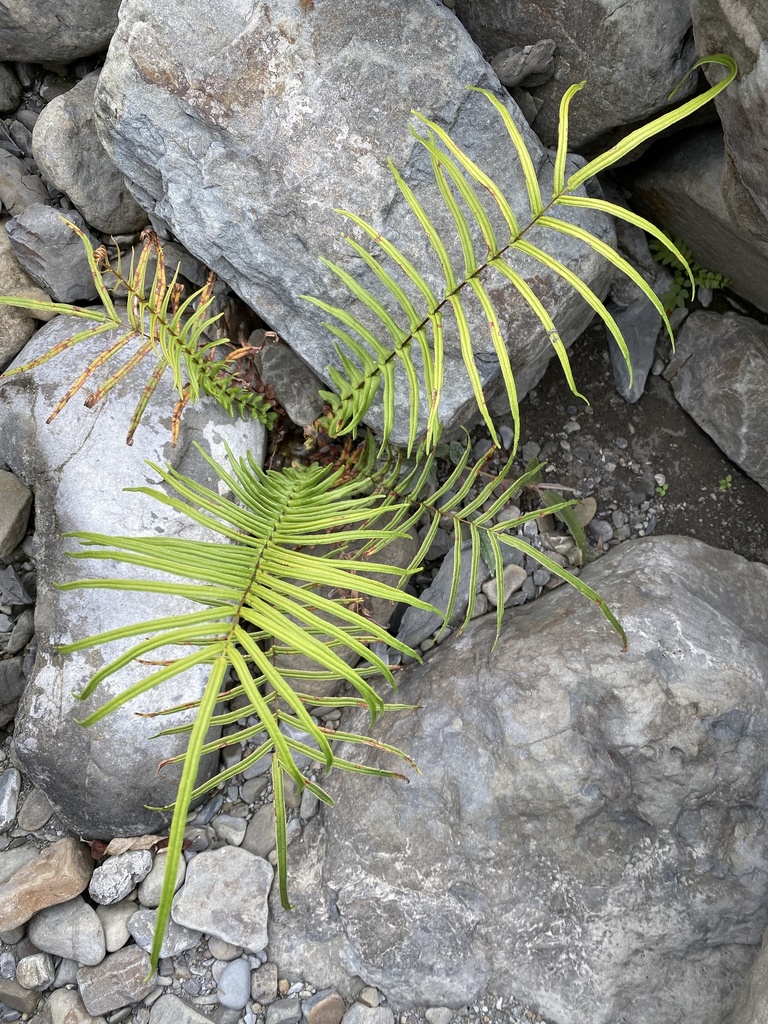
Ladder brake
Pteris vittata
Pteris vittata, the Chinese brake, Chinese ladder brake, or simply ladder brake, is a fern species in the Pteridoideae subfamily of the Pteridaceae. In the Ghanaian Akan dialect, it is called "Ayan". It is indigenous to Asia, southern Europe, tropical Africa (West and South Africa), and Australia. The type specimen was collected in China by Pehr Osbeck.
From the article Pteris vittata on Wikipedia (CC BY-SA), quoted section by section
Range & habitat
Pteris vittata is native and widespread in the paleotropics: found from the west(in Ghana; Togo; Cote D'Ivoire; Benin), east, to the south tropical, and southern Africa (in Angola; Kenya; Lesotho; Malawi; Mozambique; Namibia; Tanzania (including the Zanzibar Archipelago); Cape Province, Free State, KwaZulu-Natal, and Transvaal in South Africa; Eswatini; Uganda; Zambia; and Zimbabwe); temperate and tropical Asia (in the provinces of Anhui, Gansu, Guangdong, Guangxi, Guizhou, Hubei, Jiangxi, Sichuan, Xizang, and Yunnan in China; the prefectures of Honshu, Kyushu, Shikoku, and the Ryukyu Islands of Japan; and Thailand); and Australia, in the states of New South Wales, Queensland, Victoria, and Western Australia. Pteris vittata is often associated with limestone habitats. It may be seen growing on concrete structures and cracks, in buildings in the central business district and suburbs of Sydney. It is an introduced species in California, Texas, and the Southeastern United States. A remnant population exists in the Italian peninsula, in Sicily, Calabria and Campania.
Wikipedia: “Habitat and distribution”
At the table
Although it grows readily in the wild, Pteris vittata is sometimes cultivated. It is grown in gardens for its attractive appearance, or used in pollution control schemes: it is known to be a hyperaccumulator plant of arsenic used in phytoremediation.
Wikipedia: “Uses”
Where it lives
Recorded sightings
—
geo-referenced records in GBIF, from museums, herbaria and field observers.
Drag the globe to turn it. Dots are where records exist, not a range map; darker means more records.
In the stacks
Searching the stacks…
Every page naming Pteris vittata in the Biodiversity Heritage Library →
This page is assembled live from iNaturalist, GBIF, Wikipedia, the Source Library and the Internet Archive. It is not yet part of the hand-edited codex. iNaturalist taxon 57636.