- Plants
- ›Vascular Plants
- ›flowering plants
- ›Dicots
- ›Legumes, Milkworts, and Allies
- ›Legumes
- ›Peacock Flower Subfamily
- ›Cassieae
- ›Ceratonia
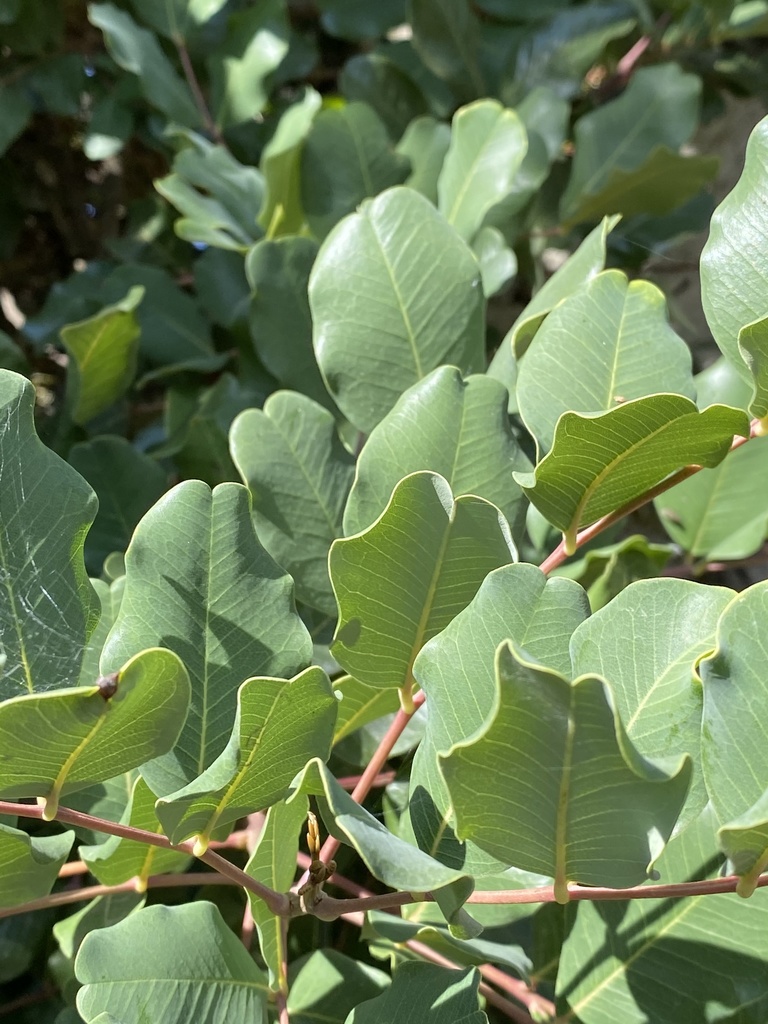
carob tree
Ceratonia siliqua
The carob ( KARR-əb; Ceratonia siliqua) is a flowering evergreen tree or shrub in the Caesalpinioideae subfamily of the legume family, Fabaceae. The carob tree is native to the Mediterranean region and the Middle East. It is widely cultivated for its edible fruit, which takes the form of seed pods, and as an ornamental tree in gardens and landscapes. Spain is its largest producer, followed by Italy and Morocco.
Carob pods have a number of culinary applications, including a powder or chips that can be used as a chocolate alternative. The seeds are used to produce locust bean gum or carob gum, a common thickening agent used in food processing.
From the article Carob on Wikipedia (CC BY-SA), quoted section by section
Description
The carob tree grows up to 15 metres (50 feet) tall. The crown is broad and semispherical, supported by a thick trunk with rough brown bark and sturdy branches. Its leaves are 10 to 20 centimetres (4 to 8 inches) long, alternate, pinnate, and may or may not have a terminal leaflet. It is frost-tolerant to roughly −7 °C (19 °F). Most carob trees are dioecious, so strictly male trees do not produce fruit, but some are hermaphroditic. When the trees blossom in autumn, the flowers are small and numerous, spirally arranged along the inflorescence axis in catkin-like racemes borne on spurs from old wood and even on the trunk (cauliflory); they are pollinated by both wind and insects. The male flowers smell like human semen, an odor that is caused in part by amines. The fruit is a legume (also known commonly, but less accurately, as a pod), that is elongated, compressed, straight, or curved, and thickened at the sutures. The pods take a full year to develop and ripen. When the sweet, ripe pods eventually fall to the ground, they are eaten by various mammals, such as swine, thereby dispersing the hard inner seed in the excrement. The seeds of the carob tree contain leucodelphinidin, a colourless flavanol precursor related to leucoanthocyanidins.
Range & habitat
The carob tree is native to the Mediterranean region and the Middle East. Although cultivated extensively, carob can still be found growing wild in eastern Mediterranean regions, and has become naturalized in the western Mediterranean.
The tree is typical in the southern Portugal region of the Algarve, where the tree is called alfarrobeira, and the fruit alfarroba. It is also seen in southern and eastern Spain (Spanish: algarrobo, algarroba, Catalan / Valencian / Balearic: garrofer, garrofera, garrover, garrovera), mainly in the regions of Andalusia, Murcia, Valencia, the Balearic Islands and Catalonia (Catalan / Valencian / Balearic: garrofer, garrofera, garrover, garrovera); Malta (Maltese: ħarruba), on the Italian islands of Sicily (Sicilian: carrua) and Sardinia (Sardinian: carrubba, carruba), in southern Croatia (Croatian: rogač), such as on the island of Šipan, in eastern Bulgaria (Bulgarian: рожков) and in southern Greece, Cyprus, as well as on many Greek islands such as Crete and Samos. The common Greek name is χαρουπιά (translit. charoupiá), or ξυλοκερατιά (translit. xylokeratiá, meaning "wooden horn"). In Turkey, it is known as "goat's horn" (Turkish: keçiboynuzu). In Israel, the Hebrew name is חרוב (translit. …
Wikipedia: “Distribution and habitat”
What it does
The carob genus, Ceratonia, belongs to the legume family, Fabaceae, and is believed to be an archaic remnant of a part of this family now generally considered extinct. It grows well in warm temperate and subtropical areas, and tolerates hot and humid coastal areas. As a xerophyte (drought-resistant species), carob is well adapted to the conditions of the Mediterranean region with just 250 to 500 millimetres (10 to 20 in) of rainfall per year. Carob trees can survive long periods of drought, but in order to grow fruit they need 500 to 550 millimetres (20 to 22 in) of rainfall per year. They prefer well-drained, sandy loams and are intolerant of waterlogging, but the deep root systems can adapt to a wide variety of soil conditions and are fairly salt-tolerant (up to 3% in soil). After being irrigated with saline water in the summer, carob trees could possibly recover during winter rainfalls. In some experiments, young carob trees were capable of basic physiological functions under high-salt conditions (40 mmol NaCl/L). Not all legume species can develop a symbiotic relationship with rhizobia to make use of atmospheric nitrogen. …
Wikipedia: “Ecology”
At the table
Carob products consumed by humans come from the dried (and sometimes roasted) pod, which has two main parts: the pulp accounts for 90% and the seeds 10% by weight. Carob pulp is sold either as flour or "chunks". The flour of the carob embryo (seed) can also be used for human and animal nutrition, but the seed is often separated before making carob powder. Carob pods are mildly sweet on their own (being roughly one third to one half sugar by dry weight), so they are used in powdered, chip or syrup form as an ingredient in cakes and cookies, sometimes as a substitute for chocolate in recipes because of the color, texture, and taste of carob. In Malta, a traditional sweet called karamelli tal-harrub and eaten during the Christian holy days of Lent and Good Friday is made from carob pods. Dried carob fruit is traditionally eaten on the Jewish holiday of Tu Bishvat. Carob pods were used as famine food in the Mediterranean Basin, including the southern Atlantic coast of Portugal and the Atlantic northwestern Moroccan coast. In rabbinic literature, carob was regarded as a low-status food. One source advises that in times of scarcity, even a single kab of carobs should not be hoarded. Other rabbinic texts refer to carob as suitable for animal feed.
Carob powder. Carob powder (carob pulp flour) is made of dried or roasted, then finely ground, carob pod pulp. …
Wikipedia: “Food”
How it is grown
The vegetative propagation of carob is naturally restricted due to its low adventitious rooting potential. Therefore, grafting and air-layering may prove to be more effective methods of asexual propagation. Seeds are commonly used as the propagation medium. The sowing occurs in pot nurseries in early spring and the cooling- and drying-sensitive seedlings are then transplanted to the field in the next year after the last frost. Carob trees enter slowly into production phase. Where in areas with favorable growing conditions, the cropping starts 3–4 years after budding, with the nonbearing period requiring up to 8 years in regions with marginal soils. Full bearing of the trees occurs mostly at a tree-age of 20–25 years when the yield stabilizes. The orchards are traditionally planted in low densities of 25–45 trees per hectare (10 to 20/acre). Hermaphroditic or male trees, which produce fewer or no pods, respectively, are usually planted in lower densities in the orchards as pollenizers. Intercropping with other tree species is widely spread. Not much cultivation management is required. Only light pruning and occasional tilling to reduce weeds is necessary. Nitrogen-fertilizing of the plants has been shown to have positive impacts on yield performance. …
Wikipedia: “Cultivation”
In human culture
The word "carob" comes from Middle French carobe (modern French caroube), which borrowed it from Arabic خَرُّوبٌ (kharrūb, "locust bean pod"), Persian khirnub and Hebrew Haruv, which ultimately borrowed it perhaps from Akkadian language harūb- or Aramaic חרובא ḥarrūḇā. Ceratonia siliqua, the scientific name of the carob tree, derives from the Greek κερατωνία keratōnía, "carob-tree" (cf. κέρας kéras, "horn"), and Latin siliqua "pod, carob". In English, it is also known as "St. John's bread" and "locust tree" (not to be confused with African locust bean). The latter designation also applies to several other trees from the same family. In Yiddish, it is called באקסער bokser, derived from the Middle High German bokshornboum "ram's horn tree" (in reference to the shape of the carob). The carat, a unit of mass for gemstones, and a measurement of purity for gold, takes its name via the Arabic qīrāṭ from the Greek name for the carob seed κεράτιον (lit. "small horn").
Wikipedia: “Etymology”
Where it lives
Recorded sightings
—
geo-referenced records in GBIF, from museums, herbaria and field observers.
Drag the globe to turn it. Dots are where records exist, not a range map; darker means more records.
In the old herbals & bestiaries

Commentaries on the Six Books of Dioscorides
Pietro Andrea Mattioli · 1560 · p.252

Commentaries on the Six Books of Pedanius Dioscorides on Medical Matter
Pietro Andrea Mattioli · 1565 · p.413

A New Herbal, or History of Plants
Rembert Dodoens (trans. Henry Lyte) · 1578 · p.764

Six Groups of the History of Plants
Rembert Dodoens · 1583 · p.796
In the stacks
Searching the stacks…
Every page naming Ceratonia siliqua in the Biodiversity Heritage Library →
This page is assembled live from iNaturalist, GBIF, Wikipedia, the Source Library and the Internet Archive. It is not yet part of the hand-edited codex. iNaturalist taxon 82742.