- Plants
- ›Vascular Plants
- ›flowering plants
- ›Dicots
- ›Legumes, Milkworts, and Allies
- ›Legumes
- ›Acacias, Mimosas, Mesquites, and Allies
- ›Faidherbia
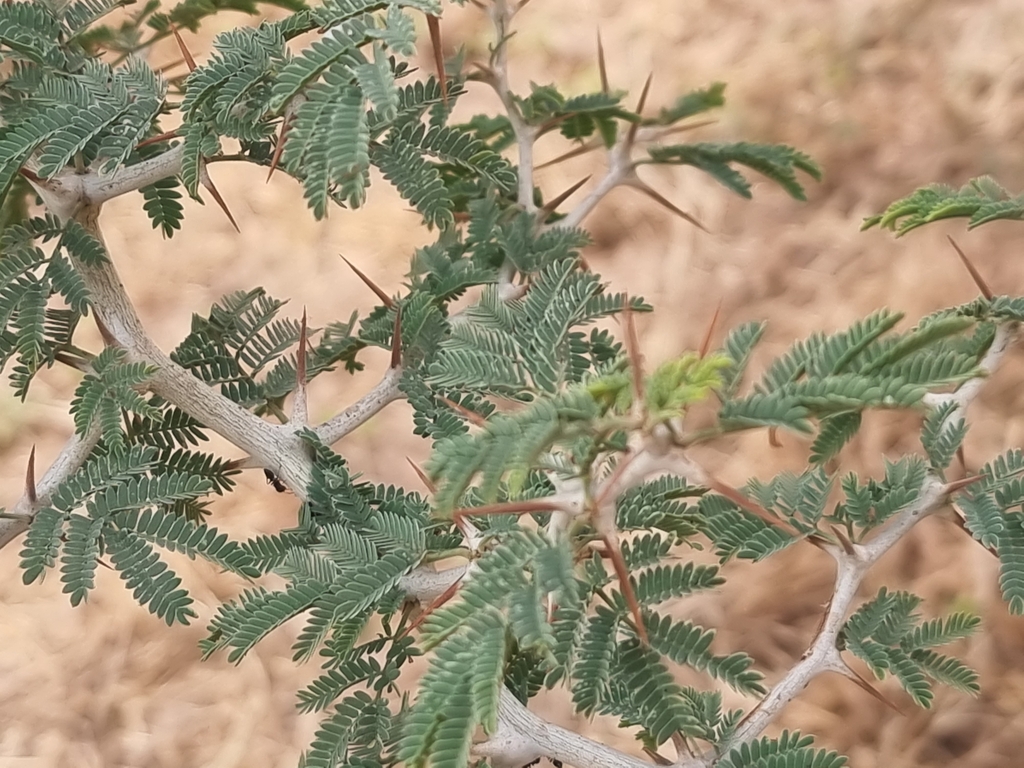
Ana tree
Faidherbia albida
Faidherbia is a genus of fabaceous plants containing one species, Faidherbia albida, which was formerly widely included in the genus Acacia as Acacia albida. The species is native to Africa and the Middle East and has also been introduced to Pakistan and India. Common names include apple-ring acacia (their circular, indehiscent seed pods resemble apple rings), white acacia, and winter thorn. The South African name is ana tree.
From the article Faidherbia on Wikipedia (CC BY-SA), quoted section by section
Description
Faidherbia is a thorny tree growing up to 6–30 m (20–98 ft) tall and up to 2 m (6+1⁄2 ft) in trunk diameter. Its deep-penetrating tap root makes it highly resistant to drought. The bark is grey, and fissured when old.
Range & habitat
In Southern Africa, it is absent from most of the territory, avoiding dry, colder and upland areas or areas of winter rainfall, but it does occur in the eastern Caprivi Strip, the northern Okavango basin, the floodplains of the Linyanti, Zambezi and Limpopo rivers, as well as southwards to Gaborone. In Zimbabwe, the tree is absent from the highlands and central plateau, but it does occur in Gonarezhou and southwards to the Kruger Park and adjacent lowveld of western Gaza and southern Maputo provinces. It reaches its southern limit along the Pongola floodplain in Maputaland. In western Namibia, it is present in the Kaokoveld, Damaraland, and the Namib-Naukluft area. In the rest of Africa, it is absent from deserts, areas of high rainfall, tropical rainforests and mountainous areas, but occurs throughout the eastern half of the continent from the southern coast in Maputaland to Egypt, throughout the Subsaharan Sahel and the Horn of Africa. In Northern Africa, besides in Egypt it also occurs in Algeria, it does not occur in Morocco proper, but is found in Western Sahara. In Asia, it is thought to be native to Yemen and Saudi Arabia in the Arabian Peninsula, Iran, and in the Levant in Israel, Syria and Lebanon. …
Wikipedia: “Distribution”
What it does
In Southern Africa, it usually grows on alluvial floodplains in bushveld, on riverbanks or flood pans, in swamps, or in dry watercourses that can flood during rains. It grows in woodland in the Sahel, along the Zambezi, and in Sudan. In the Sahel, it grows gregariously in groves. It also grows in savannahs in Sudan and the Sahel, in heavy soils with good drainage. In tropical eastern Africa, it sometimes occurs singly, but may often be the dominant species in dry woodlands. In the Sahel, it has an irregular, clumped distribution, absent in some areas, but occurring in others. It grows in areas with 250–600 mm (10–23+1⁄2 in) of rain per year.
Wikipedia: “Ecology”
At the table
Faidherbia albida is important in the Sahel for raising bees, since its flowers provide bee forage at the close of the rainy season, when most other local plants do not.
The seed pods are used for raising livestock, are used as camel fodder in Nigeria, and are eaten by stock and game in Southern Africa. They are relished by elephant, antelope, buffalo, baboons and various browsers and grazers, though strangely ignored by warthogs and zebras. The wood is used for canoes, mortars and pestles, while the bark is pounded in Nigeria and used as a packing material on pack animals. The wood has a density of about 560 kg/m3 at a water content of 12%. The energy value of the wood as fuel is 19.741 kJ/kg. Ashes of the wood are used in making soap and as a depilatory and tanning agent for hides. The wood is used for carving and the thorny branches useful for a natural barbed fence. Pods and foliage are highly regarded as livestock fodder. Some 90% of Senegalese farmers interviewed by Felker (1981) collected, stored, and rationed Acacia albida pods to livestock. Zimbabweans use the pods to sedate fish. Humans eat the boiled seeds in times of food scarcity in Zimbabwe.
It is valued in agroforestry as it fixes nitrogen, and a high yield has been achieved in at least one test plot of maize crops grown amongst the trees at a density of 100 to 25 tree per hectare. …
Wikipedia: “Uses”
In human culture
Faidherbia albida is known in the Bambara language as balanzan, and is the official tree of the city of Segou on the Niger River in central Mali. According to legend, Segou is home to 4,444 balanzan trees, plus one mysterious "missing tree" – the location of which cannot be identified. In Serer and some of the Cangin languages, it is called Saas. Saas figures prominently in the creation myth of the Serer people. According to the myth, it is the tree of life and fertility.
Wikipedia: “Cultural significance”
Where it lives
Recorded sightings
—
geo-referenced records in GBIF, from museums, herbaria and field observers.
Drag the globe to turn it. Dots are where records exist, not a range map; darker means more records.
In the old herbals & bestiaries

Itinerary: Voyage to the East or Portuguese Indies
Jan Huyghen van Linschoten · 1596 · p.161

The Malay Archipelago: The Land of the Orang-Utan and the Bird of Paradise
Alfred Russel Wallace · 1869 · p.572

A New Herbal, or History of Plants
Rembert Dodoens (trans. Henry Lyte) · 1578 · p.730

The Plants of Egypt
Prospero Alpini · 1592 · p.77
In the stacks
Searching the stacks…
Every page naming Faidherbia albida in the Biodiversity Heritage Library →
This page is assembled live from iNaturalist, GBIF, Wikipedia, the Source Library and the Internet Archive. It is not yet part of the hand-edited codex. iNaturalist taxon 343039.