- Plants
- ›Vascular Plants
- ›flowering plants
- ›Dicots
- ›Buttercups, Poppies, and Allies
- ›buttercup family
- ›Anemones, buttercups, larkspurs and allies
- ›Caltheae
- ›Caltha
- ›Caltha
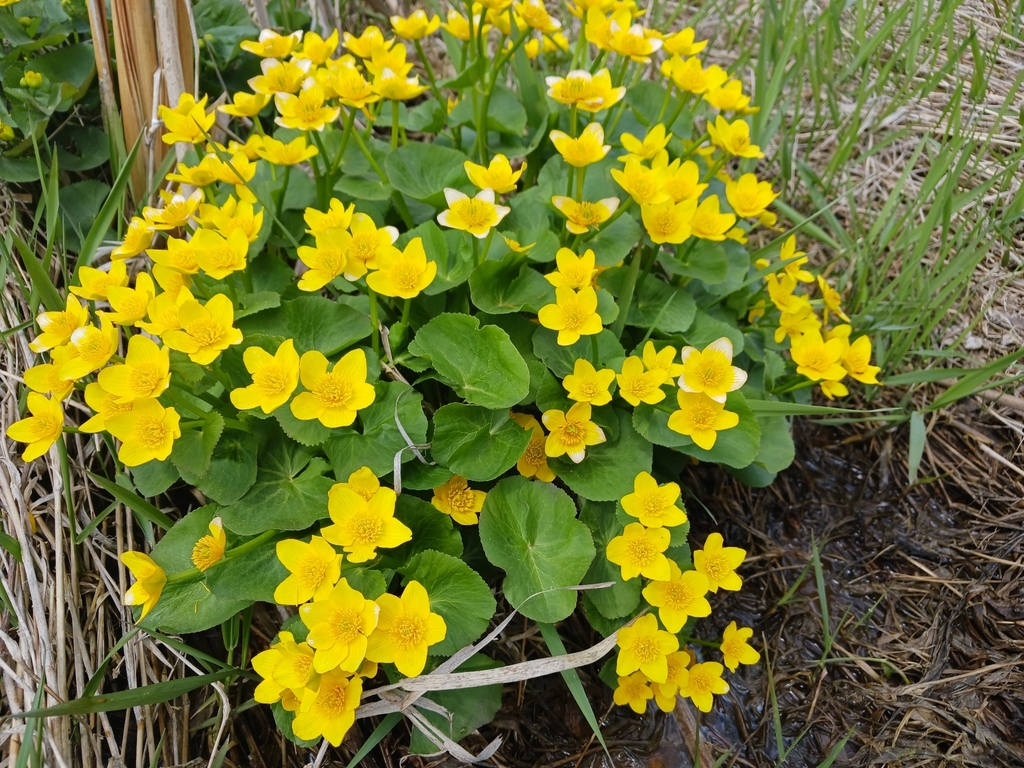
marsh marigold
Caltha palustris
Caltha palustris, known as marsh-marigold and kingcup, is a small to medium sized perennial herbaceous plant of the buttercup family, native to marshes, fens, ditches and wet woodland in temperate regions of the Northern Hemisphere. It flowers between April and August, dependent on altitude and latitude, but occasional flowers may occur at other times.
From the article Caltha palustris on Wikipedia (CC BY-SA), quoted section by section
Description
Caltha palustris is a 10–80 centimetres (4–31+1⁄2 in) high, hairless, fleshy, perennial, herbaceous plant that dies down in autumn and overwinters with buds near the surface of the marshy soil. The plants have many, 2–3 millimetres (3⁄32–1⁄8 in) thick strongly branching roots. Its flowering stems are hollow, erect or more or less decumbent. The alternate true leaves are in a rosette, each of which consist of a petiole that is about four times as long as the kidney-shaped leaf blade, which is between 3–25 cm (1+1⁄4–9+3⁄4 in) long and 3–20 cm (1+1⁄4–7+3⁄4 in) wide. The leaf possesses a heart-shaped foot, a blunt tip, and a scalloped to toothed, sometime almost entire margin particularly towards the tip. In their youth the leaves are protected by a membranous sheath, that may be up to 3 cm (1+1⁄4 in) long in fully grown plants.
Inflorescence. The common marsh-marigold mostly has several flowering stems of up to 80 cm (31 in) long, carrying mostly several seated leaflike stipules, although lower ones may be on a short petiole; and between four and six (but occasionally as few as one or as many as 25) flowers. The flowers are approximately 4 cm (1+1⁄2 in) but range between 2–5.5 cm (3⁄4–2+1⁄4 in) in diameter. …
Range & habitat
The species is native to marshes, fens, ditches and wet woodland in temperate regions of the Northern Hemisphere. It can be found in much of the northeastern United States.
Wikipedia: “Distribution and habitat”
What it does
The marsh-marigold grows in places with oxygen-rich water near the surface of the soil. It likes richer soils, but dislikes application of fertilizer and avoids high concentrations of phosphate and ammonium, and is also shy of brackish water. It is often associated with seepage that is rich in iron, because iron ions react with phosphate, thus making it unavailable for plants. The resulting insoluble mineral appears as "rusty" flocs on the water soil and the surface of the stems of marsh plants. Around the edge of lakes and rivers it grows between reeds, and it can be found in black alder coppices and other regularly flooded and always moist forests. When it is present it often visually dominates when it is in bloom. It also used to be common on wet meadows, but due to agricultural rationalization it is now limited to ditches. It is a component of purple moor grass and rush pastures – a type of Biodiversity Action Plan habitat in the UK. It occurs on poorly drained neutral and acidic soils of the lowlands and upland fringe. In western Europe, the marsh-marigold moth Micropterix calthella bites open the anthers of the marsh-marigold and other plants to eat the pollen. The caterpillars that are present in summer and autumn also feed on marsh-marigold, although these are sometimes found on mosses too. …
Wikipedia: “Ecology”
At the table
Early spring greens and buds of Caltha palustris are edible when cooked (but are poisonous when raw). Young leaves or buds should be submerged a few times in fresh boiling water until barely tender, cut into bite-sized pieces, lightly salted, and served with melted butter and vinegar. Very young flowerbuds have been prepared like capers and used as a spice. The common marsh marigold is planted as an ornamental throughout temperate regions in the world, and sometimes recommended for low maintenance wildlife gardens. The double-flowered cultivar 'Flore Pleno' has won the Royal Horticultural Society's Award of Garden Merit.
Wikipedia: “Uses”
Toxicity
Caltha contains several active substances of which the most important from a toxicological point of view is protoanemonin. Consumption of larger quantities of the plant may cause convulsions, burning of the throat, vomiting, bloody diarrhea, dizziness and fainting. Contact of the skin or mucous membranes with the juices can cause blistering or inflammation, and gastric illness if ingested. Younger parts seem to contain less toxics and heating breaks these substances down. Small amounts of Caltha in hay do not cause problems when fed to husbandry, but larger quantities lead to gastric illness. Additionally, plants that live in raw water may carry toxic organisms which can be neutralized by cooking.
In human culture
The oldest description that is generally acknowledged in the botanical literature dates from 1700 under the name Populago by Joseph Pitton de Tournefort in part 1 of his Institutiones rei herbariae. He distinguished between P. flore major, P. flore minor and P. flore plena, and already says all of these are synonymous to Caltha palustris, without mentioning any previous author. As a plant name published before 1 May 1753, Populago Tourn. is invalid. And so is the first description as Caltha palustris by Carl Linnaeus in his Genera Plantarum of 1737. But Linnaeus re-describes the species under the same name in Species Plantarum of 1 May 1753, thus providing the correct name.
Wikipedia: “Taxonomic history”
Where it lives
Recorded sightings
—
geo-referenced records in GBIF, from museums, herbaria and field observers.
Drag the globe to turn it. Dots are where records exist, not a range map; darker means more records.
In the old herbals & bestiaries

Hortus Eystettensis
Basilius Besler · 1640 · p.124

Book of Herbs
Hieronymus Bock (Tragus) · 1546 · p.144

On the Names of Plants
Hieronymus Bock (Tragus) · 1552 · p.214

History of Plants in Four Books
Valerius Cordus · 1561 · p.264

A New Herbal, or History of Plants
Rembert Dodoens (trans. Henry Lyte) · 1578 · p.56

Six Groups of the History of Plants
Rembert Dodoens · 1583 · p.609

History of Rare Plants
Carolus Clusius · 1601 · p.490

Herbarium Portatile, Oder Behendes Kräuter- und Gewächs-Buch: Darinn nicht allein 1363. so wol Einheimische als Außländndische Kräuter mit Lateinisch und Deutscher Benennung abgebildet, sondern auch die meisten, so in der Medicin gebräuchlich, kürtzlich erkläret werden
Panckow, Thomas · 1656 · p.148
In the stacks
Searching the stacks…
Every page naming Caltha palustris in the Biodiversity Heritage Library →
This page is assembled live from iNaturalist, GBIF, Wikipedia, the Source Library and the Internet Archive. It is not yet part of the hand-edited codex. iNaturalist taxon 56224.