- Plants
- ›Vascular Plants
- ›flowering plants
- ›Dicots
- ›Heathers, Balsams, Primroses, and Allies
- ›primrose family
- ›primrose subfamily
- ›Primuleae
- ›Primula
- ›Primula
- ›Primula
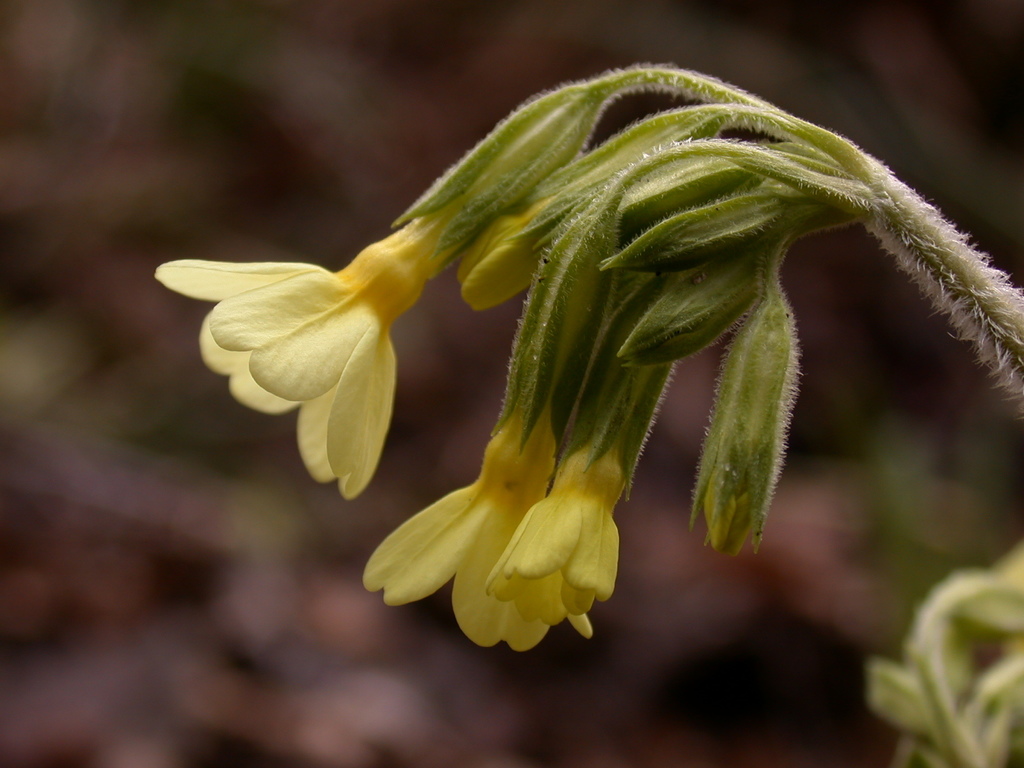
Oxlip
Primula elatior
Primula elatior, the oxlip (or true oxlip), is a species of flowering plant in the family Primulaceae, native to nutrient-poor and calcium-rich damp woods and meadows throughout Europe, with northern borders in Denmark and southern parts of Sweden, eastwards to the Altai Mountains and on the Kola Peninsula in Russia, and westwards in the British Isles.
From the article Primula elatior on Wikipedia (CC BY-SA), quoted section by section
Description
The oxlip is a herbaceous or semi-evergreen perennial plant growing to 30 cm (12 in) tall by 25 cm (10 in) broad, with a rosette of leaves 5–15 cm (2–6 in) long and 2–6 cm (0.8–2 in) broad. It produces light yellow flowers in spring, in clusters of 10-30 together on a single stem 10–30 cm (4–12 in) tall, each flower 9–15 mm (0.4–0.6 in) broad. It may be confused with the closely related cowslip (Primula veris), which has a similar general appearance, although P. veris has smaller, bell-shaped, bright yellow flowers (and red dots inside the flower), and a corolla tube without folds. The leaves of P. veris are more spade-shaped than P. elatior.
How it is grown
Primula elatior is cultivated as a garden plant. It may be used as bedding, grown from seed as a biennial, and discarded after flowering. It may be used in informal settings such as wildflower meadows. It prefers a sheltered position in full sun with moist soil. It has won the Royal Horticultural Society's Award of Garden Merit.
Wikipedia: “Cultivation”
Where it lives
Recorded sightings
—
geo-referenced records in GBIF, from museums, herbaria and field observers.
Drag the globe to turn it. Dots are where records exist, not a range map; darker means more records.
In the old herbals & bestiaries


In the stacks
Searching the stacks…
Every page naming Primula elatior in the Biodiversity Heritage Library →
This page is assembled live from iNaturalist, GBIF, Wikipedia, the Source Library and the Internet Archive. It is not yet part of the hand-edited codex. iNaturalist taxon 55840.