On eBird ↗
Gartered Violaceous Trogon
Live sightings near you, the range map, bar charts of when it is seen, and Macaulay Library photos and recordings.
Gartered Violaceous Trogon
Trogon caligatus
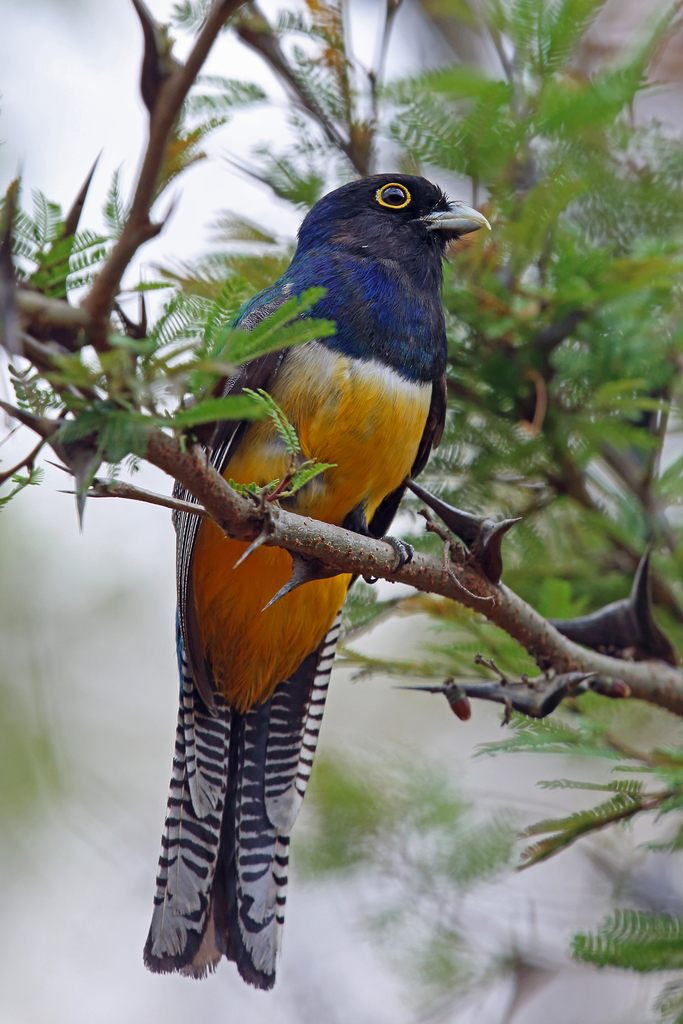
The gartered trogon (Trogon caligatus), also known as the northern violaceous trogon, is a near passerine bird in the trogon family, Trogonidae. It is found in forests in east-central Mexico, south through Central America, to north-western South America (west or north of the Andes in Colombia, Ecuador and Venezuela). It was formerly treated as a subspecies of the violaceous trogon.
From the article Gartered trogon on Wikipedia (CC BY-SA), quoted section by section
Description
Most trogons have distinctive male and female plumages, with soft, often colorful, feathers. The gartered trogon is 23 to 25 cm (9.1 to 9.8 in) long and weighs 38 to 57 g (1.3 to 2.0 oz). The nominate male's head, neck, and upper breast are a violet-blue. The face and throat are black with a pale yellow ring around the eye. A narrow white band separates the upper breast from the bright yellow lower breast and belly. The upperparts are metallic green. The tail's upperside is violet-blue with black feather tips; the underside has fine black and white bars and broad white feather tips. The wings are mostly black with some whitish inclusions. The female's head and face, upper breast, and upperparts are gray; the eyering is not complete, the belly is a duller yellow than the male's, and the underside of the tail has a different pattern of black and white. T. c. sallaei has a blackish head and upper breast and a blue nape and lower breast. Its upperparts are a yellower green than the nominate's and the upper side of the tail is green. T. c. concinnus is similar to sallaei but its upperparts and tail are bluer.
Range & habitat
T. c. sallaei is the northernmost subspecies of gartered trogon. It is found on the Caribbean slope of central Mexico and from the Caribbean and Pacific slopes of southern Mexico through Belize, Guatemala, and El Salvador into northern Honduras and possibly into Nicaragua. T. c. concinnus is found from Costa Rica through most of Panama into western Colombia, and separately from western Ecuador into northwestern Peru. The nominate T. c. caligatus is found from the Caribbean slope of Panama's Darién Province through northern Colombia into western Venezuela. It is a year round resident in Mexico but its movements elsewhere, if any, are unknown. The gartered trogon is generally a bird of semi-open landscapes such as forest edges, clearings, gallery forest, secondary forest, and shaded coffee and cacao plantations. In Mexico it is also found in denser evergreen forest and rainforest. In elevation it ranges as high as 1,400 m (4,600 ft) in Central America but is generally more common in lowlands.
Wikipedia: “Distribution and habitat”
What it does
The gartered trogon usually feeds by hovering to pick fruit and invertebrates from vegetation. It diet includes a larger amount of fruit than most other trogons but also many types of insects and other invertebrates. It sometimes joins mixed-species foraging flocks.
Wikipedia: “Feeding”
Listen
Looking for field recordings…
Where it lives
Recorded sightings
—
geo-referenced records in GBIF, from museums, herbaria and field observers.
Drag the globe to turn it. Dots are where records exist, not a range map; darker means more records.
In the stacks
Searching the stacks…
Every page naming Trogon caligatus in the Biodiversity Heritage Library →
This page is assembled live from iNaturalist, GBIF, Wikipedia, the Source Library and the Internet Archive. It is not yet part of the hand-edited codex. iNaturalist taxon 73523.