On eBird ↗
Lesser Striped Swallow
Live sightings near you, the range map, bar charts of when it is seen, and Macaulay Library photos and recordings.
Lesser Striped Swallow
Cecropis abyssinica
The lesser striped swallow (Cecropis abyssinica) is a large swallow. It breeds in Sub-Saharan Africa from Sierra Leone and southern Sudan south into eastern South Africa. It is partially migratory with South African birds wintering further north. West African birds leave the north of the breeding range in the dry season.
From the article Lesser striped swallow on Wikipedia (CC BY-SA), quoted section by section
Description
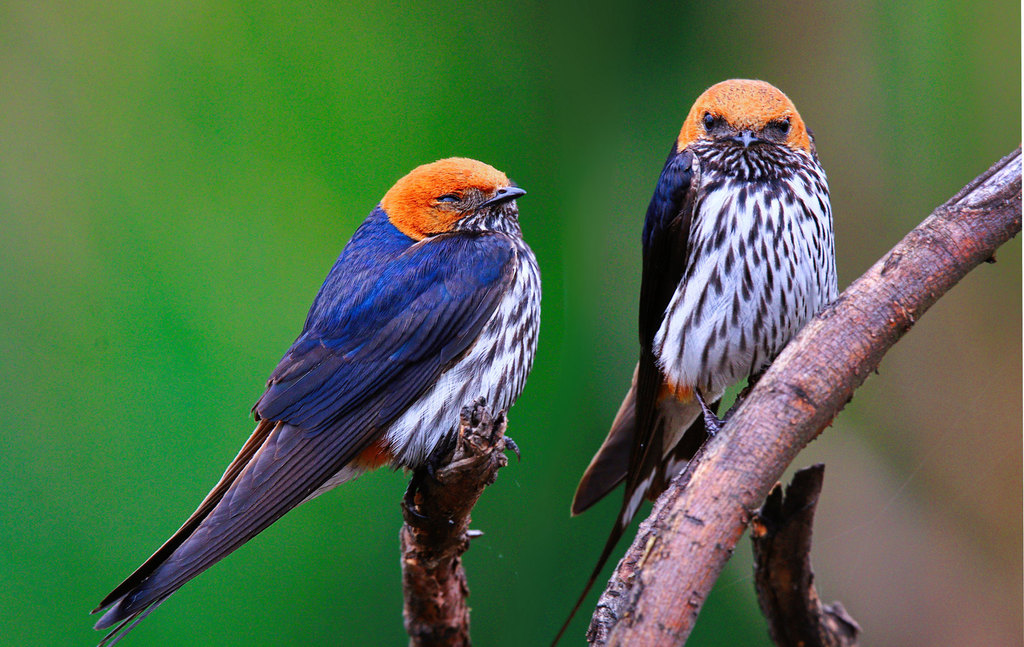
The lesser striped swallow is 15–19 cm long. It has dark blue upperparts with a red rump and a rufous-chestnut crown, nape and sides of the head. The underparts are white with dark streaking, and the upper wings and underwing flight feathers are blackish-brown. The underwing coverts are tawny. The blackish tail has very long outer feathers; these are slightly longer in the male than the female. Juveniles are duller and browner, with less contrast and shorter outer tail feathers. There are five or six subspecies differing in the extent of the underpart streaking. The lesser striped swallow has heavier and darker underparts striping, a deeper red rump, and a brighter head colour than the larger greater striped swallow.
Range & habitat
This is a bird of wooded, mainly lowland habitats. The lesser striped swallow prefers less open habitats, and is replaced in montane grassland by the greater striped swallow, Hirundo cucullata. It is common and often found around human habitation.
Wikipedia: “Habitat”
What it does
It feeds mainly on flying insects, but has been known to eat small fruits. The flight is erratic, and the call is a nasal zeh zeh zeh zeh zeh.
Breeding. The lesser striped swallow builds a bowl-shaped mud nest with a tubular entrance on the underside of a suitable structure. The nest has a soft lining, and may be reused in later years. The nest may be built in a cave, under a rock overhang or a tree branch. This species has benefited from its willingness to use buildings, bridges, culverts and similar structures. Given the choice, it will select a high nest site. The eggs are glossy white sometimes with a few brown spots; three eggs are a typical clutch. Incubation is by the female alone for 14–16 days to hatching. Both parents then feed the chicks. Fledging takes another 17–19 days, but the young birds will return to the nest to roost for a few days after their first flight.
Wikipedia: “Behavior”
Listen
Looking for field recordings…
Where it lives
Recorded sightings
—
geo-referenced records in GBIF, from museums, herbaria and field observers.
Drag the globe to turn it. Dots are where records exist, not a range map; darker means more records.
In the stacks
Searching the stacks…
Every page naming Cecropis abyssinica in the Biodiversity Heritage Library →
This page is assembled live from iNaturalist, GBIF, Wikipedia, the Source Library and the Internet Archive. It is not yet part of the hand-edited codex. iNaturalist taxon 144795.