- Plants
- ›Vascular Plants
- ›flowering plants
- ›Dicots
- ›Gentians, Dogbanes, Madders, and Allies
- ›Dogbane Family
- ›Rauvolfioideae
- ›Alyxieae
- ›Alyxiinae
- ›Alyxia
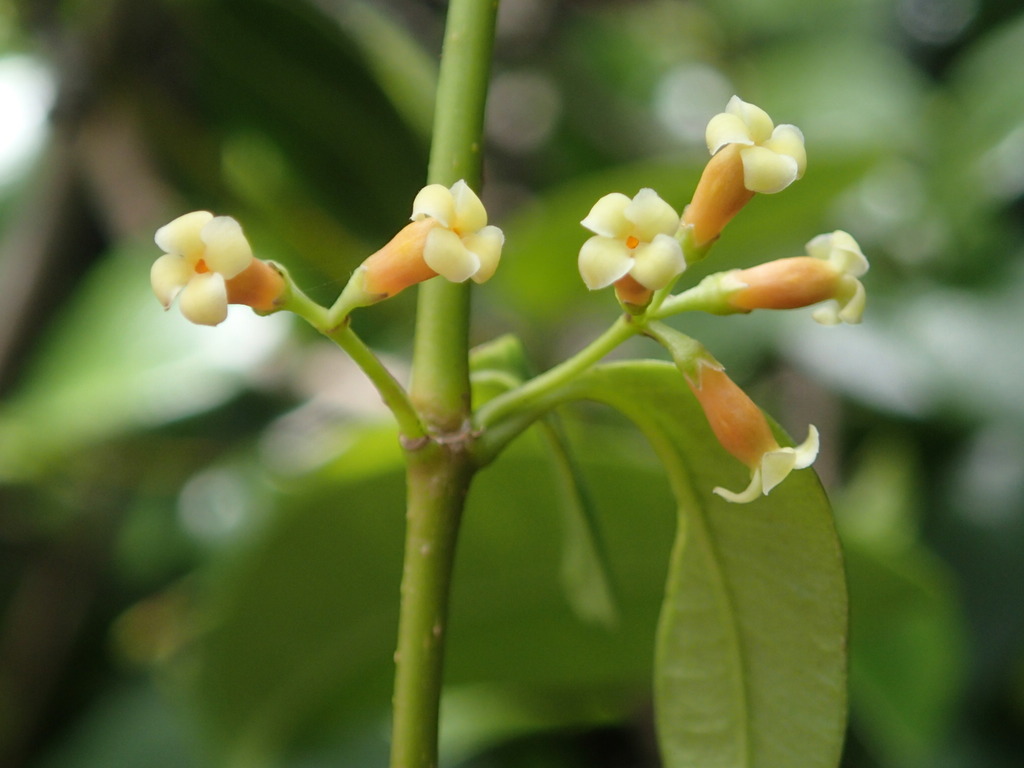
Maile
Alyxia stellata
Alyxia stellata, known as maile in Hawaiian, is a species of flowering plant in the dogbane family, Apocynaceae, that is native to the tropical Pacific from Queensland, Australia, to Hawaii, USA. It grows as either a twining liana, scandent shrub, or small erect shrub, and is one of the few vines that are endemic to the islands. The leaves are usually ternate, sometimes opposite, and can show both types on the same stem. Flowers are quite inconspicuous and have a sweet and light fragrance of honey. The bark is most fragrant and exudes a slightly sticky, milky sap when punctured, characteristic of the family Apocynaceae. The entire plant contains coumarin, a sweet-smelling compound that is also present in vanilla grass (Anthoxanthum odoratum), woodruff (Galium odoratum) and mullein (Verbascum spp.). Fruit are oval and dark purple when ripe. Maile is a morphologically variable plant and the Hawaiian names reflect this (see Ethnobotany section).
From the article Alyxia stellata on Wikipedia (CC BY-SA), quoted section by section
Range & habitat
Alyxia stellata ranges from northeastern Queensland to the tropical Pacific, including the Caroline Islands, Cook Islands, Fiji, Hawaiian Islands, Marianas, Marquesas, New Caledonia, Niue, Pitcairn Islands, Samoan Islands, Society Islands, Solomon Islands, Tonga, Tuamotu, Tubuai Islands, Vanuatu, and Wallis and Futuna. Maile can occur in most types of vegetation at elevations from 50 to 2,000 metres (200 to 6,600 ft) on all of the main Hawaiian Islands, however it is believed that both Kahoʻolawe and Niʻihau likely had populations of the species before large-scale disturbances occurred. Lowland wet forests occur from 100–1,200 m (300–3,900 ft) elevation in the Hawaiian Islands and are prime habitat for maile, receiving 150–500 cm (60–200 in) of rainfall annually. Maile is also found in montane mesic and wet communities.
Wikipedia: “Distribution and habitat”
In human culture
Mention of the maile plant occurs in various stories (moʻolelo), proverbs (ʻōlelo noʻeau), and in the song (mele) "Lei ʻAwapuhi".
Lāʻieikawai. The maile sisters are a favorite stock characters in Hawaiian romance tales. The story of Lāʻieikawai tells of five Maile sisters. Maile haʻi wale (brittle maile), Maile lau liʻi (small-leaved maile), Maile lau nui (large-leaved maile), Maile kaluhea (sweet-scented maile), and Maile pakaha (blunt-leaved maile). Kauai's maile lau liʻi is often celebrated in song and chant. The ʻōlelo noʻeau, Ka maile lau liʻi o Koʻiahi speaks of the "fine-leaved" maile of Kokeʻe, Kauaʻi which had one of the best and most fragrant maile lau liʻi in Hawaiʻi and was praised in old chants. Because maile was often placed on heiau in traditional times, the older generations of Hawaiians say that the fragrance of maile still lingers in those areas where heiau once stood or are still standing.
Puna and Panaʻewa. Several ʻōlelo noʻeau from the Hilo and Puna districts on Hawaiʻi Island paint a wonderfully fragrant picture of Puna and Panaʻewa. Ka makani hali ʻala o Puna, the fragrance-bearing wind of Puna; Lei Hanakahi i ke ʻala me ke onaona o Panaʻewa, Hanakahi is adorned with the fragrance and perfume of Panaʻewa. …
Wikipedia: “Folklore”
Where it lives
Recorded sightings
—
geo-referenced records in GBIF, from museums, herbaria and field observers.
Drag the globe to turn it. Dots are where records exist, not a range map; darker means more records.
In the old herbals & bestiaries


In the stacks
Searching the stacks…
Every page naming Alyxia stellata in the Biodiversity Heritage Library →
This page is assembled live from iNaturalist, GBIF, Wikipedia, the Source Library and the Internet Archive. It is not yet part of the hand-edited codex. iNaturalist taxon 347641.