- Plants
- ›Vascular Plants
- ›flowering plants
- ›Dicots
- ›proteas, lotuses, planes, and allies
- ›Protea family
- ›Singlet Proteas
- ›Hairiseed Proteoid Clade
- ›Protea
- ›Lasiocephalae
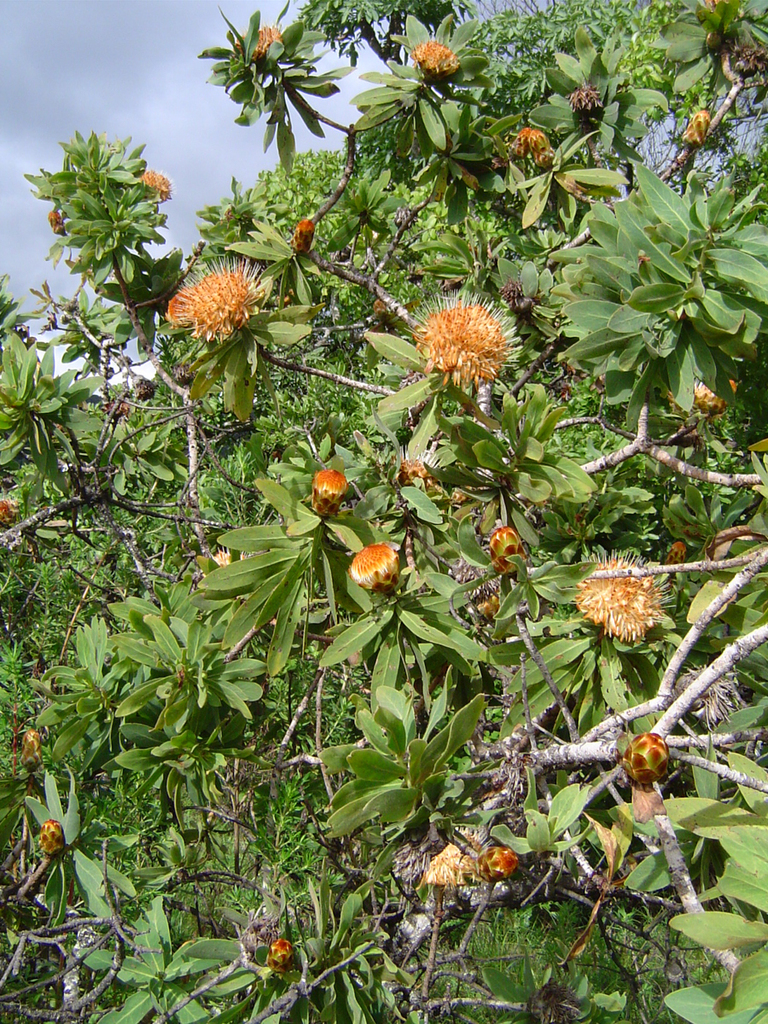
Dwarf Savanna Sugarbush
Protea welwitschii
Protea welwitschii is a species of shrub or small tree which belongs to the genus Protea, and which occurs in bushveld and different types of grassland.
Vernacular names given for this species include cluster-head protea, honey-scented protea and rusty velvet protea in southern tropical Africa, and in South Africa the dwarf savanna sugarbush, cluster-head sugarbush or the white sugar-bush. In isiZulu it is known as isiqalaba. In Afrikaans the common names of troshofiesuikerbos, kleinsuikerbos, troshofie-suikerbos, welwitsch-se-suikerbos, witsuikerbos, witsuikerboskan, and simply suikerbos, have all been recorded for this species.
From the article Protea welwitschii on Wikipedia (CC BY-SA), quoted section by section
Description
Protea welwitschii grows as a spreading, multi-stemmed shrub or small, gnarled, bushy tree. In tropical East Africa and Zambia it grows to 1–3 metres (3.3–9.8 ft), exceptionally 5 metres (16 ft), in height. On the Huíla Plateau in Angola in the 1850s Welwitsch measured it as growing to 12–20 feet (3.7–6.1 m). Plants growing in dambo in Zambia can have a strange suffrutex form, growing a number of erect, unbranched, annual or short-lived, 1 metre (3.3 ft) stems from ground level. In its shrub form it may have an underground bole or root-stock, from which the branches arise. The trunk grows to 30 centimetres (12 in) in diameter at the base. It is gnarled, and covered in an irregularly fissured, brown-black bark. The young stems are covered in a brown, tomentose fuzz. The leaves are elliptic to oblanceolate in shape, bluish-green in colour, and up to 12 by 9.5 cm in size. Young leaves are densely covered with velvety white or brown hairs, usually becoming hairless when mature, except for at their base. The flower heads are terminal at the end of branches, and usually grouped in clusters of two, or three or four, and are up to 6 cm in diameter. The bracts encircling the inflorescence are coloured white to pale cream according to one source, or pale yellowish to brown according to another, and are covered in silky hairs. The bracts can also be pink, although this is uncommon. …
Range & habitat
The species is widely distributed in the southeastern third of Africa south of the Sahara. It does not occur in the Sahel of West Africa. Countries it occurs in include Rwanda, Burundi, Uganda, Tanzania, the Democratic Republic of Congo, Zambia, Angola, Zimbabwe, Malawi, Mozambique, Lesotho and South Africa. In Zambia it has been recorded in the provinces of Western, Copperbelt, Central, Luapula, Northern, Muchinga and Lusaka. Welwitsch was only able to find the species on the Huíla Plateau during his eight years collecting botanical specimens in Angola. In Mozambique it occurs in the provinces of Manica, Niassa, Sofala and Zambezia. On the slopes below Mount Dombe in the Chimanimani Mountains it can be common in the steep grasslands just above the miombo treeline. In South Africa it occurs in the highlands across the east and northeast of the country, and can be found in Gauteng, KwaZulu-Natal, Limpopo, Mpumalanga and North West Province.
Wikipedia: “Distribution”
What it does
It occurs in various habitats, such as bushveld, thornveld, sourveld, wooded slopes, rocky hillsides, miombo and ericaceous fynbos. In East Africa it usually is found in montane grassland at 1,800 to 2,900 metres (5,900 to 9,500 ft) in altitude. In central and southeastern tropical Africa it may also occur in other grasslands such as low altitude dambos or other wet grassy places to 1,220 metres (4,000 ft) in altitude, as well as occasionally in wooded grassland, rocky grassland or normal grasslands at 1,500 to 2,400 metres (4,900 to 7,900 ft) in altitude. In South Africa it has been recorded as occurring at 300 to 2,000 metres (980 to 6,560 ft); while it primarily occurs in various types of mountainous bushveld and grassland, in some eastern areas it is found in grassland near the coast. It has been recorded at 1,390 to 1,500 metres (4,560 to 4,920 ft) in Mozambique. It is often found in rocky places. It will grow on steep slopes. It has been found growing in quartzite sandstone-derived soils in Mozambique. In South Africa it has been recorded from soils derived from dolomite, sandstone, shale or andesite, as well as in sandy soils. In areas of Zambia it can tolerate levels of copper and nickel in the soil which are toxic to most trees or shrubs. It blooms in the Summer to Autumn. …
Wikipedia: “Ecology”
In human culture
Clearly, the specific epithet commemorates the plants' discoverer, Friedrich Martin Welwitsch.
Wikipedia: “Etymology”
Where it lives
Recorded sightings
—
geo-referenced records in GBIF, from museums, herbaria and field observers.
Drag the globe to turn it. Dots are where records exist, not a range map; darker means more records.
In the stacks
Searching the stacks…
Every page naming Protea welwitschii in the Biodiversity Heritage Library →
This page is assembled live from iNaturalist, GBIF, Wikipedia, the Source Library and the Internet Archive. It is not yet part of the hand-edited codex. iNaturalist taxon 592547.