- Plants
- ›Vascular Plants
- ›Ferns
- ›Leptosporangiate Ferns
- ›Tree Ferns and Allies
- ›hairy tree ferns
- ›Dicksonia
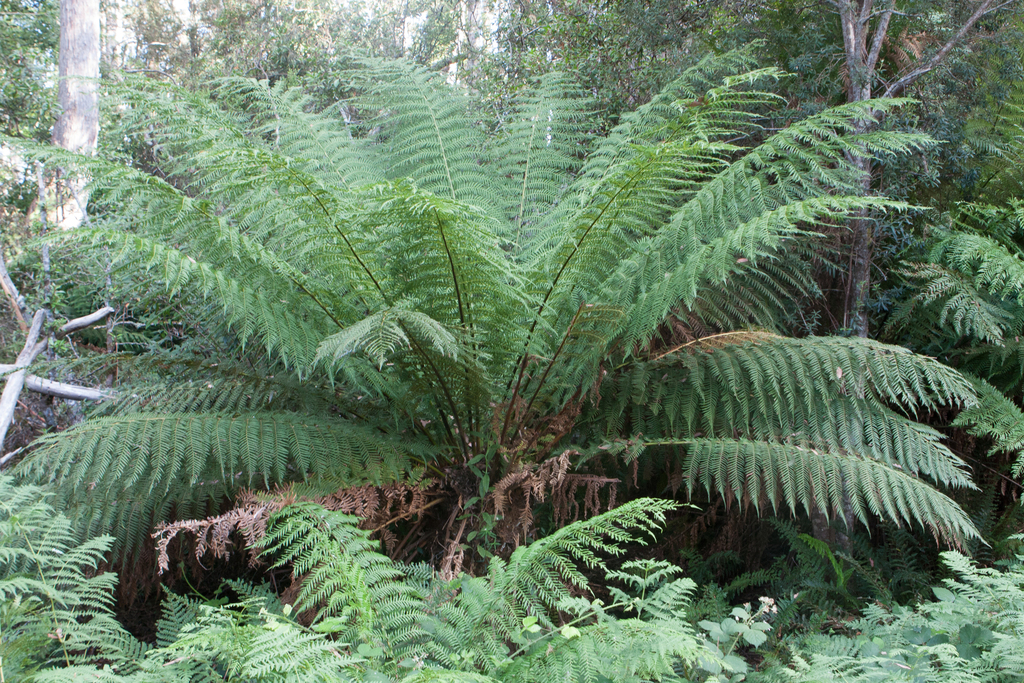
man fern
Dicksonia antarctica
Dicksonia antarctica, commonly known as the soft tree fern, is a species of fern native to eastern Australia, ranging from south-east Queensland to Tasmania. It is commonly grown as an ornamental both in Australia and elsewhere.
From the article Dicksonia antarctica on Wikipedia (CC BY-SA), quoted section by section
Range & habitat
The natural range of this fern stretches from the Bunya Mountains in southeast Queensland, southwards through the near-coastal areas of New South Wales and Victoria into Tasmania. At one time it also occurred in South Australia, but is probably extinct in the wild in that state. It has been introduced into Great Britain, Ireland, Madeira, the Azores and South Africa. It grows in rainforest and wet sclerophyll forest with high rainfall, especially in sheltered gullies and beside creeks, and under the right conditions it can dominate large areas. The altitudinal range is from close to sea level up to about 1,000 m (3,300 ft). The species is well adapted to bushfires, being able to survive in both the shade of a forest as well as the exposed situation after a fire. The trunk is fire resistant, and the crown will regrow if it is burnt.
Wikipedia: “Distribution and habitat”
What it does
Possums may sleep in the crown; they may also eat the young croziers as they uncurl, as do parrots. Crimson rosellas (Platycercus elegans) have been observed eating the sori. The caudices of tree ferns provide very good support for the growth of epiphytes. A 2005 study of 120 naturally growing specimens of Dicksonia antarctica in Tasmania found a total of 97 species of smaller ferns, mosses and bryophytes growing on them.
Wikipedia: “Ecology”
At the table
The caudices of the soft tree fern have been used for fencing and for growing orchids. Both the pith and the croziers of the soft tree fern are edible, and were eaten by indigenous Australians. The 1889 book The Useful Native Plants of Australia records that
"The pulp of the top of the trunk is full of starch, and is eaten by the aboriginals [sic] both raw and roasted. 'The native blacks [sic] of the colony used to split open about a foot and a-half of the top of the trunk, and take out the heart, in substance resembling a Swedish turnip, and of the thickness of a man's arm. This they either roasted in the ashes, or ate as bread; but it is too bitter and astringent to suit an English palate. (Gunn)'"
Wikipedia: “Uses”
How it is grown
Dicksonia antarctica generally requires a minimum rainfall of 500 mm (20 inches) per year. In dry climates, a drip irrigation or spray system applied overhead is the most effective method of watering. This plant is particularly suited to garden planting and landscaping purposes. As an ornamental plant, it has gained the Royal Horticultural Society's Award of Garden Merit.
Wikipedia: “Cultivation”
In human culture
The genus name Dicksonia is in honour of English botanist James Dickson. The species epithet antarctica is a reference to the southern distribution of the fern.
Wikipedia: “Etymology”
Where it lives
Recorded sightings
—
geo-referenced records in GBIF, from museums, herbaria and field observers.
Drag the globe to turn it. Dots are where records exist, not a range map; darker means more records.
In the stacks
Searching the stacks…
Every page naming Dicksonia antarctica in the Biodiversity Heritage Library →
This page is assembled live from iNaturalist, GBIF, Wikipedia, the Source Library and the Internet Archive. It is not yet part of the hand-edited codex. iNaturalist taxon 143921.