- Plants
- ›Vascular Plants
- ›flowering plants
- ›Dicots
- ›Sunflowers, Bellflowers, Fanflowers, and Allies
- ›Sunflowers, Daisies, Asters, and Allies
- ›Asteroideae
- ›Sunflowers and Allies
- ›Cockleburs, Ragweeds, and Wild Quinines
- ›Ambrosia
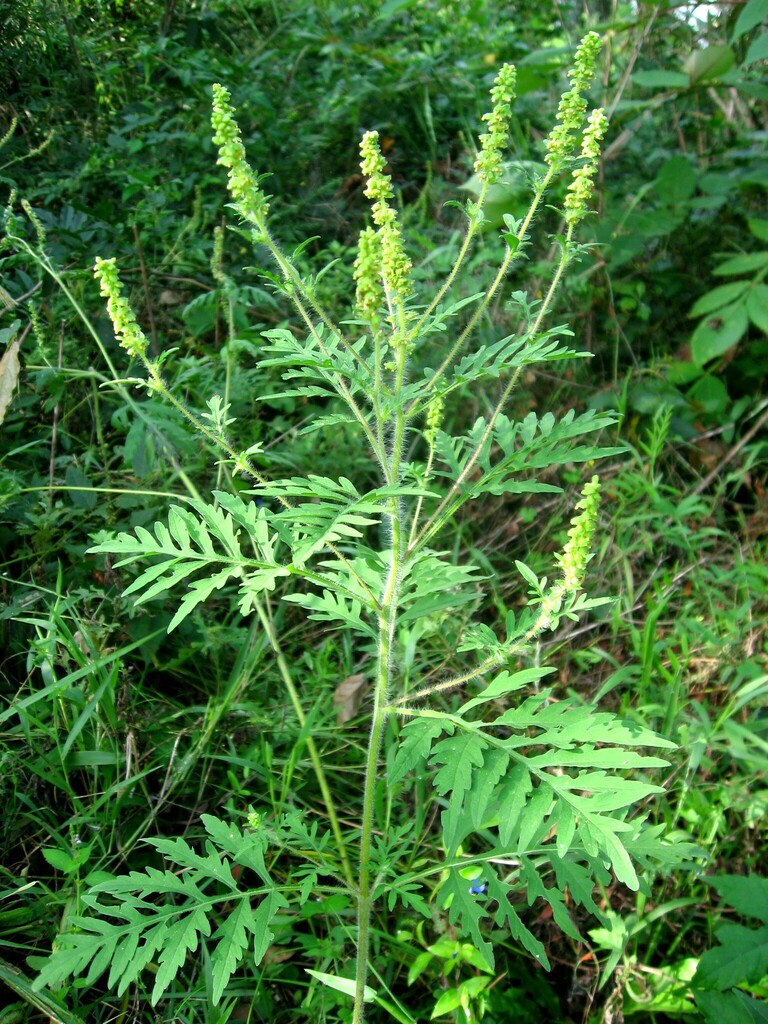
common ragweed
Ambrosia artemisiifolia
Ambrosia artemisiifolia, with the common names common ragweed, annual ragweed, and low ragweed, is a species of the genus Ambrosia native to regions of the Americas.
From the article Ambrosia artemisiifolia on Wikipedia (CC BY-SA), quoted section by section
Description
Ambrosia artemisiifolia is an annual plant that emerges in late spring. It propagates by seed. It is much-branched, and grows up to 70 centimetres (2.3 ft) in height. The pinnately divided soft and hairy leaves are 3–12 centimetres (1.2–4.7 in) long. Its bloom period is July to October in North America. Its pollen is wind-dispersed, and can be a strong allergen to people with hay fever. It produces 2–4 mm obconic green to brown fruit. It sets seed in later summer or autumn. Since the seeds persist into winter and are numerous and rich in oil, they are relished by songbirds and upland game birds.
Galls. This species is host to the following insect-induced galls:
Aceria ambrosiae Wilson, 1959 midge that forms bud-galls Asphondylia ambrosiae Gagné, 1975 Aulacidea ambrosiaecola Ragweed stem gall wasp (see image) Epiblema strenuana (Walker, 1863) stem borer moth Neolasioptera ambrosiae Felt, 1909 small stem midge. Procecidochares gibba (Loew, 1873) gall fly Rhopalomyia ambrosiae Gagné, 1975 bud gall midge
external link to gallformers
Invasive species. …
Range & habitat
The plant is native to: North America across Canada, the eastern and central United States, the Great Plains, and in Alaska; the Caribbean on Cuba, Hispaniola, and Jamaica; and South America in the southern bioregion (Argentina, Chile, Paraguay, Uruguay), the western bioregion (Bolivia, Peru), and Brazil. The distribution of common ragweed in Europe is expected to expand northwards in the future due to climate change. It is the most widespread species of the genus in North America, to which most of the other species of Ambrosia are endemic. During the summer it causes allergic reaction in those who are susceptible.
Wikipedia: “Distribution”
In medicine
Ambrosia artemisiifolia has been a traditional medicinal plant for Native American tribes, including the Cherokee, Lakota, Iroquois, Dakota, and Delaware. Historically, A. artemisiifolia was used by the Otoe Native American tribe in the Missouri River region as a remedy for nausea. It was used on the surface of the abdomen, where the patient was scarified and then dressed with the bruised leaves. It was also used by the Houma tribe in Louisiana for menstruation pain by making a tea out of the boiled roots.
Wikipedia: “Medicinal”
Where it lives
Recorded sightings
—
geo-referenced records in GBIF, from museums, herbaria and field observers.
Drag the globe to turn it. Dots are where records exist, not a range map; darker means more records.
In the stacks
Searching the stacks…
Every page naming Ambrosia artemisiifolia in the Biodiversity Heritage Library →
This page is assembled live from iNaturalist, GBIF, Wikipedia, the Source Library and the Internet Archive. It is not yet part of the hand-edited codex. iNaturalist taxon 53587.