- Animals
- ›Molluscs
- ›Gastropods
- ›Heterobranchs
- ›Euthyneura
- ›Ringipleura
- ›Nudipleura
- ›Nudibranchs
- ›Doridina
- ›Doridoidei
- ›Phyllidioidea
- ›Phyllidiid Nudibranchs
- ›Phyllidia
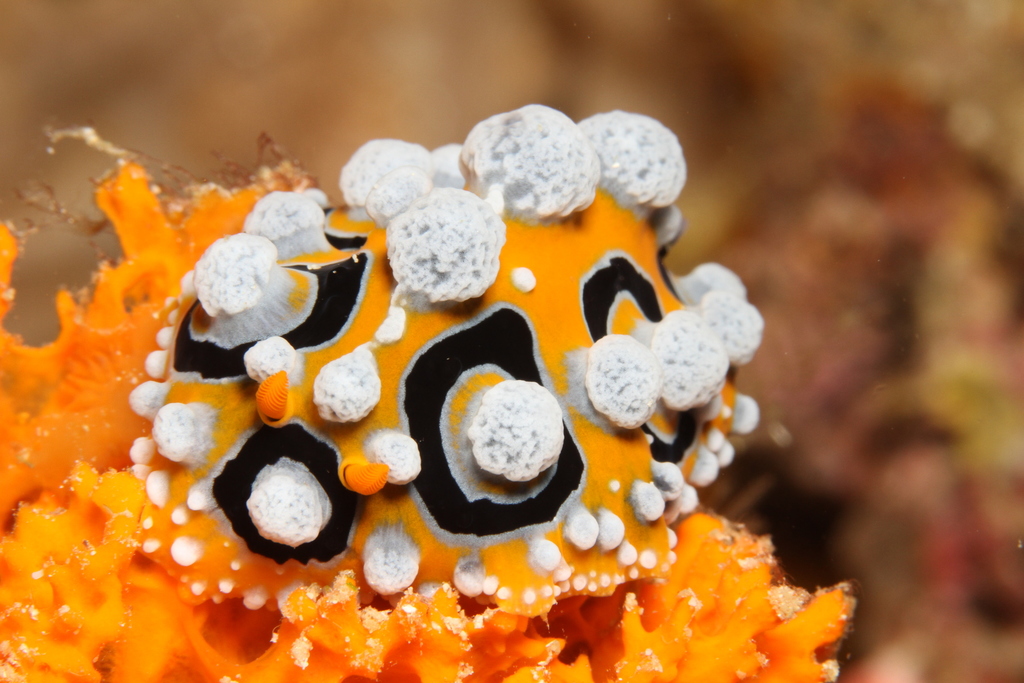
Ocellate Phyllidia
Phyllidia ocellata
Phyllidia ocellata is a species of sea slug, a dorid nudibranch, a shell-less marine gastropod mollusk in the family Phyllidiidae.
From the article Phyllidia ocellata on Wikipedia (CC BY-SA), quoted section by section
Description
This animal can measure up to 35 mm in length. It has been confused with Phyllidia japonica, Phyllidia multituberculata and Phyllidia undula and a number of other species by most workers. This nudibranch has an orange-brown dorsum interrupted by large white or grey, compound, stalked tubercles. These tubercles are distributed along a line from between the rhinophores to the tail, with more scattered and mostly smaller tubercles towards the mantle edge. There are four black rings surrounding tubercles which are placed symmetrically in the middle region of the back. Large individuals may have two more black patches towards the tail, or two more tubercles surrounded by black rings. A single tubercle in front of the rhinophores is also surrounded by a black ring. The rhinophores are orange-yellow.
Range & habitat
This species is probably confined to the central Indo-West Pacific Ocean. It is common in Indonesia and occurs from Malaysia to the Solomon Islands.
Wikipedia: “Distribution”
Where it lives
Recorded sightings
—
geo-referenced records in GBIF, from museums, herbaria and field observers.
Drag the globe to turn it. Dots are where records exist, not a range map; darker means more records.
In the stacks
Searching the stacks…
Every page naming Phyllidia ocellata in the Biodiversity Heritage Library →
This page is assembled live from iNaturalist, GBIF, Wikipedia, the Source Library and the Internet Archive. It is not yet part of the hand-edited codex. iNaturalist taxon 50554.