- Plants
- ›Vascular Plants
- ›flowering plants
- ›Dicots
- ›saxifrages, stonecrops, and allies
- ›saxifrage family
- ›saxifrage tribe
- ›Saxifraga
- ›Porphyrion
- ›Oppositifoliae
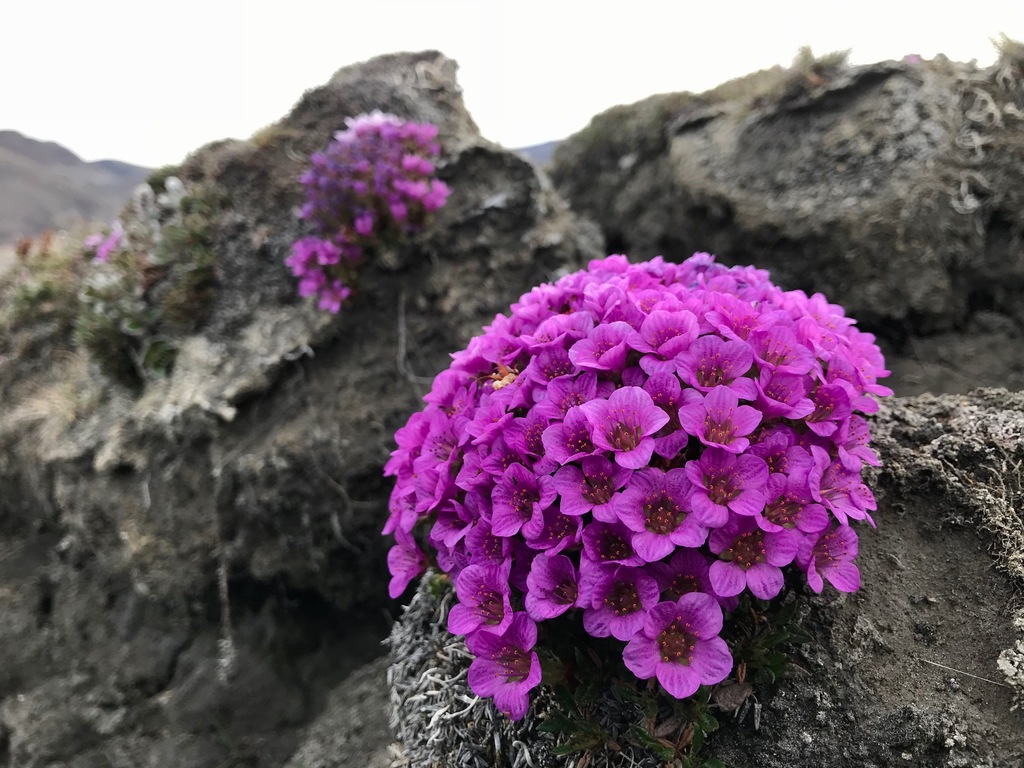
Purple Saxifrage
Saxifraga oppositifolia
Saxifraga oppositifolia, the purple saxifrage or purple mountain saxifrage, is a species of edible plant that is very common all over the high Arctic and also some high mountainous areas further south, including northern Britain, the Alps and the Rocky Mountains. It is even known to grow on Kaffeklubben Island in north Greenland, at 83°N 40°E / 83°N 40°E / 83; 40, the most northerly plant locality in the world.
From the article Saxifraga oppositifolia on Wikipedia (CC BY-SA), quoted section by section
Description
Saxifraga oppositifolia is a low-growing, densely or loosely matted plant growing up to 5 cm (2 in) high, with somewhat woody branches of creeping or trailing habit close to the surface. The leaves are small, rounded, scale-like, opposite in four rows with ciliated margins. The flowers are solitary on short stalks, petals purple or lilac, much longer than the calyx lobes. It is one of the first spring flowers, continuing to flower during the whole summer in localities where the snow melts later. The flowers grow to about 1 cm (1⁄2 in) in diameter.
Range & habitat
Saxifraga oppositifolia grows in all kinds of cold temperate to Arctic habitats, usually found from sea level up to 1,000 m (3,300 ft), in many places colouring the landscape. Its native habitats include tundra, arctic coastal bluffs, alpine scree, and rock crevices. Swiss botanist Christian Körner found the plant growing at an elevation of 4,505 m (14,780 ft) in the Swiss alps, making it the highest elevation angiosperm in Europe. It is even known to grow on Kaffeklubben Island in north Greenland, at 83°N 40°E, the most northerly plant locality in the world.
Wikipedia: “Habitat”
What it does
The flowers of Saxifraga oppositifolia may be consumed by certain animal species, such as the caterpillars of the cold-adapted Gynaephora groenlandica, the Arctic woolly-bear caterpillar.
Wikipedia: “Species interactions”
At the table
Saxifraga oppositifolia is a popular plant in alpine gardens, though difficult to grow in warm climates.
The edible flower petals are eaten, particularly in parts of Nunavut without abundant berries. They are bitter at first but then become sweet. They are also slightly sticky. It is known to the Inuit as aupilaktunnguat. The leaves and stems are brewed for herbal tea. According to many Nunavummiut, the tea is best later in the season once the flowers have died. Saxifraga oppositifolia serves as the territorial flower of Nunavut in Canada, a symbolic flower of Nordland county in Norway, and the county flower of County Londonderry in Northern Ireland.
Wikipedia: “Uses”
Where it lives
Recorded sightings
—
geo-referenced records in GBIF, from museums, herbaria and field observers.
Drag the globe to turn it. Dots are where records exist, not a range map; darker means more records.
In the stacks
Searching the stacks…
Every page naming Saxifraga oppositifolia in the Biodiversity Heritage Library →
This page is assembled live from iNaturalist, GBIF, Wikipedia, the Source Library and the Internet Archive. It is not yet part of the hand-edited codex. iNaturalist taxon 128880.