- Animals
- ›Molluscs
- ›Bivalves
- ›Autobranchia
- ›Pteriomorphia
- ›Ark Shells and Allies
- ›Arks, Bittersweet Clams and allies
- ›Ark Clams
- ›Arca
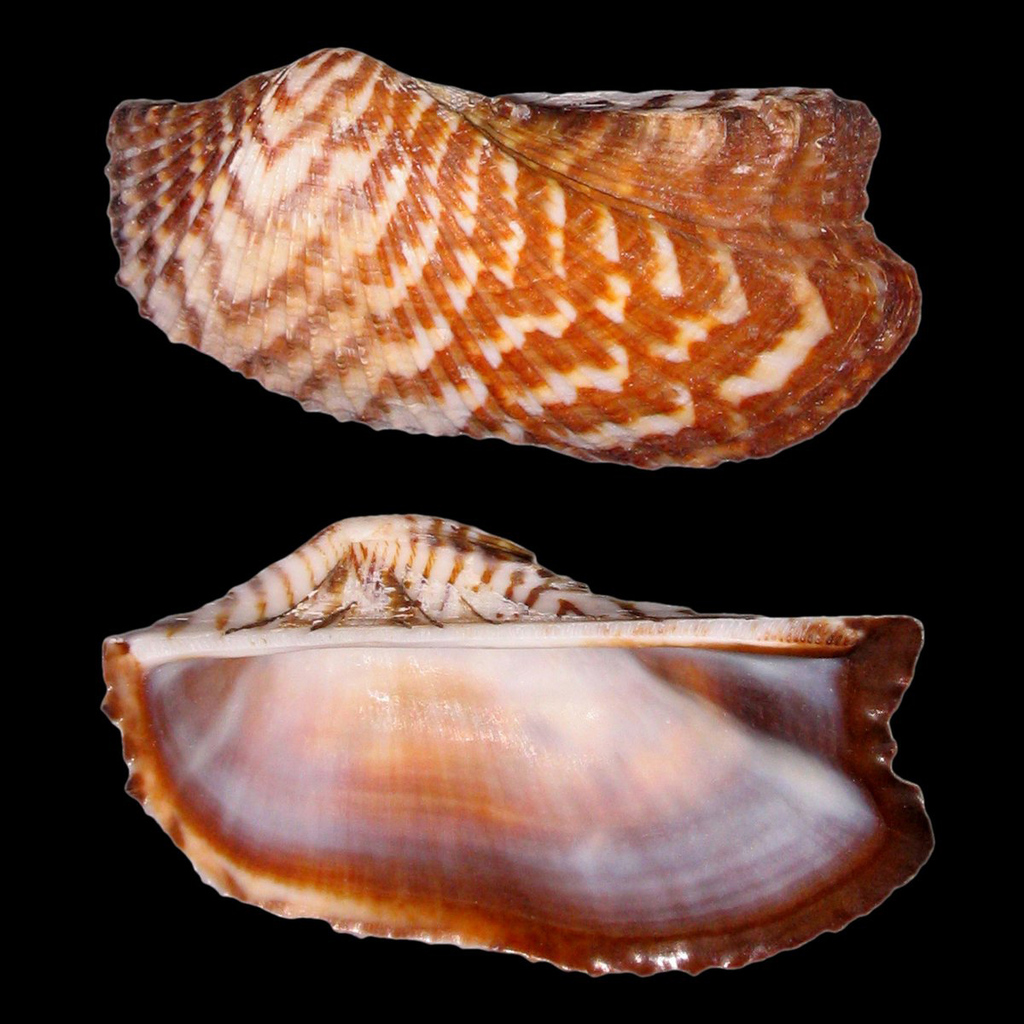
Turkey Wing
Arca zebra
Arca zebra, or the turkey wing ark clam (or simply turkey wing), is a bivalve mollusc in the family Arcidae, the ark clams.
From the article Arca zebra on Wikipedia (CC BY-SA), quoted section by section
Description
The shell of Arca zebra is boldly striped in brown and white which gives it a resemblance to the wing of a wild turkey. The whole shell (when both valves are together) has also been likened to Noah's Ark. It is a sturdy shell growing up to 4 in (10 cm) long and 2 in wide. The umbones are separated by a shallow depression, and the hinge is long and straight with about 50 small teeth. There is coarse sculpturing fanning out from the umbones. The inside of the shell is whitish or pale mauve.
Wikipedia: “Morphology”
Range & habitat
This species is found along the Atlantic coast of North America, ranging from North Carolina to the West Indies and Bermuda. It attaches itself to rocks or other hard substrates in shallow water with byssus threads.
Wikipedia: “Distribution”
What it does
Arca zebra is a filter feeder, taking in surrounding water and particulates through its reduced siphons and expelling water while consuming microscopic algae, diatoms, and phytoplankton.
Wikipedia: “Feeding”
Where it lives
Recorded sightings
—
geo-referenced records in GBIF, from museums, herbaria and field observers.
Drag the globe to turn it. Dots are where records exist, not a range map; darker means more records.
In the stacks
Searching the stacks…
Every page naming Arca zebra in the Biodiversity Heritage Library →
This page is assembled live from iNaturalist, GBIF, Wikipedia, the Source Library and the Internet Archive. It is not yet part of the hand-edited codex. iNaturalist taxon 424106.