- Animals
- ›Arthropods
- ›Hexapods
- ›Insects
- ›Winged and Once-winged Insects
- ›True Bugs, Hoppers, Aphids, and allies
- ›Plant-parasitic Hemipterans
- ›Aphids and Allies
- ›Aphidoidea
- ›Aphids
- ›Aphidinae
- ›Aphidini
- ›Aphidina
- ›Aphis
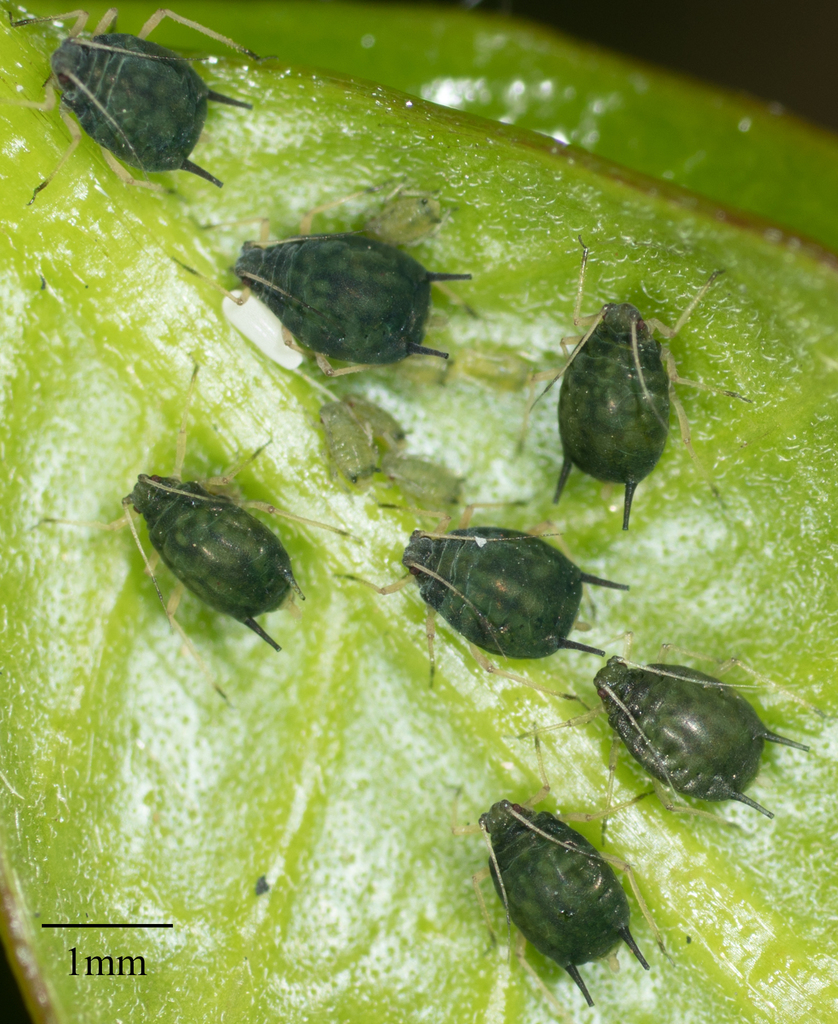
Melon Aphid
Aphis gossypii
Aphis gossypii is a tiny insect, an aphid ("greenfly") in the superfamily Aphidoidea in the order Hemiptera. It is a true bug and sucks sap from plants. It is a widely distributed pest of a variety of agricultural crops in the families Cucurbitaceae, Rutaceae and Malvaceae. Common names include cotton aphid, melon aphid and melon and cotton aphid.
From the article Aphis gossypii on Wikipedia (CC BY-SA), quoted section by section
Description
The wingless female cotton aphid has an ovoid body about two millimetres long in varying shades of green. The legs are yellow, as are the antennae which are three quarters of the length of the body. The apices of the femora, tibia and tarsi are black. The cylindrical black siphunculi are wide at the base and one fifth of the body length. The winged female has a fusiform body. Its head and thorax are black, the abdomen yellowish-green with black lateral spots and the antennae are longer than those of the apterous female. The nymphs vary in colour, being shades of green, tan and gray. They often have a dark head, thorax and wing pads and the distal portion of the abdomen is usually dark green. The body appears dull because it is dusted with wax secretions. The oval eggs are yellow when first laid but soon turn glossy black. In the southern half of the US, as far north as Arkansas, sexual reproduction of the cotton aphid is not important. Females continue to produce offspring without mating so long as the weather is favourable for feeding and growth. Further north, the cotton aphid can be holocyclic and involve two host species, with a broadleaved tree such as Catalpa, Rhamnus or Hibiscus acting as the primary host. In Europe it reproduces exclusively by asexual reproduction and can produce nearly fifty generations a year under favourable conditions. …
Wikipedia: “Morphology”
Range & habitat
It is not known where this species originated, but it is now found in tropical and temperate regions throughout the world except extreme northern areas. It is common in North and South America, Central Asia, Africa, Australia, Brazil, East Indies, Mexico and Hawaii and in most of Europe. It is cosmopolitan in habitat. It thrives outdoors in southern Europe but survives only under glass in northern Europe. In the former Soviet Union it is found up to 54°N.
Wikipedia: “Distribution”
Listen
Looking for field recordings…
Where it lives
Recorded sightings
—
geo-referenced records in GBIF, from museums, herbaria and field observers.
Drag the globe to turn it. Dots are where records exist, not a range map; darker means more records.
In the stacks
Searching the stacks…
Every page naming Aphis gossypii in the Biodiversity Heritage Library →
This page is assembled live from iNaturalist, GBIF, Wikipedia, the Source Library and the Internet Archive. It is not yet part of the hand-edited codex. iNaturalist taxon 309466.