- Animals
- ›Chordates
- ›Vertebrates
- ›Reptiles
- ›Snakes and Lizards
- ›Snakes
- ›Blind snakes
- ›Typical Blind Snakes
- ›Afrotyphlopinae
- ›Afrotyphlops
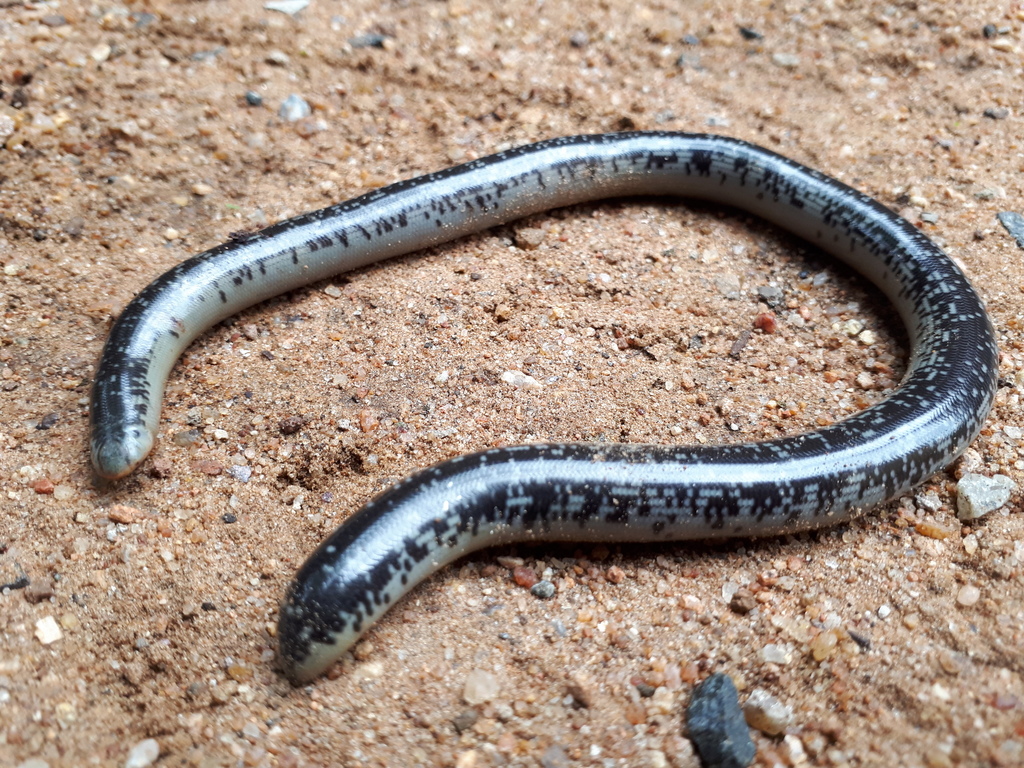
Schlegel’s Beaked blind snake
Afrotyphlops schlegelii
Afrotyphlops schlegelii, commonly known as Schlegel's beaked blind snake or Schlegel's giant blind snake, is a species of snake in the family Typhlopidae. The species is endemic to eastern and southern Africa, and bears the distinction of being the world's largest typhlopid. It is harmless to humans and lives exclusively on a diet of termites.
From the article Afrotyphlops schlegelii on Wikipedia (CC BY-SA), quoted section by section
Description
Three distinct color phases of A. schlegelii are found: uniform, blotched, or striped.
Uniform phase specimens are black to brown dorsally, straw-colored ventrally. Blotched phase individuals have black to dark brown irregular blotches dorsally, and are yellow-green to yellow ventrally and on the sides. The striped phase results from each scale being edged with black. These black lines merge with age. The maximum recorded snout-vent length (SVL) is 95 cm (37+3⁄8 in). The scales are arranged in 30-44 rows around the body. There are more than 300 scales in the vertebral row (maximum 623). The snout is very prominent, with a sharp horizontal cutting edge, below which are located the nostrils. The rostral is very large, extending as far back as the eyes. The portion of the rostral visible from below is broader than long. There are four upper labials. The nasal is semidivided, the suture proceeding from the first upper labial. A preocular is present, narrower than the nasal or the ocular, in contact with the second and third upper labials. The eyes distinct, located below the suture between the preocular and the ocular. The diameter of the body goes 25 to 30 times in the total length. The tail is broader than long, ending in a spine.
Range & habitat
A. schlegelii is found in Angola, Botswana, the Democratic Republic of the Congo, Eswatini, Ethiopia, Kenya, Malawi, southern Mozambique, northern Namibia, Somalia, South Africa, southern Sudan, Tanzania, northern Uganda, Zambia, and Zimbabwe.
Wikipedia: “Geographic range”
What it does
A. schlegelii is fossorial, and very large individuals are found deep underground.
Wikipedia: “Behavior”
In human culture
The specific name, schlegelii, is in honor of German herpetologist Hermann Schlegel.
Wikipedia: “Etymology”
Where it lives
Recorded sightings
—
geo-referenced records in GBIF, from museums, herbaria and field observers.
Drag the globe to turn it. Dots are where records exist, not a range map; darker means more records.
In the stacks
Searching the stacks…
Every page naming Afrotyphlops schlegelii in the Biodiversity Heritage Library →
This page is assembled live from iNaturalist, GBIF, Wikipedia, the Source Library and the Internet Archive. It is not yet part of the hand-edited codex. iNaturalist taxon 539226.