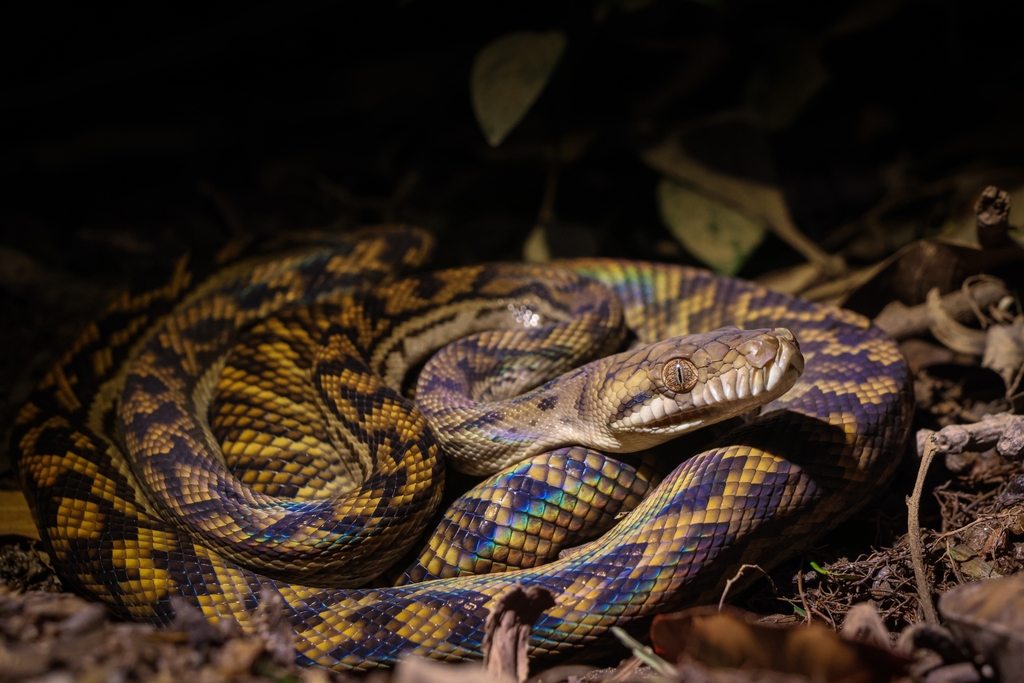
Australian Scrub Python
Simalia kinghorni
The Australian scrub python (Simalia kinghorni), also known commonly as Kinghorn's python and simply as the scrub python is a species of snake in the family Pythonidae. The species is indigenous to forests of northern Australia. It is one of the world's longest and largest snakes, and is the longest and largest in Australia. In 2014 it was reclassified to the genus Simalia alongside a few other former Morelia species, but scientific debate over this continues.
From the article Australian scrub python on Wikipedia (CC BY-SA), quoted section by section
Description
The Australian scrub python is commonly considered arboreal or tree-dwelling, making it one of the world's largest and longest arboreal species of snakes. This snake has an ornate dorsal pattern consisting of browns and tans, with many different natural variations, and an iridescent sheen. Its belly is usually white, sometimes with some yellows. The top of the head is covered with large symmetrical shields, and there are heat-sensing pits on the rostral and some labials.
Size. S. kinghorni exhibits sexual dimorphism, with males usually growing a third longer and twice as heavy than females. Females reach sexual maturity with a snout-to-vent length (SVL) of about 2.27 m (7.4 ft) while males reach sexual maturity with an SVL of 1.34 m (4.4 ft). On the Tully River, a river about 140 km south of Cairns, 24 adult females were measured. They had an average SVL of 2.68 m (8.8 ft) and a mass of 3.4 kg (7.5 lb). In the same place, 80 adult males had an average SVL of 2.91 m (9.5 ft) and a weight of 5.1 kg (11 lb). Of these, the largest male had an SVL of 3.76 m (12.3 ft) and a weight of 11 kg (24 lb). In the past, data on the lengths of individuals longer than 6 meters were repeatedly mentioned in the literature, and all of them today can no longer be verified and cause serious doubts, in particular, in Fearn & Sambono (2000). …
Range & habitat
S. kinghorni in mostly is found in Northern Australia, in Queensland and Cape York Peninsula. The species also occurs in several Islands of Torres Strait (e.g. Hinchinbrook). On the mainland, its range extends from the tip of the Cape York Peninsula south along the coastal rainforest through the Atherton Tableland, the forested eastern foothills of the Great Dividing Range, along the coast through Mount Speck to the Burdekin River south of Townsville. In 2004, an even more southern population was described in the Conway rainforest, south of Airlie Beach. Accurate information about the population size and possible connections with more northern populations is not yet available. However, it is assumed that it was installed in 1990 by adult animals that escaped from the local zoo, and has been successfully distributed since then living within various forests and more densely vegetated parts of the Australian bush.
Wikipedia: “Distribution and habitat”
What it does
S. kinghorni is one of the largest land predators in Australia, and depending on the habitat, age and size, the prey range can vary from small mammals, birds and reptiles to wallabies. The basis of the diet consists of birds and mammals. Among them, for example, rainbow bee-eaters (Merops ornatus), bush rats (Rattus fuscipes), northern quolls (Dasyurus hallucatus), spectacled flying fox (Pteropus conspicillatus), northern brown bandicoots (Isoodon macrourus), long-nosed bandicoots (Perameles nasuta) and striped possums (Dactylopsila trivirgata). In addition, on the outskirts of settlements, the species repeatedly feeds on domestic poultry. Relatively often there is also predation of pythons on small wallaby species in particular agile wallabies (Notamacropus agilis), red-legged pademelons (Thylogale stigmatica) and Bennett's tree-kangaroos (Dendrolagus bennettianus). One of the largest animal victims documented to date was a 10 kg (22 lb) adult mobile wallaby, which was swallowed by a female python 4.33 m (14.2 ft) long and weighing 13.5 kg (30 lb).
Wikipedia: “Diet”
Where it lives
Recorded sightings
—
geo-referenced records in GBIF, from museums, herbaria and field observers.
Drag the globe to turn it. Dots are where records exist, not a range map; darker means more records.
In the stacks
Searching the stacks…
Every page naming Simalia kinghorni in the Biodiversity Heritage Library →
This page is assembled live from iNaturalist, GBIF, Wikipedia, the Source Library and the Internet Archive. It is not yet part of the hand-edited codex. iNaturalist taxon 540202.