- Animals
- ›Molluscs
- ›Gastropods
- ›Vetigastropods
- ›Trochida
- ›Top Snails, Turban Snails, and Allies
- ›Tegulidae
- ›Rochia
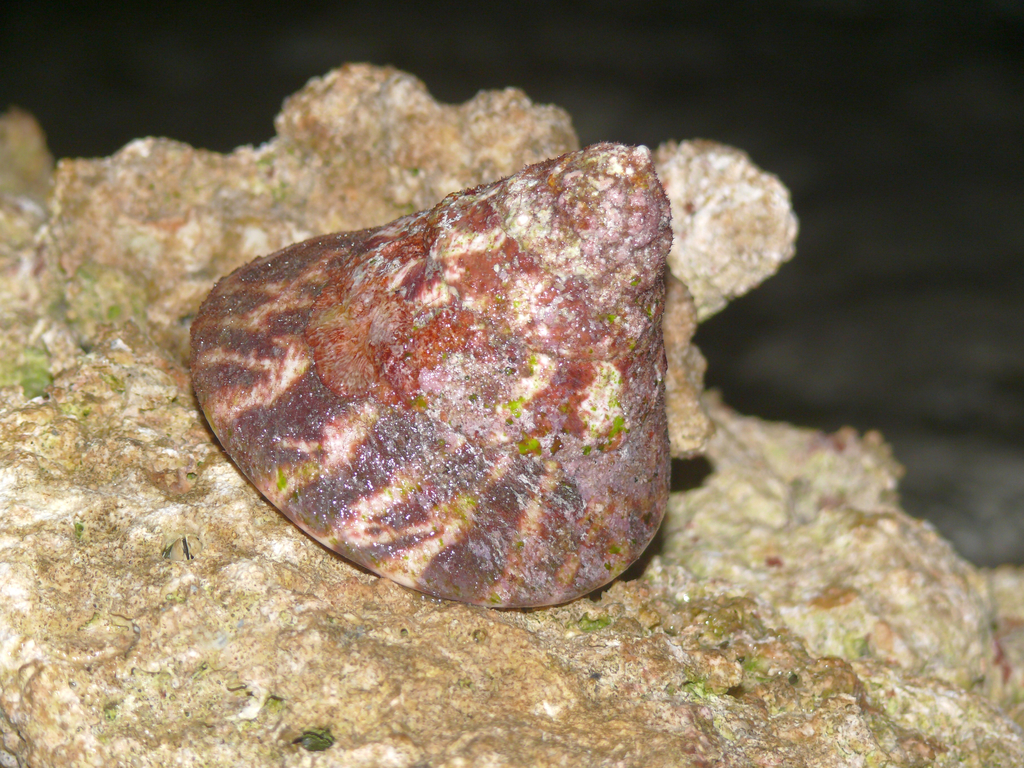
Commercial Top Shell
Rochia nilotica
Rochia nilotica, common name the commercial top shell, is a species of sea snail, a marine gastropod mollusk in the family Tegulidae.
From the article Rochia nilotica on Wikipedia (CC BY-SA), quoted section by section
Description
The length of the shell varies between 50 mm and 165 mm, its diameter between 100 mm and 120 mm. The large, ponderous, shell has a conical shape, appearing subperforate. It is covered by a corneous striate, brown or yellowish cuticle usually lost on the upper whorls. Its color beneath the cuticle is white, longitudinally striped with crimson, violet or reddish brown. The base of the shell is maculate or radiately strigate with a lighter shade of the same. The spire is strictly conical. The apex is acute, usually eroded. The shell contains 8-10 whorls. The upper ones are tuberculate at the sutures, and spirally beaded, the following flat on their outer surfaces, smooth, separated by linear suture. The body whorl is expanded, dilated and compressed at the obtuse periphery, more or less convex below, indented at the axis. The umbilical tract is covered by a spiral pearly deeply entering callus. The aperture is transverse and very oblique. The columella is oblique, terminating in a denticle below, and with a strong spiral fold above, deeply inserted into the axis. The operculum is circular, thin, corneous, orange-brown, and composed of about 10 whorls.
Range & habitat
This marine species is widespread in the Indo-Pacific (from Madagascar, Sri Lanka, Andaman and Nicobar Islands, to as far east as French Polynesia, north to southern Japan and Hawaii, and south to Australia, including New Ireland, New Caledonia, North Australia, French Polynesia, etc.).
Wikipedia: “Distribution”
What it does
Rochia nilotica can live for up to 15 years and are able to reproduce at about 2 years of age. Females release more than 1 million eggs. Breeding period occurs during spring tides with nocturnal spawning. The eggs fertilised by males hatch to larval stages. Embryos develop into free-swimming planktonic marine larvae (trochophore) and later into juvenile veligers that drift with currents before settling on a rocky surface. After 2 or more years they may become adults.
Wikipedia: “Life cycle”
In human culture
The very large shells of this species have a very thick inner layer of nacre. They are used commercially to make mother of pearl buttons, mother of pearl beads, pendants and so on. In 2006, for example, the sole commercial export of the Wallis and Futuna Islands was 19 tons of "Trochus" shells, valued at US$122,000.
Wikipedia: “Human culture”
Where it lives
Recorded sightings
—
geo-referenced records in GBIF, from museums, herbaria and field observers.
Drag the globe to turn it. Dots are where records exist, not a range map; darker means more records.
In the stacks
Searching the stacks…
Every page naming Rochia nilotica in the Biodiversity Heritage Library →
This page is assembled live from iNaturalist, GBIF, Wikipedia, the Source Library and the Internet Archive. It is not yet part of the hand-edited codex. iNaturalist taxon 962782.