 NL·0253
Herbarium of the Nature Library
- Name
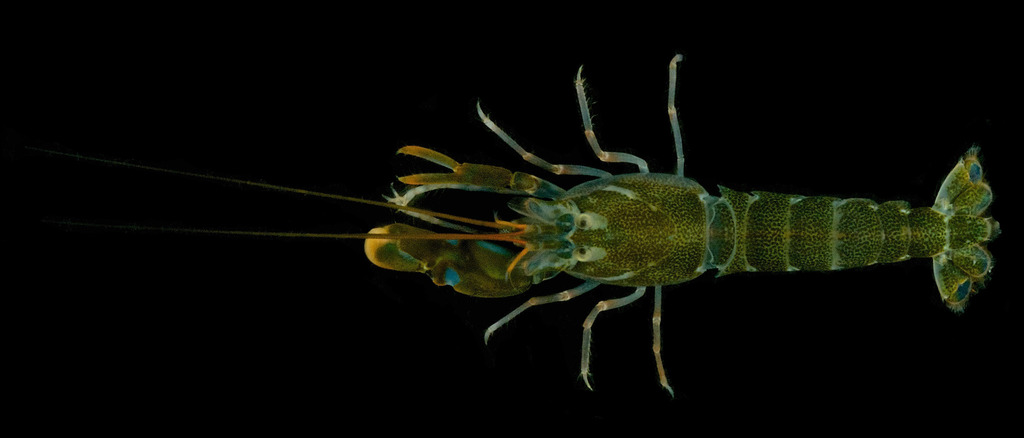
- Alpheus heterochaelis
- Family
- Alpheidae
- Native to
- Western Atlantic, from lower Chesapeake Bay and North Carolina to the Gulf of Mexico; Caribbean and Brazilian records are uncertain because the species was split into a complex
- Habitat
- Oyster reefs, Estuaries, Seagrass, Mudflats
Bigclaw snapping shrimp
Alpheus heterochaelis
Also calledPistol shrimp (English) · Camarón pistola (Spanish) · Crevette pistolet (French)
A small shrimp with one huge claw that snaps shut so fast it creates a collapsing bubble hot enough to emit a flash of light. The snap stuns prey and is one of the loudest sounds made by any animal.
Alpheus heterochaelis, the bigclaw snapping shrimp, is a snapper or pistol shrimp in the family Alpheidae. It is found in the western Atlantic Ocean and the Gulf of Mexico. Wikipedia
What it can do
- iClaw snap produces a cavitation bubble that collapses with a sound above 200 dB (re 1 µPa at 1 m)
- iiThe collapsing bubble briefly reaches several thousand degrees and emits light ('shrimpoluminescence')
- iiiCan regrow a lost snapping claw, often switching which side carries it
- ivLives in mated pairs in burrows
In the field
Field marks
- aSmall, greenish to translucent brown shrimp
- bOne massively enlarged claw, up to half the body length
- cEyes hidden under a hood on the carapace
- dCrackling sound from reefs
- Voice
- A sharp click or pop; massed shrimp make a constant frying or crackling sound underwater.
- Not to be confused with
- Other Alpheus and Synalpheus snapping shrimps are separated by claw shape and colour; Synalpheus are usually smaller and live inside sponges.
- Where to see it
- Oyster reefs and estuaries of the US Atlantic and Gulf coasts; listen with a hydrophone or near docks at low tide.
- When
- Year-round
Listen
Looking for field recordings…
Life & habits
- Diet
- Small fish, worms and crustaceans stunned by the snap
- Habitat
- Burrows and crevices in oyster reefs, rubble, seagrass and muddy estuaries
- Size
- About 3–5 cm
Rivals threaten each other by opening the snapping claw and firing water jets rather than fighting directly.
Where it lives
Recorded sightings
—
geo-referenced records in GBIF, from museums, herbaria and field observers.
Native range
Western Atlantic, from lower Chesapeake Bay and North Carolina to the Gulf of Mexico; Caribbean and Brazilian records are uncertain because the species was split into a complex
Drag the globe to turn it. Dots are where records exist, not a range map; darker means more records.
In the old herbals & bestiaries
No plate in the Source Library names this exact species, so these show its closest relatives as the old naturalists drew them: same genus, or the same kind of animal. Click a plate to read the page it came from, with translation.

Ulyssis Aldrovandi ... De reliquis animalibus exanguibus, utpote de mollibus, crustaceis, testaceis & zoophytis, libri quatuor post mortem eius editi
Relative · Aldrovandi, Ulisse · 1618 · p.47

History of Animals, Book II: On Oviparous Quadrupeds
Relative · Conrad Gessner · 1586 · p.586

History of Animals, Book II: On Oviparous Quadrupeds
Relative · Conrad Gessner · 1586 · p.586

Theater of Earthly Creatures
Relative · Anonymous · 1672 · p.316

Georg Wolfgang Knorr; Johann Ernst Immanuel Walch — Schnecken und Muscheln (1770)
Relative · Georg Wolfgang Knorr; Johann Ernst Immanuel Walch · 1770 · p.119

De Indiae utriusque re naturali et medica
Relative · Willem Piso · 1658 · p.105

Theater of Earthly Creatures
Relative · Anonymous · 1672 · p.312

Books on Marine Fishes
Relative · Guillaume Rondelet · 1554 · p.853

Books on Marine Fishes
Relative · Guillaume Rondelet · 1554 · p.568

Commentaries on the Six Books of Dioscorides on Medical Matter
Relative · Pietro Andrea Mattioli · 1563 · p.280
In the stacks
Searching the stacks…
Every page naming Alpheus heterochaelis in the Biodiversity Heritage Library →
Marginalia
During the Second World War, the crackle of snapping shrimp beds interfered with naval sonar, and submarines were able to use the noise as acoustic cover.
Curiosity
Light flashes from its collapsing bubbles were first recorded in this species in 2001 and nicknamed 'shrimpoluminescence'.
Kinship





Fact-checked: 1 correction made to this sheet. Photographs: iNaturalist contributors under the licences shown. Records: GBIF.org. Historical plates: Source Library (CC BY-SA 4.0; originals public domain). Summary text: Nature Library editors and Wikipedia (CC BY-SA). Medicinal and edibility notes are historical and educational, not advice. iNaturalist taxon 260291.