 NL·0667
Herbarium of the Nature Library
- Name
- Ceratotherium simum
- Family
- Rhinocerotidae
- Native to
- Southern Africa (mainly South Africa, plus Namibia, Kenya, Zimbabwe, Botswana and others); the northern form once ranged from Uganda to Chad
- Habitat
- Savanna, Grassland
White rhinoceros
Ceratotherium simum
Also calledUmkhombe (Zulu) · Kifaru (Swahili) · Witrenoster (Afrikaans) · Báixīniú 白犀牛 (Chinese)
The largest rhinoceros and, after elephants, the heaviest land animal, a grazer with a wide square lip for cropping grass. Southern white rhinos recovered from perhaps fewer than a hundred around 1900 to over 15,000, though poaching for horn remains a constant threat.
The white rhinoceros, white rhino or square-lipped rhinoceros is the largest extant species of rhinoceros. It has a wide mouth used for grazing and is the most social of all rhino species. The white rhinoceros consists of two subspecies: the southern white rhinoceros, with an estimated 17,464 individuals in the wild as of the end of 2023, and the much rarer northern white rhinoceros. The northern subspecies is critically endangered and on the brink of extinction; it has only two confirmed left as of 2018. Sudan, the world's last known male northern white rhinoceros, died in Kenya in March 2018. White rhinoceros can run up to 40 mph (64 km/h) for very short bursts. They can maintain speeds of around 30–31 mph (48–50 km/h) for a good amount of time, and they have good stamina. Wikipedia
What it can do
- iMows grass with a broad, square lip, creating short 'grazing lawns' used by other grazers
- iiCommunicates through shared dung middens, which carry information about sex, age and breeding state
- iiiHas a front horn of compacted keratin that can exceed 1 m
- ivCharges at up to ~40 km/h
In the field
Field marks
- aWide, square lip
- bHump on the neck
- cTwo horns
- dGrazes on grass
- Not to be confused with
- Black rhino has a hooked lip, no neck hump and browses; white rhino calves run ahead of their mother, black rhino calves behind. Never approach on foot; watch from a vehicle, boat or hide, or with a licensed guide.
- Where to see it
- Hluhluwe–iMfolozi Park and Kruger (South Africa)
- When
- Resident
Listen
Looking for field recordings…
Life & habits
- Diet
- Herbivore: short grasses
- Habitat
- Open grassland and savanna with water and shade
- Size
- Males up to ~2,300–3,600 kg and ~1.8 m at the shoulder; females ~1,700 kg
- Lifespan
- 40–50 years
Calves walk ahead of their mothers, unlike black rhino calves, which follow behind.
Where it lives
Recorded sightings
—
geo-referenced records in GBIF, from museums, herbaria and field observers.
Native range
Southern Africa (mainly South Africa, plus Namibia, Kenya, Zimbabwe, Botswana and others); the northern form once ranged from Uganda to Chad
Drag the globe to turn it. Dots are where records exist, not a range map; darker means more records.
In the old herbals & bestiaries
No plate in the Source Library names this exact species, so these show its closest relatives as the old naturalists drew them: same genus, or the same kind of animal. Click a plate to read the page it came from, with translation.

The Pagan World and the Origin of its Gods
Relative · Herold, Johann · 1554 · p.504

Cosmographey: das ist Beschreibung aller Laender
Relative · Münster, Sebastian · 1598 · p.1536

History of All Cloven-Hoofed Quadrupeds
Relative · Ulisse Aldrovandi · 1621 · p.906

Theater of Earthly Creatures
Relative · Anonymous · 1672 · p.14

The Embassy of the Dutch East India Company to the Tartar Cham
Relative · Johan Nieuhof · 1665 · p.451

The Pagan World and the Origin of its Gods
Relative · Herold, Johann · 1554 · p.453

Ornithology
Relative · Ulisse Aldrovandi · 1599 · p.840

Sancai Tuhui (Vol. 92)
Relative · 王圻, 王思義 · 1609 · p.11

Noah's Ark
Relative · Athanasius Kircher · 1675 · p.106

Georg Wolfgang Knorr — Deliciae naturae selectae (1771)
Relative · Georg Wolfgang Knorr · 1771 · p.344
In the stacks
Searching the stacks…
Every page naming Ceratotherium simum in the Biodiversity Heritage Library →
Marginalia
Reserves in Zululand, including Hluhluwe-iMfolozi (1895), sheltered the last southern white rhinos, and 'Operation Rhino' in the 1960s moved them to parks across Africa. The name 'white' is often traced, without firm evidence, to Dutch or Afrikaans wijd, 'wide', for its mouth.
Curiosity
Only two northern white rhinos, both female, survive; scientists are trying to save the subspecies with IVF and surrogate southern white mothers.
Kinship
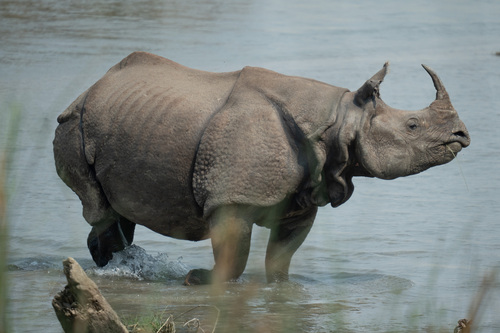



Photographs: iNaturalist contributors under the licences shown. Records: GBIF.org. Historical plates: Source Library (CC BY-SA 4.0; originals public domain). Summary text: Nature Library editors and Wikipedia (CC BY-SA). Medicinal and edibility notes are historical and educational, not advice. iNaturalist taxon 43348.