 NL·0668
Herbarium of the Nature Library
- Name
- Rhinoceros unicornis
- Family
- Rhinocerotidae
- Native to
- Northeast India (Assam, West Bengal, Uttar Pradesh) and lowland Nepal; formerly across the Indus and Ganges plains
- Habitat
- Tall floodplain grassland, Riverine forest, Wetland
Indian rhinoceros
Rhinoceros unicornis
Also calledGaiṇḍā (Hindi/Urdu) · Gaḍā (Nepali) · Gor (Assamese) · Khaḍgamṛga (Sanskrit) · Greater one-horned rhinoceros
A single-horned rhino with skin folded like riveted armour plates, living in the tall floodplain grasslands of the Brahmaputra and the Nepal terai. From fewer than 200 animals in the early 1900s it has recovered to over 4,000, one of Asia's great conservation comebacks, about two-thirds of them in Kaziranga National Park.
The Indian rhinoceros, also known as the greater one-horned rhinoceros, great Indian rhinoceros or Indian rhino, is a rhinoceros species native to the Indian subcontinent. It is the second largest living rhinoceros and the largest in Asia, with adult males weighing 2.07–2.2 t and adult females 1.6 t. Its thick skin is grey-brown with pinkish skin folds. It has a single horn on its snout that grows up to 57.2–61.6 cm (22.5–24.3 in) long. Its upper legs and shoulders are covered in wart-like bumps, and it is nearly hairless aside from the eyelashes, ear fringes and tail brush. Wikipedia
What it can do
- iGrazes tall elephant grass, keeping floodplain grasslands open for other species
- iiStrong swimmer that crosses rivers and wallows for hours
- iiiDefends itself mainly with sharp lower tusks (incisors) rather than its horn
- ivUses communal dung heaps (middens) that act as scent noticeboards
In the field
Field marks
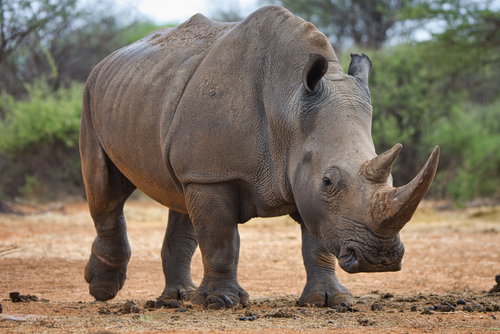
- aSilhouette: massive grey body with deep skin folds at shoulder, flank and rump giving an 'armour-plated' look
- bSingle horn, usually 20–30 cm, on the nose
- cSkin covered with wart-like bumps on the shoulders and legs
- dSigns: large dung middens along trails, three-toed tracks about 25 cm across, wallows in mud
- Not to be confused with
- The Javan rhino (also one-horned) survives only in Ujung Kulon, Java, and has finer, mosaic-like skin texture without warts. The African white and black rhinos have two horns.
- Where to see it
- Kaziranga, Pobitora and Manas national parks (Assam); Jaldapara and Gorumara (West Bengal); Dudhwa (Uttar Pradesh); Chitwan and Bardia (Nepal)
- When
- Resident; Kaziranga is open roughly November–April, closed through the monsoon floods
Listen
Looking for field recordings…
Life & habits
- Diet
- Grasses, reeds, aquatic plants, fruit, leaves and crops
- Habitat
- Alluvial floodplain grassland, swamps and adjoining forest
- Size
- 1.7–2 m at shoulder; males about 2,000–2,700 kg
- Lifespan
- About 35–45 years
Mostly solitary, but gathers at wallows and grazing lawns. Feeds mainly in the morning and evening and lies in mud or water through the heat of the day.
Where it lives
Recorded sightings
—
geo-referenced records in GBIF, from museums, herbaria and field observers.
Native range
Northeast India (Assam, West Bengal, Uttar Pradesh) and lowland Nepal; formerly across the Indus and Ganges plains
Drag the globe to turn it. Dots are where records exist, not a range map; darker means more records.
In the old herbals & bestiaries
Woodcuts and engravings matched from the Source Library’s scanned books by name. Plates marked “relative” show a close kin rather than this exact species. Click a plate to read the page it came from, with translation.

The Pagan World and the Origin of its Gods
Herold, Johann · 1554 · p.504

Cosmographey: das ist Beschreibung aller Laender
Münster, Sebastian · 1598 · p.1536

History of All Cloven-Hoofed Quadrupeds
Ulisse Aldrovandi · 1621 · p.906

Theater of Earthly Creatures
Anonymous · 1672 · p.14

The Embassy of the Dutch East India Company to the Tartar Cham
Johan Nieuhof · 1665 · p.451

The Pagan World and the Origin of its Gods
Herold, Johann · 1554 · p.453

Ornithology
Ulisse Aldrovandi · 1599 · p.840

Sancai Tuhui (Vol. 92)
王圻, 王思義 · 1609 · p.11

Noah's Ark
Athanasius Kircher · 1675 · p.106

Georg Wolfgang Knorr — Deliciae naturae selectae (1771)
Georg Wolfgang Knorr · 1771 · p.344
In the stacks
Searching the stacks…
Every page naming Rhinoceros unicornis in the Biodiversity Heritage Library →
Marginalia
Rhinos appear on several Indus Valley Civilisation seals from Mohenjo-daro, and the Mughal emperor Babur recorded hunting them near Peshawar in the early 1500s. Albrecht Dürer's famous 1515 woodcut depicts an Indian rhino sent from Gujarat to Lisbon.
Curiosity
Dürer never saw the animal he drew: his armour-plated rhino, based on a sketch and a letter, remained Europe's standard image of a rhino into the 18th century.
Kinship



Photographs: iNaturalist contributors under the licences shown. Records: GBIF.org. Historical plates: Source Library (CC BY-SA 4.0; originals public domain). Summary text: Nature Library editors and Wikipedia (CC BY-SA). Medicinal and edibility notes are historical and educational, not advice. iNaturalist taxon 43345.